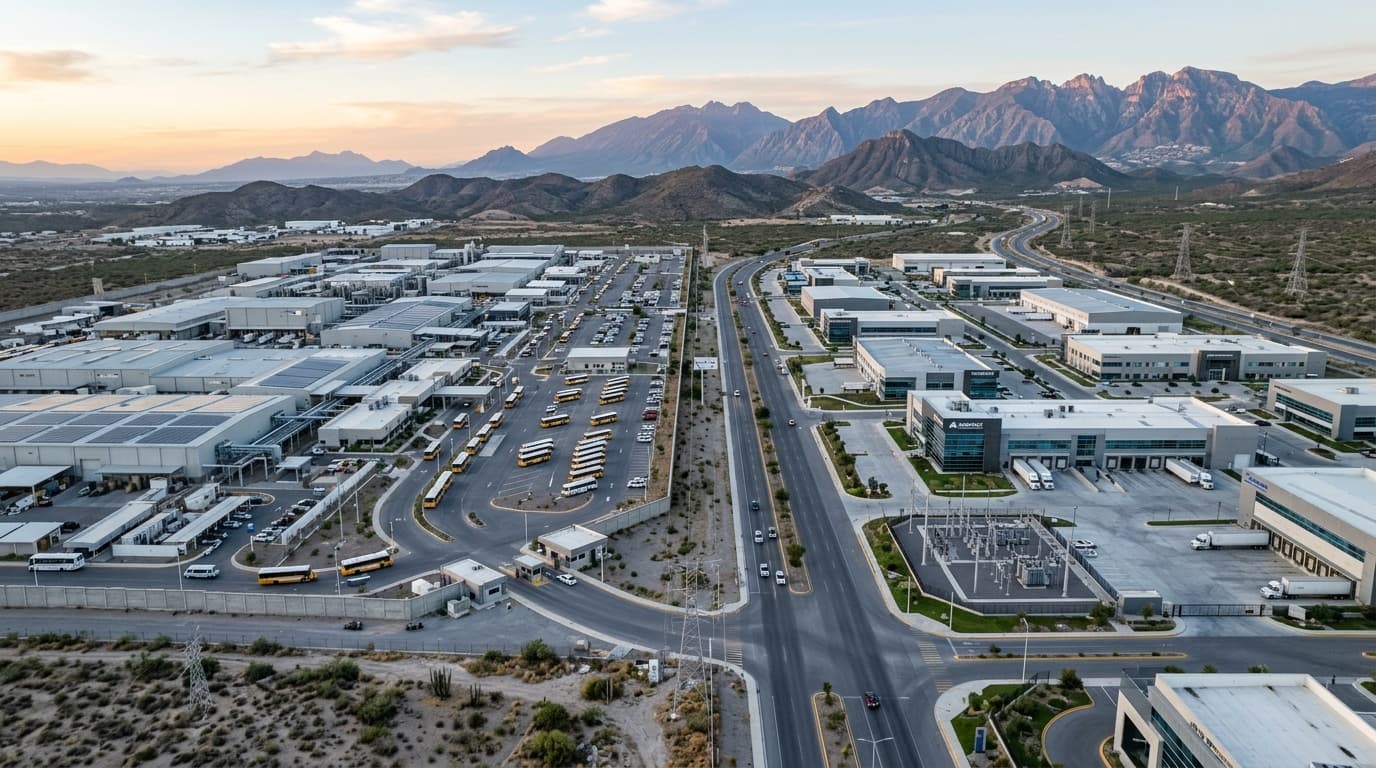
Manufacturing Campus vs. Industrial Park in Mexico: The 2026 Operational, Cost & Lock-in Comparison
Compare proprietary Mexico manufacturing campuses vs independent Class A FIBRA parks. Audit 5-year TCO, CAM markups, captive labor dynamics, and shelter exit lock-in risks.
Manufacturing Campus vs. Industrial Park in Mexico: The 2026 Operational, Cost & Lock-in Comparison
In late 2026, foreign direct investment into Mexican manufacturing reached record annual run-rates exceeding $40 billion USD. Driven by supply chain decoupling from Asia, USMCA tariff compliance mandates, and logistical proximity to North American consumer corridors, corporate boardrooms are moving past preliminary site exploration into active physical deployment.
However, corporate site-selection committees and chief financial officers encounter an aggressive divergence in market messaging. On one side, legacy shelter operators are heavily marketing the concept of the "Manufacturing Campus"—presenting it as an all-inclusive, frictionless ecosystem where foreign corporations run production while the campus operator manages everything else. On the other side, institutional developers and real estate investment trusts (FIBRAs) offer Class A Independent Industrial Parks, where physical facility leasing is strictly unbundled from administrative, customs, and human resource services.
Deciding between a bundled proprietary manufacturing campus and an unbundled institutional industrial park is not merely a real estate choice. It is a structural governance decision that permanently dictates your 5-year operating expenditure, your exposure to vendor lock-in, your intellectual property perimeter security, and your ability to transition into an independent Mexican corporate subsidiary. This forensic guide delivers an objective, unvarnished comparison tailored for CFOs, General Counsels, and Vice Presidents of Global Operations.
Defining the Models: What Is a Proprietary Manufacturing Campus vs. an Independent Industrial Park?
To evaluate these options objectively, executives must understand the structural and legal architecture of each model.
+---------------------------------------------------------------------------------------------------+
|                        PHYSICAL & CONTRACTUAL ARCHITECTURE COMPARISON                             |
+---------------------------------------------------------------------------------------------------+
|  PROPRIETARY MANUFACTURING CAMPUS MODEL                 INDEPENDENT CLASS A INDUSTRIAL PARK       |
|  (e.g., Tetakawi, Entrada Group)                        (e.g., Prologis, FINSA, VESTA, FIBRAs)     |
|                                                                                                   |
|  +---------------------------------------------+        +--------------------------------------+  |
|  |             SINGLE PRIVATE OPERATOR         |        |         INSTITUTIONAL DEVELOPER      |  |
|  |                                             |        |             (Landlord Only)          |  |
|  |  +-------------------+ +-----------------+  |        +--------------------------------------+  |
|  |  | Physical Building | | Shelter Services|  |                           |                      |
|  |  |   (Master Lease)  | | (HR, IMMEX, IT) |  |                           | Direct NNN Lease     |
|  |  +-------------------+ +-----------------+  |                           v                      |
|  |           |                     |           |        +--------------------------------------+  |
|  |           v                     v           |        |           TENANT FACILITY            |  |
|  |  [ Bundled Contract / Cross-Default Clause ]|        | (Autonomous Perimeter / Direct Meter)|  |
|  +---------------------------------------------+        +--------------------------------------+  |
|                        |                                                   |                      |
|                        v                                                   v                      |
|             MANUFACTURING TENANT                               CHOICE OF OPERATING MODEL          |
|    (Cannot fire shelter without moving plant)            (Unbundled Shelter OR Standalone S.de R.L|
+---------------------------------------------------------------------------------------------------+
The Proprietary Manufacturing Campus Architecture
Pioneered in the 1980s by companies such as The Offshore Group (now Tetakawi) in the Hermosillo and Guaymas manufacturing corridor and the Saltillo and Ramos Arizpe automotive cluster, and cross-referenced in our 2026 Top Mexico Shelter Companies Matrix, the manufacturing campus was created to resolve infrastructure vacuums in secondary Mexican markets. In these locations, municipal water, high-voltage electrical grid connections, and specialized technical labor were historically absent.
In a proprietary campus:
- Real Estate Ownership: The campus operator owns or long-term master-leases the entire industrial acreage and constructs the industrial buildings.
- Contractual Bundling: The tenant does not sign a direct real estate lease with an independent landlord. Instead, the tenant executes an integrated agreement (frequently styled as a "Shelter and Facilities Agreement" or an Industrial Sublease linked to a Master Services Agreement).
- Shared Ecosystem: Tenants share centralized perimeter security, internal access roads, communal cafeterias, on-site medical clinics, and shared electrical substations sub-metered by the operator.
- Operating Shell: The foreign corporation operates under the single IMMEX program and legal tax umbrella of the campus operator.
The Independent Class A Industrial Park Architecture
Modern Mexican industrial real estate is dominated by institutional real estate investment trusts—known as FIBRAs (Fideicomisos de Inversión en Bienes Raíces)—and world-class private developers certified by AMPIP (Asociación Mexicana de Parques Industriales Privados) under standard NMX-R-046-SCFI-2015. Leaders include Prologis, Vesta, FINSA, Fibra Uno, Fibra Monterrey, and CPA. Explore Class A inventory across the border and Monterrey Class A industrial market using our interactive Mexico industrial park map.
In an independent industrial park:
- Pure Landlord Relationship: The developer is strictly a commercial real estate landlord. They build to institutional Class A specifications (32- to 36-foot clear heights, 6- to 8-inch laser-screed reinforced floor slabs, dedicated truck courts, and FM Global fire protection).
- Unbundled Autonomy: The tenant signs a direct, institutional Triple-Net (NNN) lease agreement. The landlord has zero involvement in the tenant's human resources, payroll, customs brokerage, or operational governance.
- Flexible Operating Vehicles: The tenant possesses complete sovereignty over how they operate inside the four walls of the facility:
- Operating through an independent, unbundled shelter provider (such as Prodensa, IVEMSA, NAPS, or American Industries), retaining the right to switch service providers without moving physical facilities.
- Operating as a wholly owned standalone Mexican corporate subsidiary (Sociedad de Responsabilidad Limitada de Capital Variable - S. de R.L. de C.V.), eliminating third-party management markups entirely.
The Unvarnished Cost Comparison: Lease Rates, CAM Markups, and Bundled Service Padding
When reviewing preliminary marketing proposals, corporate decision-makers frequently fall victim to headline lease rate illusions. A campus proposal may appear competitive on initial inspection because legal setup fees and environmental permitting line-items are waived. However, a forensic 5-year Total Cost of Occupancy (TCO) audit reveals substantial structural cost inflation. Before committing capital, model your exact headcount and utility loads on our fully burdened Mexico manufacturing cost calculator.
+---------------------------------------------------------------------------------------------------+
|                5-YEAR TOTAL ADMINISTRATIVE & OCCUPANCY COST (300 FTEs)                            |
+---------------------------------------------------------------------------------------------------+
|  PROPRIETARY MANUFACTURING CAMPUS                                                                 |
|  [||||||||||||||||||||||||||||||||||||||||||||||||||||||||||||||||||||||||||||] $7,200,000 USD    |
|  (Bundled markups, loaded hourly fees, utility redistribution margins)                            |
|                                                                                                   |
|  INDEPENDENT PARK + UNBUNDLED SHELTER (Graduating to Standalone Year 3)                           |
|  [||||||||||||||||||||||||||] $2,340,000 USD                                                      |
|  (Pure NNN lease + fixed per-head fee Years 1-2, internal G&A Years 3-5)                          |
|                                                                                                   |
|  NET 5-YEAR CASH CONSERVATION VIA UNBUNDLING: $4,860,000 USD                                      |
+---------------------------------------------------------------------------------------------------+
1. Base Rent & CAM Fee Forensic Audit
In open industrial corridors such as Saltillo, Monterrey, Querétaro, or Ciudad Juárez, institutional Class A NNN lease rates benchmarked by CBRE and JLL range from $0.58 to $0.78 USD per square foot per month (depending on submarket vacancy and tenant improvement allowances). Common Area Maintenance (CAM) fees in institutional parks are competitively audited, typically running $0.03 to $0.06 USD per square foot per month, covering external perimeter security, landscaping, storm-water basin maintenance, and common lighting.
In contrast, proprietary manufacturing campuses frequently structure lease rates between $0.85 and $1.15 USD per square foot per month equivalent. More critically, CAM fees inside proprietary campuses frequently surge to $0.09 to $0.16 USD per square foot per month. Because the campus operator controls the private security force, on-site fire brigades, internal road repairs, and communal amenities, these CAM charges represent a significant profit center rather than an audited pass-through expense. For forensic audit protocols on unbundling these fees, review our CFO forensic audit of shelter markups and hidden lease liabilities. Furthermore, if your production process requires heavy extraction or industrial wastewater treatment, audit park rights under our guide on industrial water concessions and CONAGUA compliance.
2. Utility Redistribution & Sub-metering Premiums
Under Mexican energy law, industrial consumers connected to the National Electric System (SEN) pay tariffs regulated by the Energy Regulatory Commission (CRE) and billed directly by CFE Suministrador de Servicios Básicos (typically under the GDMTH - Gran Demanda Media Tensión Horaria tariff).
In an independent industrial park, the tenant holds an individual CFE meter. The billing is direct, transparent, and non-negotiable by third parties: you pay the exact regulated tariff published in the Diario Oficial de la Federación.
Inside a proprietary manufacturing campus, the campus operator frequently holds a single high-voltage master connection with CFE and redistributes electrical power to individual tenant buildings through private sub-meters. This private redistribution structure introduces three financial leakages:
- Administrative Handling Markups: Operators often add an administrative redistribution charge of 8% to 15% on total monthly utility consumption.
- Peak-Hour Load Apportionment: In campuses lacking advanced telemetry for individual building power factor and harmonic distortion monitoring, peak capacity charges (cargos por demanda máxima) may be blended and distributed across tenants, forcing efficient operators to subsidize energy-intensive neighbors.
- Industrial Water Surcharges: Campuses operating private deep-well concessions or internal reverse-osmosis plants bill water at composite internal tariffs that can run 20% to 40% higher than regulated municipal industrial tariffs (such as Agua y Drenaje de Monterrey - SADM, or CESPT in Baja California).
3. The Headcount Escalation Trap (The 300-FTE Inflection Point)
The most severe financial penalty of the bundled campus model occurs as manufacturing headcount scales. Proprietary campus operators monetize administrative shelter services through one of three mechanisms:
- A percentage markup on gross payroll (typically 9% to 14% applied to all wages, overtime, social security, and statutory bonuses).
- An all-inclusive direct labor billing rate (e.g., billing the client $6.50 to $7.50 USD per hour worked while direct worker compensation averages $4.20 to $4.80 USD).
- A monthly per-employee administrative fee ($350 to $550 USD per direct employee per month).
Consider a plant scaling from a pilot line of 50 operators to a full commercial assembly operation of 300 operators over a 5-year planning horizon:
- Under a Bundled Campus Retainer ($400/emp/month): At 300 direct labor employees, the monthly administrative shelter fee is $120,000 USD, totaling $1,440,000 USD annually. Over 5 years, cumulative administrative service fees exceed $7,200,000 USD—excluding building rent, utilities, and direct wages.
- Under an Unbundled Independent Strategy: The manufacturer operates under an independent shelter provider for Years 1 and 2 at a negotiated, competitive fee of $200/emp/month ($720,000/year). By Year 3, having stabilized manufacturing lines, the company exercises its legal right to "graduate" into its own standalone corporate subsidiary (S. de R.L. de C.V.) within the exact same building. The company replaces the shelter provider with an internal in-house HR, payroll, and customs team costing $300,000 USD annually in fixed G&A overhead.
- Net 5-Year Capital Preservation: Total administrative overhead under the unbundled path is $2,340,000 USD, generating a net CFO cash savings of $4,860,000 USD compared to the campus model.
The Vendor Lock-In Trap: The Legal and Financial Mechanics of Shelter-Real Estate Tying
In corporate governance, operational separation of concerns is a fundamental risk-mitigation doctrine. An enterprise never permits its commercial landlord to manage its payroll, nor does it allow its legal compliance firm to dictate physical factory occupancy. Proprietary manufacturing campuses violate this doctrine by systematically tying the physical asset to the service contract.
+---------------------------------------------------------------------------------------------------+
|                         THE SHELTER-REAL ESTATE EXIT DILEMMA                                      |
+---------------------------------------------------------------------------------------------------+
|  SCENARIO: Shelter service fees escalate by 20%, or recruitment quality collapses.                |
|                                                                                                   |
|  TENANT IN A PROPRIETARY MANUFACTURING CAMPUS:                                                    |
|  * Legal Reality: Master Sublease is tied to the Shelter Agreement via cross-default clauses.    |
|  * Cannot dismiss the shelter operator without forfeiting the factory lease.                     |
|  * EXECUTING AN EXIT REQUIRES:                                                                    |
|    1. De-rigging and dismantling all production machinery, CNCs, cleanrooms, and paint lines.     |
|    2. Physical relocation of heavy equipment to a new industrial park.                            |
|    3. Total loss of trained workforce (campus non-poach clauses prevent hiring your own team).    |
|    4. Re-certification audits for customer quality standards (ISO 9001, AS9100, IATF 16949).      |
|    5. Estimated Transition CapEx: $1,500,000 - $3,500,000 USD + 4 months production stoppage.     |
|  * OUTCOME: 92% of corporate tenants capitulate and accept uncompetitive fee markups.            |
|                                                                                                   |
|  TENANT IN AN INDEPENDENT CLASS A INDUSTRIAL PARK:                                                |
|  * Legal Reality: Tenant holds a direct NNN Lease with the Institutional Landlord (FIBRA).        |
|  * Service Agreement with Independent Shelter is a standalone administrative contract.           |
|  * EXECUTING AN EXIT REQUIRES:                                                                    |
|    1. Serving standard 90-to-180 day termination notice to the shelter provider.                  |
|    2. Executing legal Employer Substitution (Sustitución Patronal) under LFT Article 41.          |
|    3. Transitioning existing plant workers seamlessly onto the company's standalone subsidiary.   |
|    4. Zero machinery moves. Zero downtime. Zero customer re-qualification audits.                 |
|  * OUTCOME: Complete executive leverage, operational continuity, and permanent cost control.      |
+---------------------------------------------------------------------------------------------------+
The Tying Contract Mechanics (Ventas Atadas)
Inside standard proprietary campus agreements, corporate legal teams encounter cross-default and lease-contingency provisions. If the client delivers notice of intent to terminate administrative services, the contract stipulates that:
- The real estate sublease automatically terminates concurrently with the service agreement.
- The client is legally deemed to have abandoned the premises, forfeiting security deposits and triggering accelerated lease-term liquidated damages.
- The campus operator enforces aggressive non-compete and non-solicitation covenants over all plant personnel, legally barring the foreign manufacturer from directly employing the operators, technicians, and supervisors who have run their machinery for years.
While Mexican Antitrust Law—governed by the Federal Economic Competition Commission (COFECE) under Article 54 of the Ley Federal de Competencia Económica—expressly prohibits relative monopolistic practices including tied sales (ventas atadas), litigating these provisions through Mexican administrative tribunals (Tribunales Colegiados de Circuito) requires 24 to 36 months of complex commercial litigation. In the interim, factory production is completely halted.
The "Relocation Hostage" Reality
Because moving a precision manufacturing operation is financially catastrophic, campus operators know that the switching barrier for an established tenant is extraordinarily high. Once a manufacturer has anchored heavy machinery, calibrated multi-stage curing ovens, validated cleanrooms, or integrated complex assembly cells, the physical cost of moving exceeds millions of dollars.
As a result, when campus operators enforce annual contractual escalations, introduce administrative handling charges, or fail to resolve critical recruitment shortfalls, corporate leadership faces an impossible dilemma: absorb the financial extraction or shut down the supply chain to relocate.
Shared Infrastructure vs. Dedicated Autonomy: Substation Drops, Logistics Bays & Security Perimeters
Physical asset specifications dictate manufacturing feasibility. While proprietary campuses market their turnkey infrastructure as a major advantage, advanced manufacturers in automotive tier-1, semiconductor packaging, medical devices, and aerospace often encounter severe technical constraints within shared campus environments.
1. Electrical Capacity and Substation Sizing (MVA Allocations)
In nearshoring hubs across Mexico, electrical power availability is the primary constraint on manufacturing expansion. Saturated CFE transmission lines mean that securing dedicated medium- and high-voltage grid connections can take 12 to 24 months.
- In a Proprietary Manufacturing Campus: The developer typically operates one or two master private substations (e.g., a 20 MVA or 30 MVA transformer bank at 115 kV) that feed the entire multi-tenant campus through internal 13.8 kV or 34.5 kV distribution lines. While this allows a new tenant to secure an immediate 500 kVA or 1,000 kVA drop on Day 1, power expansion is capped by campus aggregate consumption. If neighboring campus tenants expand their stamping presses or injection molding lines, the operator may refuse your request for additional power, forcing your operation into unresolvable capacity bottlenecks.
- In an Independent Class A Industrial Park: Master-planned parks developed by institutional FIBRAs are engineered with dedicated utility rights-of-way and pre-approved substation sites coordinated with CFE and CENACE (Centro Nacional de Control de Energía). High-draw enterprise tenants (>3 MVA to 20+ MVA) negotiate dedicated substation land parcels directly within their lease covenants, securing exclusive, non-dilutable power drops engineered specifically for their technical load profiles.
2. Physical Perimeter Security & Trade Compliance (C-TPAT / OEA / ITAR)
Cross-border logistics security is governed by strict regulatory frameworks, including U.S. Customs and Border Protection's C-TPAT (Customs-Trade Partnership Against Terrorism) program and Mexico's OEA (Operador Económico Autorizado). Furthermore, aerospace and defense component manufacturers must satisfy strict physical access control mandates under U.S. ITAR (International Traffic in Arms Regulations).
- Campus Shared Security Perimeters: In a proprietary campus, all vehicular and pedestrian traffic passes through communal security gates managed by third-party private security guards employed by the campus operator. Cargo trucks carrying your raw materials and finished goods share holding yards with dozens of unrelated companies. If a neighboring tenant in the campus experiences a contraband event, cargo contamination, or security breach, the entire campus entrance can be frozen by the Mexican National Guard (Guardia Nacional) or state police, halting your outbound JIT shipments to the U.S. border.
- Standalone Facility Security Sovereignty: In an independent industrial park, while the outer park maintains macro-perimeter fencing, each individual facility features an autonomous, dedicated perimeter: private access gates, dedicated guardhouses, dedicated biometric access control, isolated truck courts with private anti-ram bollards, and segregated CCTV monitoring infrastructure. This dedicated posture ensures full compliance with C-TPAT Tier 3 and OEA certification criteria, guaranteeing uncompromised access to expedited FAST lanes at commercial border crossings.
The Captive Labor Paradox: Talent Pooling vs. Intra-Campus Wage Inflation and Union Politics
Workforce acquisition and retention represent the primary day-to-day operational challenge in Mexico’s tight industrial labor markets. The labor dynamics between enclosed campuses and independent industrial corridors present sharp operational contrasts.
+---------------------------------------------------------------------------------------------------+
|                                 WORKFORCE ARCHITECTURE AUDIT                                      |
+---------------------------------------------------------------------------------------------------+
|  METRIC                     PROPRIETARY MANUFACTURING CAMPUS    INDEPENDENT CLASS A INDUSTRIAL PARK |
+-----------------------------+-----------------------------------+---------------------------------+
|  Labor Pool Dynamics        | Enclosed, captive workforce       | Broad municipal catchment area   |
|                             | shared across 10-30 campus plants | accessed via private busing     |
+-----------------------------+-----------------------------------+---------------------------------+
|  Internal Wage Competition  | High; operators hop across fences | Low; distinct geographical      |
|                             | for $0.25/hr wage differentials   | buffers between competitors     |
+-----------------------------+-----------------------------------+---------------------------------+
|  Wage Flexibility           | Capped; operator enforces unified | Complete; tenant sets customized|
|                             | campus-wide wage bands            | compensation, perks, and bonuses|
+-----------------------------+-----------------------------------+---------------------------------+
|  Union Representation       | Single master union holds campus  | Plant-specific democratic union |
|                             | collective bargaining agreement   | under 2019 Federal Labor Reform |
+-----------------------------+-----------------------------------+---------------------------------+
|  Shift Flexibility          | Constrained by campus master bus  | Autonomous; tenant runs 24/7,   |
|                             | and cafeteria operating schedules | 4x3, or continuous shifts       |
+-----------------------------+-----------------------------------+---------------------------------+
The Intra-Campus Poaching Dynamic
Campus marketing materials emphasize a "readily available, centralized labor force." In practice, this creates a localized bidding war. When 15 to 25 manufacturing facilities operate within the identical fenced compound, operators and technicians interact daily in common cafeterias, recreational fields, and shared bus staging zones.
If a neighboring automotive harness plant receives an urgent surge order and offers an extra $200 MXN weekly attendance bonus or improved cafeteria subsidies, hundreds of direct operators from adjacent electronics or medical facilities will walk across the campus street to switch employers. Because all workers operate under the administrative umbrella of the same campus operator, transferring personnel between buildings is administratively frictionless for the worker, but creates severe turnover volatility for the abandoned tenant.
Unified Campus Union Agreements vs. Plant-Level Democratic Bargaining
Under Mexico's historic 2019 Labor Reform (Reforma a la Ley Federal del Trabajo) and USMCA Chapter 23 labor mandates, all existing collective bargaining agreements (CCTs) were subjected to democratic secret-ballot worker legitimation (legitimación de contratos colectivos), overseen by the Federal Center for Conciliation and Labor Registration (CFCRL).
In many proprietary manufacturing campuses, labor relations have historically been managed under an overarching master union agreement negotiated directly between the campus operator and established regional union federations (such as the CTM or CROC). While this centralization was designed to maintain industrial peace, it creates critical strategic limitations in 2026:
- Inflexible Work Rules: Plant managers cannot easily customize overtime agreements, 12-hour continuous shift patterns (e.g., 4x3 continental shifts), or specific technical grading criteria without reopening negotiations for the entire campus.
- USMCA Rapid Response Labor Mechanism (RRLM) Exposure: Under USMCA Annex 31-A, if workers in any facility allege a denial of free association or collective bargaining rights, the U.S. Interagency Labor Committee can trigger an RRLM enforcement action. Operating in a campus with an entrenched, top-down union increases the risk of labor petitions that can result in the suspension of preferential tariff treatment by U.S. Customs and Border Protection (CBP) at the border.
- Autonomous Plant Culture: In an independent industrial park, the manufacturer can cultivate a direct, modern corporate culture, establishing plant-specific joint health and safety committees (Comisiones Mixtas de Seguridad e Higiene) and executing localized collective bargaining agreements that align precisely with their proprietary manufacturing rhythm.
The Exit Strategy: Transitioning to a Wholly Owned Subsidiary (S. de R.L. de C.V.)
The ultimate objective of most sophisticated multinational manufacturers expanding into Mexico follows a three-stage maturity lifecycle: Crawl, Walk, Run.
+---------------------------------------------------------------------------------------------------+
|                        THE THREE-STAGE NEARSHORING MATURITY LIFECYCLE                             |
+---------------------------------------------------------------------------------------------------+
|                                                                                                   |
|     STAGE 1: CRAWL (Months 1–18)                  STAGE 2: WALK (Months 18–36)                    |
|     * Launch under Shelter Model.                 * Operations mature and scale.                  |
|     * Rapid 90-day time-to-market.                * Direct labor stabilizes (>150 FTEs).          |
|     * Eliminate early regulatory risk.            * Executive team evaluates cost efficiency.     |
|                                                                                                   |
|                                         |                                                         |
|                                         v                                                         |
|                             STAGE 3: RUN (Month 36+)                                              |
|                             * GRADUATION TO STANDALONE SUBSIDIARY                                 |
|                             * Form direct entity (S. de R.L. de C.V.).                            |
|                             * Transfer IMMEX and VAT certifications.                              |
|                             * Eliminate 100% of third-party shelter markups.                      |
|                                                                                                   |
+---------------------------------------------------------------------------------------------------+
|  THE CRITICAL FORK IN THE ROAD AT STAGE 3:                                                        |
|                                                                                                   |
|  IF LOCATED IN AN INDEPENDENT INDUSTRIAL PARK:                                                    |
|  --> Execute Employer Substitution in the SAME BUILDING.                                          |
|  --> Zero downtime. Machine lines never stop running.                                             |
|  --> Full long-term cost optimization achieved.                                                   |
|                                                                                                   |
|  IF LOCATED IN A PROPRIETARY MANUFACTURING CAMPUS:                                                |
|  --> Campus operator refuses standalone operation inside their private park.                      |
|  --> Mandatory physical eviction, machinery de-rigging, and complete workforce loss.              |
|  --> Company remains trapped in Stage 1/2 cost structures indefinitely.                           |
+---------------------------------------------------------------------------------------------------+
The In-Place Graduation Blueprint in an Independent Park
When an enterprise manufacturer deploys inside a Class A industrial park with an unbundled shelter provider, the legal path to full Mexican autonomy is straightforward and established:
- Corporate Incorporation: The foreign parent company incorporates a Mexican operating entity—typically a Sociedad de Responsabilidad Limitada de Capital Variable (S. de R.L. de C.V.) due to its corporate flow-through tax classification under U.S. check-the-box regulations.
- Direct IMMEX and VAT Registration: The company obtains its standalone IMMEX authorization from the Ministry of Economy (Secretaría de Economía) and secures its VAT and IEPS Certification (Certificación en Materia de IVA e IEPS, Rubro A or AA) from the SAT, permitting duty-free temporary importation of inventory and tooling.
- *Employer Substitution (Sustitución Patronal): Under Article 41 of Mexico's Federal Labor Law (LFT), the company executes a formal Employer Substitution. The existing factory workforce transitions from the shelter provider's payroll entity to the new corporate entity with 100% recognition of accrued seniority (antigüedad*), vacation reserves, and statutory benefits. Not a single employee is dismissed, and production lines continue without interruption.
- Customs Asset Transfer via Virtual Pedimentos: Machinery, production tooling, and work-in-progress (WIP) inventories temporarily imported under the shelter's IMMEX are legally transferred to the new subsidiary's IMMEX utilizing virtual export/import customs declarations (Pedimentos V1) pursuant to General Foreign Trade Rules (Reglas Generales de Comercio Exterior).
- Lease Continuity: Because the lease was executed directly between the foreign parent (or its Mexican affiliate) and the institutional FIBRA landlord, the lease remains completely unchanged. The factory never moves, customer certifications remain intact, and hundreds of thousands of dollars in annual shelter fees are permanently eliminated.
The Eviction Barrier in a Proprietary Campus
In contrast, proprietary campus operators view tenant graduation as direct revenue loss. Because the operator's business model relies on monetization across both real estate leasing and administrative head-count markups, campuses do not allow tenants to operate standalone subsidiaries inside their buildings.
If a manufacturer inside a proprietary campus decides to operate independently, the operator enforces lease termination clauses. The manufacturer must:
- Locate a new facility in another industrial park.
- Execute a multi-million-dollar plant decommissioning, transportation, and re-installation program.
- Surrender all non-poach claims over the campus workforce, forcing the company to recruit and train an entirely new labor force from scratch.
- Re-apply for all municipal environmental operating licenses, civil protection permits, and fire safety certifications at the new location.
Faced with this massive capital disruption, the vast majority of campus tenants abandon graduation plans and remain locked in perpetual high-cost administrative shelter status.
Forensic Comparison Matrix: Proprietary Campus vs. Independent Industrial Park
The following analytical matrix compares the structural, financial, and legal parameters governing facility site selection in Mexico for 2026:
| Comparison Metric | Proprietary Manufacturing Campus (e.g., Tetakawi, Entrada Group) | Independent Class A Industrial Park with Unbundled Shelter (e.g., Prologis + IVEMSA/Prodensa) | Independent Class A Industrial Park with Standalone Entity (S. de R.L.) |
|---|---|---|---|
| Real Estate Contract Model | Bundled industrial sublease tied to master shelter contract | Direct institutional NNN lease with independent FIBRA landlord | Direct institutional NNN lease with independent FIBRA landlord |
| Average Class A Lease Rate (2026) | $0.85 – $1.15 / SF / month (bundled premium) | $0.58 – $0.78 / SF / month (pure market rate) | $0.58 – $0.78 / SF / month (pure market rate) |
| CAM Fee Range & Auditability | $0.09 – $0.16 / SF / month (opaque, operator-controlled) | $0.03 – $0.06 / SF / month (transparent line-item audit) | $0.03 – $0.06 / SF / month (transparent line-item audit) |
| Electrical Power Structure | Shared campus substation; private sub-metering + administrative markups | Dedicated CFE high-voltage drop; direct utility billing at GDMTH rates | Dedicated CFE high-voltage drop; direct utility billing at GDMTH rates |
| Speed to First Production | 60 – 90 days (Fastest market entry) | 90 – 120 days (Rapid entry with full asset portability) | 180 – 270 days (Requires full subsidiary & permit setup) |
| Vendor Portability | Zero portability. Firing the shelter forces physical plant eviction | Total portability. Can change shelter provider in 90 days in-place | Complete autonomy. Zero third-party service provider dependency |
| Labor & Union Governance | Shared campus labor pool; single master union collective agreement | Regional municipal labor draw; plant-level collective agreement | Full autonomous HR governance; customized labor culture & shifts |
| C-TPAT / OEA Physical Security | Shared multi-tenant campus gate; vulnerability to neighbor incidents | Dedicated facility perimeter; private guardhouse and truck court | Dedicated facility perimeter; private guardhouse and truck court |
| IMMEX Legal Exposure | Operates under shelter umbrella; shared regulatory exposure | Operates under dedicated or segregated shelter IMMEX program | Owned 100% by foreign parent; direct SAT customs accountability |
| Graduation Path to Standalone | Blocked. Eviction required to operate standalone subsidiary | Seamless. Execute sustitución patronal in the same building | Already achieved. Operating as permanent corporate entity |
| 5-Year Cumulative TCO (300 FTEs) | Highest. ($7.2M administrative fees + real estate premiums) | Moderate. ($2.3M total admin fees with Year 3 graduation) | Lowest Long-Term. (Zero third-party margins; fixed internal G&A) |
Executive Decision Matrix: When Does a Manufacturing Campus Make Sense, and When Does It Not?
To assist C-level corporate committees in evaluating real estate and operational proposals, Nearshore Navigator utilizes an 8-factor quantitative feasibility diagnostic:
+---------------------------------------------------------------------------------------------------+
|                        EXECUTIVE SITE SELECTION DECISION FLOWCHART                                |
+---------------------------------------------------------------------------------------------------+
|                                                                                                   |
|  1. What is your planned manufacturing footprint?                                                 |
|     * Under 40,000 sq. ft.  ----------------------------------------> [ Leans Toward CAMPUS ]     |
|     * Over 50,000 sq. ft.   ----------------------------------------> [ Leans Toward INDEPENDENT ]|
|                                                                                                   |
|  2. What is your electrical power draw requirement?                                               |
|     * Under 1,000 kVA (Standard assembly) --------------------------> [ CAMPUS Viable ]          |
|     * Over 2,500 kVA (Plastics, stamping, foundry, cleanrooms) -----> [ INDEPENDENT Mandatory ]   |
|                                                                                                   |
|  3. What is your time-to-first-part deadline?                                                     |
|     * Urgent (<90 days; immediate production required) -------------> [ CAMPUS Advantaged ]      |
|     * Standard (120–180 days; permits structured development) ------> [ INDEPENDENT Advantaged ] |
|                                                                                                   |
|  4. Do you require physical perimeter isolation (ITAR / C-TPAT Tier 3)?                           |
|     * Yes (Defense, proprietary aerospace, medical device testing) -> [ INDEPENDENT Mandatory ]   |
|     * No (Standard consumer assembly, packaging) -------------------> [ CAMPUS Acceptable ]      |
|                                                                                                   |
|  5. What is your 5-year corporate endgame in Mexico?                                              |
|     * Permanent outsourcing of Mexican operational compliance ------> [ CAMPUS Acceptable ]      |
|     * Establishment of a wholly owned corporate asset / subsidiary -> [ INDEPENDENT Mandatory ]   |
|                                                                                                   |
+---------------------------------------------------------------------------------------------------+
When a Manufacturing Campus Makes Strategic Sense:
- Low-Capex Pilot Plants & Rapid Market Probing: For small-to-medium enterprises (SMEs) taking their first step outside the United States, leasing 20,000 to 40,000 square feet with 30 to 75 operators, a manufacturing campus provides an unmatched turnkey launchpad.
- Extreme Speed-to-Market Mandates: If a Tier-1 automotive customer issues a commercial contract requiring operational assembly in Mexico within 75 calendar days to avoid steep contractual non-delivery penalties, a campus can deliver plug-and-play facilities that bypass lengthy utility and permitting lead times.
- Zero In-House Mexican Management Appetite: If corporate leadership has zero interest in ever establishing a permanent Mexican corporate presence or developing in-house Mexican labor and tax capabilities, paying a bundled premium to a campus operator provides an insular "plug-in" operating environment.
When an Independent Class A Industrial Park Is Mandatory:
- Scale Exceeding 60,000 Square Feet & 150 Headcount: Once operations surpass these thresholds, the cumulative headcount and utility markups charged by proprietary campus operators become financially indefensible, draining millions from operating EBITDA.
- Energy-Intensive or Complex Manufacturing: Operations involving heavy precision metal stamping, progressive die tooling, high-tonnage plastic injection molding, automated surface-mount electronics (SMT), or pharmaceutical cleanrooms require dedicated, non-dilutable MVA power drops, specialized vibration-isolated floor slabs, and high-volume industrial water treatment that campuses cannot accommodate.
- Strict Intellectual Property & Defense Compliance: Facilities governed by ITAR, proprietary aerospace IP, or medical device cleanroom validation protocols require dedicated physical access perimeters, private security guards reporting directly to the tenant, and complete physical separation from neighboring manufacturers.
- Long-Term Enterprise Value Creation: If your corporate board views Mexican operations as a strategic core asset that enhances enterprise valuation, you must maintain real estate lease portability, direct vendor accountability, and an unencumbered path to full corporate independence.
Take the Next Step in Your Site Selection Due Diligence
Before committing capital to an irreversible 7-to-10 year industrial lease agreement, validate your operational assumptions:
- Complete our interactive Nearshore Manufacturing Feasibility & Lease Assessment to benchmark your labor volume and real estate risk profile.
- Book an unbundled lease and shelter due diligence consultation with Denisse Martinez to review your proposed Master Services Agreement (MSA) and inspect Class A park alternatives.
How Nearshore Navigator Protects Your Expansion
Choosing where and how to manufacture in Mexico is one of the most consequential capital allocation decisions an executive leadership team will make. Traditional real estate brokers earn commissions calculated on gross transaction value, incentivizing high-cost leases. Conversely, proprietary shelter operators pitch their walled-garden campuses as the only safe way to operate in Mexico.
Nearshore Navigator provides an entirely independent, conflict-free advisory platform. We do not own industrial parks, we do not take developer kickbacks, and we do not force clients into proprietary shelter vehicles.
Our corporate advisory team delivers:
- Forensic Proposal Audits: We deconstruct and normalize real estate and shelter proposals from operators across Mexico—exposing hidden CAM fees, utility redistribution markups, severance liability transfers, and cross-default tying clauses.
- Unbundled RFP Management: We run competitive, unbundled site-selection tenders across institutional Class A industrial parks (FIBRAs) and vetted, independent shelter providers—securing market-low NNN lease terms and transparent, capped administrative fees.
- Graduation & Legal Sovereignty Structuring: We architect your corporate leases and Master Services Agreements with guaranteed in-place graduation rights, enabling your business to transition seamlessly from a shelter model into an independent Mexican subsidiary (S. de R.L. de C.V.) without moving a single machine.
Before signing a 5-year bundled campus contract or committing capital to a locked-in lease, schedule a confidential executive advisory session with Nearshore Navigator. We will model your 5-year Total Cost of Occupancy across both campus and unbundled alternatives with complete, objective transparency.
Regulatory & Statutory Citations
- AMPIP (Asociación Mexicana de Parques Industriales Privados): Mexican Industrial Park Standard NMX-R-046-SCFI-2015.
- Ley Federal del Trabajo (LFT): Article 13–15 (REPSE Specialized Subcontracting); Article 41 (Sustitución Patronal / Employer Substitution); 2019 Democratic Labor Reform.
- Ley Federal de Competencia Económica (LFCE): Article 54 (Relative Monopolistic Practices and Tied Sales / Ventas Atadas).
- Ley Aduanera: Article 108 (IMMEX Temporary Import Regimes and Annex 24 Inventory Control).
- Ley de la Industria Eléctrica (LIE): Article 12, 17, and CRE Regulations on Industrial Grid Interconnection and GDMTH Tariffs.
- USMCA / T-MEC: Chapter 20 (Intellectual Property); Chapter 23 (Labor Standards); Annex 31-A (Facility-Specific Rapid Response Labor Mechanism).
Strategic Nearshoring & Industrial Intelligence
For North American executives, CFOs, and supply chain directors evaluating cross-border manufacturing, explore our master portal on nearshoring Mexico, review Class A availability and park vacancy in our comprehensive dossier on industrial real estate Tijuana, evaluate operational risk mitigation under maquiladora advisory and shelter services, or model your exact multi-state savings using the interactive nearshore landed cost calculator.