Water Rights & CONAGUA Concession Playbook for Mexico Manufacturing: Securing Industrial Concessions, Zero Liquid Discharge (ZLD) & Drought Resilience (2026)
Master Mexico industrial water due diligence. Secure CONAGUA REPNA concessions, comply with NOM-001-SEMARNAT-2021, and engineer Zero Liquid Discharge (ZLD) in drought zones.
Water Rights & CONAGUA Concession Playbook for Mexico Manufacturing: Securing Industrial Concessions, Zero Liquid Discharge (ZLD) & Drought Resilience (2026)
In corporate boardrooms evaluating nearshoring expansions to Mexico, physical infrastructure due diligence has historically focused on two variables: industrial real estate lease rates and electrical power drops from the Federal Electricity Commission (CFE). However, in 2026, an equally formidable operational constraint has emerged as a primary risk factor for corporate capital: industrial water sovereignty and environmental wastewater compliance.
Over 85% of foreign direct manufacturing investment in Mexico is concentrated across the arid northern border and Bajío states—including Nuevo León, Coahuila, Chihuahua, Sonora, Baja California, and Querétaro. In these manufacturing corridors, severe hydrological deficits have prompted the Mexican federal government, under the leadership of President Claudia Sheinbaum, to implement sweeping regulatory changes.
The publication of the Programa Nacional Hídrico (PNH) 2026–2030 in the Diario Oficial de la Federación, the replacement of the legacy water rights registry with the Registro Nacional de Agua para el Bienestar (REPNA), and the strict, unexempted enforcement of NOM-001-SEMARNAT-2021 wastewater standards have fundamentally transformed industrial water management. Multinational corporations can no longer treat water as a routine utility hookup.
A single permitting error, an unverified concession title, or non-compliant effluent discharge can lead to the Federal Environmental Protection Agency (PROFEPA) ordering an *immediate total facility shutdown (clausura definitiva)*, stranding tens of millions of dollars in manufacturing capital.
This executive guide delivers a definitive operational, legal, and engineering playbook for Chief Financial Officers, Vice Presidents of Global Operations, Environmental Health and Safety (EHS) Directors, and corporate site-selection committees navigating industrial water acquisition and compliance in Northern Mexico.
The Northern Mexico Hydrological Reality: Arid Basins, Overdrafted Aquifers, and Zonas de Veda
To understand why water due diligence is critical for plant site selection, corporate leaders must examine the physical and legal hydrology of Northern Mexico.
+---------------------------------------------------------------------------------------------------+
|                        NORTHERN MEXICO INDUSTRIAL HYDROLOGICAL MAP (2026)                         |
+---------------------------------------------------------------------------------------------------+
|                                                                                                   |
|  BAJA CALIFORNIA CORRIDOR (Tijuana, Mexicali):                                                    |
|  * Source: Colorado River Aqueduct (Acueducto Río Colorado-Tijuana) + Coastal Aquifers.           |
|  * Hydrological Status: EXTREME DEFICIT. International Treaty (IBWC Minute 330) cuts allocations.  |
|  * Legal Reality: Total Veda on new wells in Tijuana. Industrial municipal tariffs exceed $8/m³.   |
|                                                                                                   |
|  CHIHUAHUA & SONORA CORRIDORS (Juárez, Chihuahua City, Hermosillo, Guaymas):                      |
|  * Source: Deep underground bolsons and alluvial aquifers (Hueco Bolson, Valle de Guaymas).       |
|  * Hydrological Status: SEVERE OVERDRAFT. Static water tables dropping 1.5m to 3.0m annually.      |
|  * Legal Reality: Strict extraction metering; saline intrusion in coastal Sonoran basins.          |
|                                                                                                   |
|  RIO BRAVO / COAHUILA-NUEVO LEÓN CORRIDOR (Monterrey, Saltillo, Ramos Arizpe):                    |
|  * Source: SADM grid (El Cuchillo II aqueduct), regional reservoirs, and limestone aquifers.      |
|  * Hydrological Status: CRITICAL OVEREXPLOITATION (Santa Catarina, Monterrey, Ramos Arizpe basins)|
|  * Legal Reality: Veda Total. Absolute freeze on new extraction concessions; mandated greywater.  |
|                                                                                                   |
+---------------------------------------------------------------------------------------------------+
The Federal Statutory Framework: Ley de Aguas Nacionales & Zonas de Veda
Under Article 27 of the Political Constitution of the United Mexican States, all surface water and groundwater resources are the sovereign property of the Nation. Private property ownership of land does not convey ownership of the water beneath the subsoil.
The management, allocation, and regulatory policing of water resources are vested exclusively in the National Water Commission (CONAGUA - Comisión Nacional del Agua), an autonomous administrative branch of the Ministry of the Environment and Natural Resources (SEMARNAT), pursuant to the Ley de Aguas Nacionales (LAN).
To protect depleted hydrological basins from collapse, the federal executive issues statutory presidential decrees known as Zonas de Veda (Prohibition Zones):
- Veda Total (Absolute Moratorium): Codified across the industrial submarkets of Monterrey, Saltillo, Tijuana, and Querétaro, a total veda decree makes it legally impossible for CONAGUA to grant new groundwater extraction concessions (concesiones de extracción de aguas subterráneas).
- Legal Implications for Siting: If an engineering firm or real estate broker claims that an incoming manufacturing facility can "simply drill its own on-site well," they are misinformed or willfully misleading your investment committee. Any drilling of an unauthorized well violates Article 118 of the LAN, resulting in federal criminal prosecution, equipment seizure, and immediate facility closure.
The 2026 Regulatory Revolution: Sheinbaum's National Water Plan & The Transition from REPDA to REPNA
In May 2026, the federal administration enacted the most profound overhaul of Mexican water governance in three decades: the Programa Nacional Hídrico (PNH) 2026–2030.
+---------------------------------------------------------------------------------------------------+
|                        THE HISTORICAL VS. 2026 WATER GOVERNANCE SHIFT                             |
+---------------------------------------------------------------------------------------------------+
|  THE LEGACY REGULATORY REGIME (Pre-2026)                THE MODERN REGULATORY REGIME (2026 PNH)   |
|                                                                                                   |
|  * Registry System:                                     * Registry System:                        |
|    REPDA (Registro Público de Derechos de Agua).         REPNA (Registro Nacional de Agua         |
|    Manual, fragmented, decentralized paper records.       para el Bienestar). Fully digital cloud.|
|                                                                                                   |
|  * Title Transfers (*Mercado Negro*):                   * Title Transfers (*Mercado Negro*):      |
|    Informal trading of inactive agricultural titles;     Strict forensic audits; agricultural to  |
|    reclassified to industrial without public review.     industrial conversions subject to public |
|                                                          hydrological availability hearings.      |
|                                                                                                   |
|  * Extraction Telemetry:                                * Extraction Telemetry:                   |
|    Self-reported, quarterly mechanical meter logs;       Mandatory real-time satellite telemetry  |
|    frequent tampering with extraction volumes.           meters transmitting directly to CONAGUA. |
|                                                                                                   |
|  * Industrial Regularization:                           * Industrial Regularization:              |
|    Periodic presidential amnesty amparos allowed         EXCLUDED from amnesty decrees; expired   |
|    expired titles to be restored.                        industrial titles permanently cancelled. |
+---------------------------------------------------------------------------------------------------+
The 3 Legal Pathways to Secure Industrial Water
Pathway 1: Acquisition and Transfer of Existing Concessions (REPNA Title Transmission)
Because new concessions are frozen, an expanding manufacturer requiring dedicated deep-well water must purchase an existing, valid concession title from an existing holder (frequently an agricultural cooperative, farm, or retired manufacturing facility) and petition CONAGUA for a *Transmission of Rights and Change of Use (Transmisión de Derechos y Cambio de Uso)* pursuant to Articles 29 Bis, 49, and 54 of the LAN.
- The Approval Window: This is not an automated commercial transaction. Processing a formal concession transmission through CONAGUA’s regional basin councils (Organismos de Cuenca) requires 6 to 12 months of technical hydrological review.
- *Volume Reduction Audits (Caducidad): Under Article 29 Bis of the LAN, if the historical concession holder failed to exploit the full registered volumetric quota for two consecutive years, CONAGUA automatically applies statutory forfeiture (caducidad parcial o total*), wiping out the unused volume before approving the transfer.
Pathway 2: Municipal Industrial Utility Contracts (SADM, CESPT, CESPE, CEA)
For facilities operating in urban industrial submarkets without private wells, water must be contracted directly from municipal public utilities:
- Monterrey Metropolitan Area: Servicios de Agua y Drenaje de Monterrey (SADM).
- Tijuana & Tecate: Comisión Estatal de Servicios Públicos de Tijuana (CESPT).
- Mexicali: Comisión Estatal de Servicios Públicos de Mexicali (CESPM).
- Querétaro: Comisión Estatal de Aguas de Querétaro (CEA).
While contracting with a municipal utility eliminates the legal complexity of owning federal water concessions, it exposes the plant to severe operational vulnerabilities: high progressive volumetric tariffs ($4.50 to $8.50 USD per cubic meter) and physical supply curtailments during seasonal summer droughts when municipal water authorities legally prioritize residential neighborhoods over industrial parks.
Pathway 3: Master Concessions Inside Institutional Industrial Parks
The most secure operational pathway for mid-to-large manufacturers is leasing within an institutional Class A industrial park (developed by members of AMPIP such as Prologis, FINSA, Vesta, or CPA) that holds an active, legally unencumbered Master Industrial Water Concession Title.
- Lease Covenant Allocation: The park developer contracts a specific volumetric allocation—measured in cubic meters per month ($m^3/\text{month}$) or liters per second ($L/s$)—directly into the triple-net (NNN) lease covenants.
- Dedicated Treatment & Loop: Top-tier parks maintain their own central deep-well extraction network, secondary water treatment facilities, and internal greywater circulation lines (línea morada), guaranteeing continuous operational pressure even during regional municipal supply crises.
The Wastewater Revolution: March 2026 Hard Enforcement of NOM-001-SEMARNAT-2021
While securing water intake is vital, disposing of industrial wastewater effluent represents the most immediate regulatory hazard facing nearshoring manufacturing plants in Mexico.
+---------------------------------------------------------------------------------------------------+
|                        WASTEWATER PARAMETERS: NOM-001-1996 VS. NOM-001-2021                       |
+---------------------------------------------------------------------------------------------------+
|  REGULATORY PARAMETER       HISTORICAL (NOM-001-1996)           ENFORCED TODAY (NOM-001-2021)     |
+-----------------------------+-----------------------------------+---------------------------------+
|  Core Organic Load Metric   | DBO5 (Biochemical Oxygen Demand)  | DQO (Chemical Oxygen Demand)    |
|                             | Measured slowly over 5 days       | Measures total refractory toxics|
+-----------------------------+-----------------------------------+---------------------------------+
|  Color & Aesthetic Limits   | None / Subjective visual check    | COLOR VERDADERO (True Color)    |
|                             |                                   | Strict Platinum-Cobalt units    |
+-----------------------------+-----------------------------------+---------------------------------+
|  Toxicity Testing           | No acute toxicity parameters      | TOXICIDAD AGUDA (Acute Toxicity)|
|                             |                                   | Bioassays with Daphnia magna    |
+-----------------------------+-----------------------------------+---------------------------------+
|  Thermal Discharge Limit    | 40°C maximum temperature          | 35°C maximum temperature        |
|                             |                                   | Requires cooling retention ponds|
+-----------------------------+-----------------------------------+---------------------------------+
|  Heavy Metals Limits        | Broad historical ranges           | Slashed permissible limits for  |
|  (Cadmium, Lead, Mercury)   |                                   | Arsenic, Cadmium, Hexavalent Cr |
+-----------------------------+-----------------------------------+---------------------------------+
The Hard March 2026 Enforcement Cliff
When NOM-001-SEMARNAT-2021 was originally published, SEMARNAT established transitional staging periods for the most complex technological parameters (True Color, DQO, and Acute Toxicity).
In March 2026, all transitional relief periods permanently expired.
PROFEPA and CONAGUA environmental inspection divisions are actively conducting unannounced physical sampling audits across industrial corridors. The enforcement consequences of non-compliance under Title Eight of the Ley de Aguas Nacionales are severe:
- Financial Penalties: Fines ranging from $35,000 to $250,000 USD per verified discharge event, escalating daily.
- *Immediate Physical Drain Closure (Clausura de Descargas):* PROFEPA seals the facility’s external discharge outfalls with tamper-evident federal tape, physically halting plant operations within hours.
- Revocation of Concession Titles: Chronic non-compliance results in the permanent cancellation of the facility’s extraction and discharge concessions under Article 29 Bis of the LAN.
The Zero Liquid Discharge (ZLD) Blueprint: Engineering 95%+ Closed-Loop Industrial Water Recycling
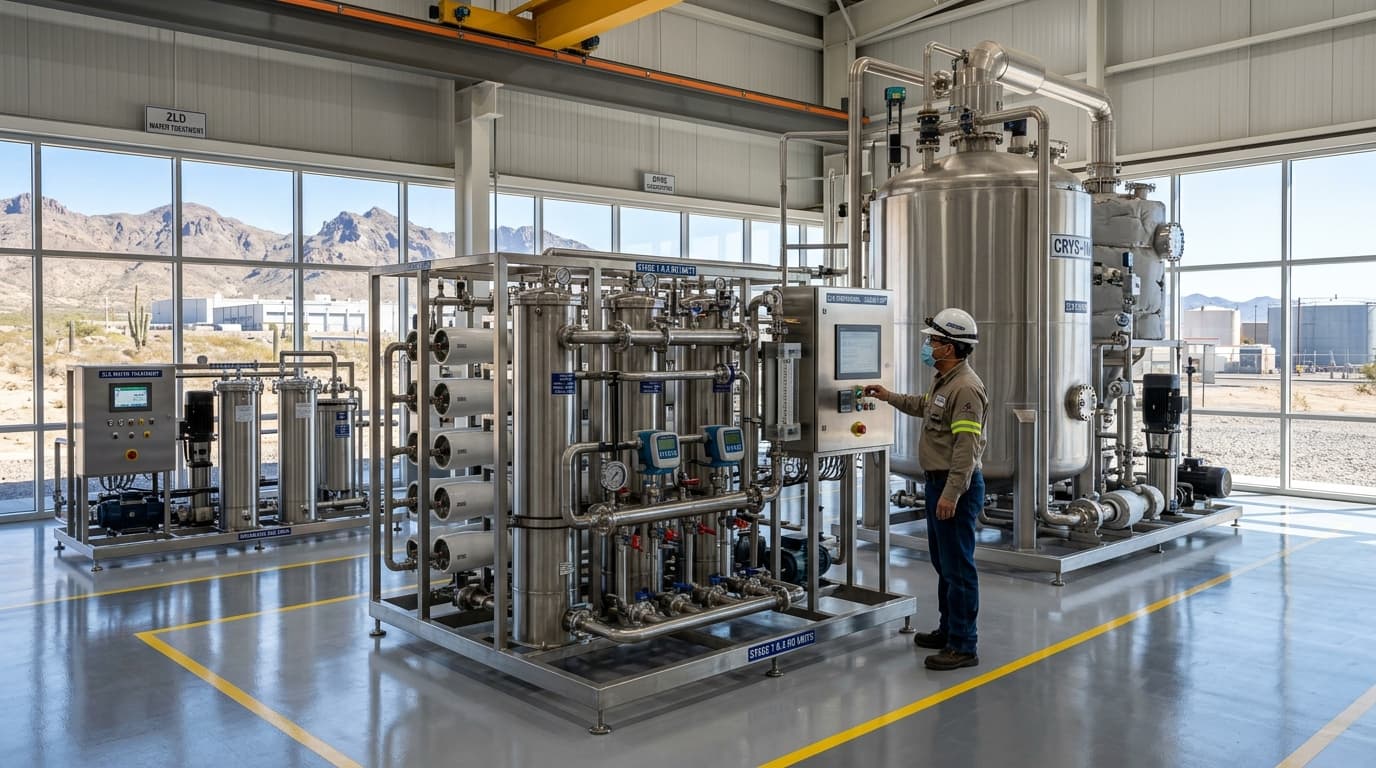
To achieve absolute immunity from CONAGUA discharge audits, insulate their operations from municipal water rationing, and satisfy corporate ESG mandates, advanced manufacturing operations across Northern Mexico are adopting Zero Liquid Discharge (ZLD) systems.
+---------------------------------------------------------------------------------------------------+
|                           THE 5-STAGE INDUSTRIAL ZLD PROCESS FLOW                                 |
+---------------------------------------------------------------------------------------------------+
|                                                                                                   |
|  [ STAGE 1: EQUALIZATION & CHEMICAL PRE-TREATMENT ]                                               |
|  * Raw industrial wastewater enters equalization tanks. Coagulation, flocculation, and pH        |
|    adjustment remove suspended solids and neutralize heavy metal hydroxides.                      |
|                                     |                                                             |
|                                     v                                                             |
|  [ STAGE 2: ULTRAFILTRATION (UF) MEMBRANE SKIDS ]                                                 |
|  * Hollow-fiber or ceramic ultrafiltration membranes remove sub-micron colloidal particles,       |
|    oils, and bacteria, achieving a Silt Density Index (SDI) < 3.0.                                |
|                                     |                                                             |
|                                     v                                                             |
|  [ STAGE 3: HIGH-EFFICIENCY REVERSE OSMOSIS (HERO / SWRO) ]                                       |
|  * High-pressure spiral-wound RO membranes operate at 800–1,200 PSI, recovering 75% to 85% of    |
|    clean permeate water, which returns directly to cooling towers and manufacturing lines.        |
|                                     |                                                             |
|                                     v                                                             |
|  [ STAGE 4: MECHANICAL VAPOR RECOMPRESSION (MVR) BRINE EVAPORATOR ]                               |
|  * RO reject brine (concentrated TDS > 60,000 mg/L) enters a falling-film MVR evaporator. Thermal |
|    vapor recompression evaporates 90% of remaining water, recovering ultra-pure distillate.       |
|                                     |                                                             |
|                                     v                                                             |
|  [ STAGE 5: THERMAL CRYSTALLIZER & FILTER PRESS ]                                                 |
|  * Saturated brine slurry is crystallized. A heavy-duty chamber filter press extracts remaining   |
|    moisture, producing a dry solid salt cake classified under NOM-052-SEMARNAT-2005 for disposal. |
|                                                                                                   |
|  TOTAL PLANT WATER RECOVERY EFFICIENCY: 95.0% TO 98.5% CLOSED LOOP                                |
+---------------------------------------------------------------------------------------------------+
The Financial Business Case for ZLD in Mexico
While historical executives dismissed ZLD as overly capital-intensive, the 2026 economic equation in Northern Mexico has flipped. ZLD has become an aggressive, value-generating investment:
- Capex Benchmarks: Modular, skid-mounted industrial ZLD systems range from $800,000 to $2,500,000 USD for treatment capacities between $100\text{ m}^3/\text{day}$ and $500\text{ m}^3/\text{day}$.
- Volumetric Tariff Elimination: Eliminates up to 90% of municipal freshwater intake tariffs ($85 to $145 MXN per $m^3$ in Monterrey), generating $300,000 to $650,000 USD in direct annual utility OpEx savings.
- Zero Discharge Permitting Liability: By discharging zero liquid effluent into sewers or federal water bodies, the facility eliminates 100% of CONAGUA discharge duties (Derechos de Descarga under LFD Art. 223) and completely bypasses NOM-001-SEMARNAT-2021 inspection liability.
- Payback Horizon: With avoided tariffs, zero regulatory fines, and uninterrupted production during municipal water rationing, full capital payback is routinely achieved within 3.2 to 4.8 years.
Regional Hydrological Playbooks: Monterrey, Saltillo, Tijuana & Mexicali
Every Mexican manufacturing hub presents a unique hydrological risk profile that dictates facility site selection and engineering specifications:
+---------------------------------------------------------------------------------------------------+
|                        REGIONAL INDUSTRIAL WATER & REGULATORY MATRIX                              |
+---------------------------------------------------------------------------------------------------+
|  REGION               PRIMARY WATER SOURCE         KEY HYDROLOGICAL RISK       RECOMMENDED STRATEGY|
+-----------------------+----------------------------+---------------------------+------------------+
|  Monterrey            | SADM Municipal Grid +      | Severe seasonal municipal | Contract industrial |
|  (Nuevo León)         | Treated Greywater + Wells  | rationing; Veda Total     | greywater line +   |
|                       | (El Cuchillo II aqueduct)  | across all local aquifers | install onsite ZLD|
+-----------------------+----------------------------+---------------------------+------------------+
|  Saltillo /           | Private Deep Wells         | Declining limestone water | Audit park well   |
|  Ramos Arizpe         | (Zapalinamé aquifer)       | tables (1.5m drop/yr);    | titles in REPNA;   |
|  (Coahuila)           |                            | high mineral hardness     | install RO skids  |
+-----------------------+----------------------------+---------------------------+------------------+
|  Tijuana              | CESPT Municipal Network    | Colorado River shortages  | Advanced closed-  |
|  (Baja California)    | (95% imported via aqueduct)| (IBWC Minute 330 cuts);   | loop recycling;   |
|                       |                            | high tariffs ($8.50/m³)   | water storage tank|
+-----------------------+----------------------------+---------------------------+------------------+
|  Mexicali             | Colorado River Irrigation  | IBWC Treaty volumetric    | Agricultural right|
|  (Baja California)    | Canals (Distrito 014)      | cutbacks; high salinity   | swaps + onsite    |
|                       |                            |                           | water purification|
+-----------------------+----------------------------+---------------------------+------------------+
1. Monterrey (Nuevo León): The Apodaca, Pesquería & Santa Catarina Hubs
Following the severe 2022–2024 water crises, Nuevo León completed the 93-kilometer El Cuchillo II aqueduct, delivering an additional 5,000 liters per second to the Monterrey metropolitan grid.
However, Servicios de Agua y Drenaje de Monterrey (SADM) enforces strict industrial offtake quotas. Large manufacturing facilities in Apodaca, Ciénega de Flores, and Santa Catarina are required to execute dual-piping connections: receiving fresh municipal water strictly for potable and sanitary use, while contracting treated wastewater (línea morada) at $35–$55 MXN/$m^3$ for industrial cooling towers, boiler feed, and process lines.
2. Saltillo & Ramos Arizpe (Coahuila): The Automotive Heavyweight
Located just 45 minutes west of Monterrey, the Saltillo automotive corridor (home to GM Ramos Arizpe, Stellantis Saltillo Truck Assembly, and hundreds of Tier-1 suppliers) relies almost exclusively on groundwater extracted from deep limestone karst aquifers.
Because municipal utility Aguas de Saltillo (Agsal) has limited distribution in industrial corridors, over 80% of manufacturing facilities rely on private on-site wells or industrial park master concessions.
Water in this region features extreme mineral hardness (often exceeding 600–900 ppm of calcium carbonate and high silica content). Incoming manufacturers must budget significant CapEx for heavy-duty industrial water softening and double-pass reverse osmosis skids to prevent catastrophic scaling in heat exchangers and tooling circuits.
3. Tijuana & Mexicali (Baja California): Colorado River Treaty Dynamics
Baja California’s manufacturing ecosystem is defined by international transboundary hydrology governed by the International Boundary and Water Commission (IBWC / CILA) under the 1944 U.S.-Mexico Water Treaty:
- Tijuana: Tijuana possesses no major natural rivers or abundant freshwater aquifers. Approximately 95% of the city’s water is pumped over the Sierra de Juárez mountains from the Colorado River via the aging Acueducto Río Colorado-Tijuana (ARCT). Driven by historic droughts in the Lake Mead basin, the U.S. and Mexico executed Minute 330, mandating progressive volumetric cuts in Colorado River water delivered to Baja California. As a result, CESPT industrial water tariffs are the highest in Mexico, frequently reaching $8.50 USD per cubic meter, making internal recycling economically non-negotiable.
- Mexicali: In contrast, Mexicali sits directly within the fertile Mexicali Valley, fed by massive gravity irrigation canals (Distrito de Riego 014). While volumetric water is abundant compared to Tijuana, industrial expansion faces intense local sociopolitical scrutiny (exemplified by the historical citizen protests that canceled Constellation Brands' $1.4B USD brewery in 2020). Manufacturers must navigate formal agricultural-to-industrial water swaps under strict state oversight.
Forensic Comparison Matrix: Regional Industrial Water Costs & Compliance
The following analytical matrix compares industrial water economics, regulatory lead times, and operational risks across Mexico’s primary manufacturing corridors for 2026:
| Operational Parameter | Monterrey Submarkets (Apodaca, Pesquería, Santa Catarina) | Saltillo Submarkets (Ramos Arizpe, Derramadero) | Tijuana Industrial Corridors (Otay Mesa, El Florido) | Mexicali Industrial Corridors (Silicon Border, Palaco) |
|---|---|---|---|---|
| Primary Industrial Water Source | SADM Municipal Grid + Treated Greywater (Línea Morada) | Private Groundwater Extraction Wells (Limestone Aquifers) | CESPT Municipal Grid (Colorado River Aqueduct) | Agricultural Concession Swaps (Distrito de Riego 014) |
| CONAGUA Aquifer Status | Veda Total (Absolute Moratorium); Zero new well permits | Overexploited; Declining water tables (1.5m–2.5m/yr drop) | Overdrafted coastal basin; Severe saline intrusion risk | Overdrafted; Governed by IBWC/CILA Treaty Shortage Rules |
| Municipal Water Tariff (2026) | $4.50 – $7.50 / $m^3$ USD ($85 – $145 MXN) | $3.80 – $5.50 / $m^3$ USD (Aguas de Saltillo industrial) | $5.20 – $8.50 / $m^3$ USD (Highest border water tariff) | $2.80 – $4.20 / $m^3$ USD (Most cost-effective border tariff) |
| Línea Morada (Treated Greywater) | Highly developed municipal reuse network available | Limited; predominantly confined to major master parks | Low municipal availability; trucking often required | Moderate; localized industrial park reuse systems |
| REPNA Concession Transfer Window | 9 to 14 months (High CONAGUA regulatory scrutiny) | 6 to 10 months (Moderate processing timeline) | 8 to 12 months (Restricted transfer volumes) | 6 to 9 months (Established irrigation swap framework) |
| Wastewater Enforcement Standard | NOM-001-SEMARNAT-2021 + SADM Strict Pre-treatment | NOM-001-SEMARNAT-2021 + Local Basin Limits | NOM-001-SEMARNAT-2021 + EPA Cross-Border Scrutiny | NOM-001-SEMARNAT-2021 + Agricultural Runoff Controls |
| ZLD Necessity Index (1–10) | 9.0 / 10 (Mandatory for permitting high-draw plants) | 8.5 / 10 (Crucial to mitigate aquifer depletion) | 8.5 / 10 (Essential due to CESPT drain capacity limits) | 7.5 / 10 (High for heavy chemicals/electronics) |
| Seasonal Drought Curtailment Risk | High (Municipal supply rationing during summer peaks) | Moderate-High (Well yield depletion in severe droughts) | Extreme (Colorado River Treaty Minute 330 cutbacks) | High (Treaty-mandated volumetric agricultural reductions) |
| ESG / Investor Scrutiny Level | Extreme (National media spotlight; community scrutiny) | High (Automotive OEM supply chain ESG audits) | High (Cross-border San Diego/Tijuana watershed impact) | Extreme (Post-Constellation Brands brewery precedent) |
| Recommended Facility Strategy | Dual-source: SADM connection + Onsite ZLD 95% recycling | Concession purchase + Deep well backup + Closed loop | Advanced RO + Internal recycling + Low-water tooling | Agricultural right swap + Onsite desalination/treatment |
Executive 10-Point Water Feasibility Checklist for Site Selection Committees
Before executing a commercial real estate lease, purchasing industrial acreage, or signing a Letter of Intent (LOI) in Mexico, corporate investment committees must mandate completion of the following 10-point due diligence audit:
+---------------------------------------------------------------------------------------------------+
|                        THE C-SUITE INDUSTRIAL WATER FEASIBILITY CHECKLIST                         |
+---------------------------------------------------------------------------------------------------+
|                                                                                                   |
|  [ ] 1. REPNA TITLE VERIFICATION                                                                   |
|      Demand certified copies of the concession title. Validate the registration number in         |
|      CONAGUA's online REPNA portal. Confirm title is active, unencumbered, and not expired.       |
|                                                                                                   |
|  [ ] 2. VOLUMETRIC ALLOCATION VS. DEMAND GAP                                                      |
|      Compare your plant's peak daily process water demand ($m^3/\text{day}$) against the title's   |
|      authorized annual volume ($m^3/\text{year}$). Factor in seasonal peak fluctuations.          |
|                                                                                                   |
|  [ ] 3. HISTORICAL TAX DUTY CLEARANCE (FORMATO 5)                                                 |
|      Audit the seller's or developer's federal water duty payment receipts (*Ley Federal de       |
|      Derechos* Art. 223) for the preceding 5 years. Unpaid federal duties transfer to the buyer.   |
|                                                                                                   |
|  [ ] 4. MUNICIPAL "CARTA DE FACTIBILIDAD"                                                         |
|      Secure an official, written feasibility commitment from the municipal utility (SADM, CESPT)   |
|      guaranteeing continuous flow rate (liters per second) and required dynamic line pressure.    |
|                                                                                                   |
|  [ ] 5. SEWER DISCHARGE CAP & PRE-TREATMENT COVENANTS                                             |
|      Review the industrial park or municipal sewer discharge agreement. Audit maximum allowable    |
|      temperature, COD, and heavy metal concentrations before wastewater leaves your property.     |
|                                                                                                   |
|  [ ] 6. RAW WATER CHEMICAL ANALYSIS                                                               |
|      Collect physical water samples from the site's supply line. Perform certified laboratory     |
|      testing for Total Dissolved Solids (TDS), silica, calcium, chlorides, and sulfate hardness.  |
|                                                                                                   |
|  [ ] 7. LÍNEA MORADA (TREATED EFFLUENT) PROXIMITY                                                 |
|      Verify physical proximity to municipal or park treated greywater distribution mains. Calculate|
|      interconnection piping CapEx to utilize lower-cost recycled water for cooling towers.        |
|                                                                                                   |
|  [ ] 8. PHYSICAL ZLD TREATMENT PLANT FOOTPRINT                                                     |
|      Ensure architectural building layouts allocate dedicated square footage (minimum 3,000 to   |
|      8,000 sq. ft.) with adequate ceiling clearance and drainage retention for an on-site ZLD.   |
|                                                                                                   |
|  [ ] 9. SOLID WASTE MANAGEMENT FOR DRIED SALT CAKE                                                |
|      Establish handling protocols and secure certified hazardous waste disposal contracts under   |
|      NOM-052-SEMARNAT-2005 for solid crystallizer salt cakes produced by ZLD processing.          |
|                                                                                                   |
|  [ ] 10. LEASE CONTRACT WATER CONTINGENCY CLAUSE                                                  |
|      Incorporate explicit contractual language stipulating that the industrial lease or purchase  |
|      is null and void with 100% deposit refund if CONAGUA or municipal water permits are denied.  |
|                                                                                                   |
+---------------------------------------------------------------------------------------------------+
How Nearshore Navigator Secures Your Water Sovereignty
Navigating Mexican environmental law, municipal utility politics, and hydrological engineering requires specialized, objective expertise. Traditional commercial real estate brokers are incentivized to close transactions quickly, frequently glossing over water availability constraints until after lease agreements are executed.
Nearshore Navigator provides an independent, technical advisory platform that eliminates water and environmental risk from your expansion roadmap.
Our environmental and site-selection advisory practice delivers:
- Forensic REPNA Concession Audits: We conduct exhaustive legal due diligence on federal water concession titles—verifying title validity in CONAGUA registries, calculating historical extraction forfeiture risks, and auditing federal tax duty clearances.
- Utility Negotiation & Línea Morada Contracting: We negotiate directly with municipal water boards (SADM, CESPT, CESPE, CEA) to secure binding feasibility letters, favorable industrial volumetric tariffs, and dedicated treated effluent (línea morada) offtake allocations.
- Turnkey ZLD & Water Engineering Due Diligence: Our engineering team models your manufacturing process water mass balance, designs customized Zero Liquid Discharge (ZLD) technical skids, and calculates exact CapEx, OpEx, and payback curves to insulate your operation from regulatory halts and regional droughts.
Before signing an industrial lease or committing capital to a Northern Mexico manufacturing site, schedule a confidential executive consultation with Nearshore Navigator. We will audit your water security and regulatory compliance with complete, uncompromised independence.
Official Regulatory & Legal References
- Constitución Política de los Estados Unidos Mexicanos: Article 27 (National Ownership of Waters and Natural Resources).
- Ley de Aguas Nacionales (LAN): Articles 20, 22 (Extraction and Discharge Concessions); Articles 29 Bis, 49–54 (Transmission of Rights and Forfeiture); Articles 118, 119 (Violations and Sanctions).
- Programa Nacional Hídrico (PNH) 2026–2030: Federal Executive Decree published in the Diario Oficial de la Federación.
- Normas Oficiales Mexicanas (NOMs):
- NOM-001-SEMARNAT-2021: Maximum Permissible Limits for Contaminants in Wastewater Discharges into National Water Bodies.
- NOM-052-SEMARNAT-2005: Characteristics, Identification Procedure, and Classification of Hazardous Industrial Wastes.
- Ley Federal de Derechos (LFD): Articles 223–231 (Duty Tariffs on the Extraction and Discharge of National Waters).
- International Treaties: 1944 U.S.-Mexico Water Treaty and International Boundary and Water Commission (IBWC / CILA) Minute 330 (Shortage Sharing and Water Delivery Reductions in the Colorado River Basin).
Strategic Nearshoring & Industrial Intelligence
For North American executives, CFOs, and supply chain directors evaluating cross-border manufacturing, explore our master portal on nearshoring Mexico, review Class A availability and park vacancy in our comprehensive dossier on industrial real estate Tijuana, evaluate operational risk mitigation under maquiladora advisory and shelter services, or model your exact multi-state savings using the interactive nearshore landed cost calculator.