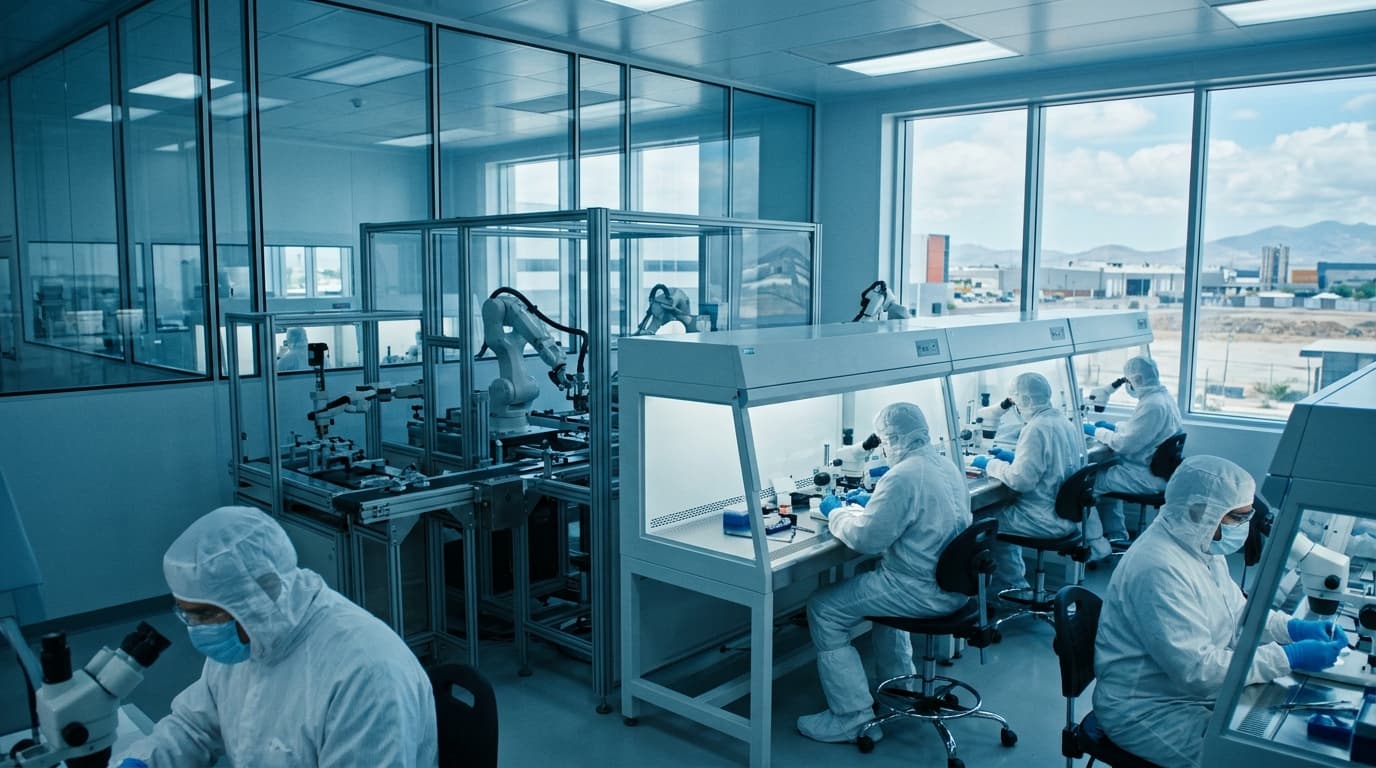
Tijuana Medical Device Manufacturing Guide: Cleanroom Validation, ISO 13485 & FDA QMSR Compliance (2026)
Master Tijuana medical device manufacturing. Technical guide to ISO Class 7/8 cleanrooms, ISO 13485 & FDA QMSR harmonization, IQ/OQ/PQ & Otay Mesa logistics.
Tijuana Medical Device Manufacturing Guide: Cleanroom Validation, ISO 13485 & FDA QMSR Compliance (2026)
A Comprehensive Technical Blueprint on ISO Class 7/8 Cleanroom Engineering, FDA Quality Management System Regulation Harmonization, Otay Mesa Sterilization Corridors, and IQ/OQ/PQ Transfer Roadmaps
By Denisse Martinez, Senior Technical SEO & Trade Compliance Specialist
Executive Direct Answer: Medical Device Manufacturing in Tijuana
Tijuana represents North America’s largest medical device manufacturing cluster, housing over 65 multinational facilities including Medtronic, BD, and ICU Medical, supported by 50,000+ certified technicians. The ecosystem offers immediate proximity to Southern California, robust IMMEX duty-free importation frameworks, established ISO 13485 supply chains, and rapid dual-border sterilization logistics via Otay Mesa.
Executive Summary: Tijuana's North American Medical Device Leadership
Tijuana represents North America’s largest medical device manufacturing cluster, housing over 65 multinational facilities including Medtronic, BD, and ICU Medical, supported by 50,000+ certified technicians. The ecosystem offers immediate proximity to Southern California, robust IMMEX duty-free importation frameworks, established ISO 13485 supply chains, and rapid dual-border sterilization logistics via Otay Mesa.
Over the past three decades, the municipality of Tijuana, Baja California, has evolved from a conventional labor-arbitrage maquiladora enclave into the preeminent high-precision biomedical and life sciences engineering capital of North America. Today, the Baja California medical device cluster consolidates more than 65 multinational original equipment manufacturer (OEM) operations and certified contract manufacturing organizations (CMOs), collectively deploying more than 50,000 highly trained operators, cleanroom technicians, quality assurance engineers, and regulatory compliance directors.
Global medical technology industry leaders—including Medtronic, CareFusion/Becton Dickinson (BD), Fisher & Paykel Healthcare, Integer Holdings (Greatbatch Medical), ICU Medical, Teleflex, Outset Medical, and Smiths Medical—operate mega-facilities in Tijuana's prime industrial submarkets, such as El Florido, Otay Centenario, Parque Industrial Pacífico, and Valle Sur. These sites manufacture mission-critical devices spanning cardiovascular implant delivery systems, hemodialysis bloodlines, intensive care infusion pumps, neurostimulation leads, neonatal respiratory circuits, orthopedic implants, and precision surgical instruments distributed to hospitals in over 120 countries.
+----------------------------------------------------------------------------------------------------+
|                         TIJUANA MEDICAL DEVICE CLUSTER AT A GLANCE (2026)                          |
+----------------------------------------------------------------------------------------------------+
| Active Multinational Facilities         | 65+ Tier-1 OEMs & Specialized Contract Manufacturers     |
| Direct Technical & Assembly Workforce   | 50,000+ Certified Cleanroom Operators & Engineers        |
| Annual Medical Export Value             | $6.2+ Billion USD Exported Directly to Global Markets     |
| Dominant Cleanroom Classifications      | ISO Class 7 (Class 10,000) & ISO Class 8 (Class 100,000)  |
| Regional University Pipeline             | 3,500+ Annual Engineering Graduates (Biomedical/MEC/IE)  |
| Proximity to Southern California Hubs   | 20 Minutes to San Diego Biotech / 2 Hours to Irvine MedTech|
| Border Clearance Mechanism              | FAST Commercial Lanes / C-TPAT & OEA Certified Drayage    |
| Primary Regulatory Clearances           | US FDA Registered / ISO 13485:2016 / COFEPRIS / EU MDR    |
+----------------------------------------------------------------------------------------------------+
The fundamental catalyst underpinning this cluster’s rapid expansion is the structural convergence of four strategic nearshore pillars:
- $0
FDA 21 CFR Part 820 & QMSR / ISO 13485 Harmonization in Mexico
The FDA Quality Management System Regulation (QMSR) harmonizes 21 CFR Part 820 with ISO 13485:2016, eliminating redundant dual-audit burdens for Tijuana medical device manufacturers. Plants in Mexico now unify global quality manuals under ISO 13485 structure while maintaining mandatory FDA statutory carve-outs covering Medical Device Reporting, corrections and removals, and rigorous design controls.
The regulatory landscape governing medical device manufacturing in Mexico has reached a transformative milestone with the formal enactment of the United States Food and Drug Administration (FDA) Quality Management System Regulation (QMSR). By officially amending 21 CFR Part 820 to incorporate by reference the international quality standard ISO 13485:2016 (Medical devices — Quality management systems — Requirements for regulatory purposes), the FDA has fundamentally streamlined regulatory compliance across North American production networks.
Historically, medical device contract manufacturers and captive maquiladoras in Tijuana were forced to maintain bifurcated quality systems: an ISO 13485-compliant Quality Management System (QMS) to satisfy European Union Medical Device Regulation (EU MDR 2017/745), Health Canada (MDSAP), and Latin American regulatory bodies, run in parallel with a distinct FDA 21 CFR Part 820 Quality System Regulation (QSR) framework required for products destined for the United States.
+----------------------------------------------------------------------------------------------------+
|               FDA 21 CFR PART 820 (QMSR) VS. ISO 13485:2016 HARMONIZATION ARCHITECTURE              |
+----------------------------------------------------------------------------------------------------+
|  CORE STANDARD: ISO 13485:2016 (Clause 4 through Clause 8)                                         |
|  - Clause 4: General QMS & Documentation Architecture (Quality Manual, Medical Device File)        |
|  - Clause 5: Management Responsibility & Customer Focus                                           |
|  - Clause 6: Resource Management & Cleanroom Infrastructure Controls                                |
|  - Clause 7: Product Realization (Design Controls, Purchasing, Production, Traceability)           |
|  - Clause 8: Measurement, Analysis & Improvement (CAPA, Internal Audit, Complaint Handling)        |
+----------------------------------------------------------------------------------------------------+
|  FDA QMSR STATUTORY SPECIFIC REQUIREMENTS (PRESERVED & ENFORCED IN 21 CFR PART 820)                |
|  + 21 CFR Part 803: Medical Device Reporting (MDR adverse event escalation protocols)              |
|  + 21 CFR Part 806: Medical Device Corrections and Removals (Field actions and recalls)           |
|  + 21 CFR Part 830: Unique Device Identification (UDI direct marking and GUDID submission)        |
|  + 21 CFR § 820.45: Specific controls for Device Labeling and Sterile Packaging release            |
|  + 21 CFR § 820.65: Traceability mandates for life-supporting and life-sustaining implants        |
+----------------------------------------------------------------------------------------------------+
Eliminating Dual-Documentation Overhead
Under the harmonized QMSR, Mexican manufacturing facilities can decommission redundant standard operating procedures (SOPs). A single, integrated Quality Manual satisfies both international Notified Bodies and FDA Foreign Regulatory Investigators. Crucially, ISO 13485's heavy emphasis on enterprise-wide risk management—anchored by ISO 14971 (Application of risk management to medical devices)—now serves as the explicit foundation for FDA compliance throughout the entire product lifecycle, from incoming raw polymer inspection to cleanroom terminal sealing.
However, C-Suite manufacturing executives must avoid the dangerous misconception that ISO 13485 certification alone guarantees FDA QMSR compliance. The FDA has deliberately preserved several statutory requirements within 21 CFR Part 820 that exceed baseline ISO 13485 requirements:
- $0
Dual-Jurisdiction Readiness: FDA & COFEPRIS NOM-241 Alignment
Medical operations in Tijuana also operate under Mexican domestic sanitary oversight governed by the Federal Commission for the Protection against Sanitary Risks (COFEPRIS). Mexican regulatory policy enforces NOM-241-SSA1-2021 (Good Manufacturing Practices for Medical Device Facilities).
Fortunately for nearshore operators, NOM-241-SSA1-2021 was drafted to mirror ISO 13485:2016 and the Pharmaceutical Inspection Co-operation Scheme (PIC/S) standards. Consequently, a Tijuana cleanroom engineered to satisfy FDA QMSR mandates simultaneously achieves full compliance with Mexican sanitary inspection guidelines, creating an airtight, internationally defensible quality architecture.
ISO Class 7 & Class 8 Cleanroom Engineering: Build-to-Suit vs. Retrofit in Tijuana
Medical device cleanroom validation in Tijuana adheres to ISO 14644-1 standards, requiring laminar airflow, HEPA filtration cascades, positive pressure differentials (10–15 Pa), and strict bioburden controls. While build-to-suit Class 7 facilities demand 9–14 months and $250–$450/sq.ft capital expenditure, Class 8 modular retrofits in existing industrial parks deploy within 90–120 days at 40% lower initial investment.
At the core of Tijuana’s medical manufacturing success is its sophisticated cleanroom engineering ecosystem. The assembly of sterile, invasive, or blood-contacting medical devices demands stringently controlled environments governed by ISO 14644 (Cleanrooms and associated controlled environments), specifically Part 1 (Classification of air cleanliness by particle concentration), Part 2 (Monitoring to provide evidence of cleanroom performance), and Part 3 (Test methods).
Medical device operations in Tijuana predominantly utilize two cleanroom classifications depending on device criticality, bioburden thresholds, and downstream sterilization methodologies:
- $0
Cleanroom Aerodynamic & Environmental Specifications Matrix
The following matrix delineates the technical performance criteria required for cleanroom qualification under ISO 14644-1 and FDA QMSR expectations:
| Technical Parameter | ISO Class 7 (Federal Standard 209E Class 10,000) | ISO Class 8 (Federal Standard 209E Class 100,000) | Uncontrolled Packaging / Staging Area |
|---|---|---|---|
| Max Particles/m³ (≥ 0.5 µm) | 352,000 particles/m³ | 3,520,000 particles/m³ | Unregulated (> 35,000,000 particles/m³) |
| Max Particles/m³ (≥ 5.0 µm) | 2,930 particles/m³ | 29,300 particles/m³ | Unregulated |
| Air Changes Per Hour (ACH) | 30 – 60 ACH | 15 – 25 ACH | 4 – 8 ACH |
| Airflow Pattern | Non-unidirectional or partial laminar displacement | Non-unidirectional (turbulent dilution) | Conventional HVAC mixing |
| Filtration Final Stage | Terminal HEPA H14 (99.995% efficiency @ 0.3 µm) | Ceiling HEPA H13/H14 (99.95% - 99.995% efficiency) | Pre-filters MERV 13 to MERV 16 |
| Differential Pressure Cascade | +30 to +45 Pa relative to ambient (+10 to +15 Pa relative to Class 8) | +15 to +25 Pa relative to ambient / gowning airlock | Neutral or slightly positive (+5 Pa) |
| Relative Humidity (RH) | 40% to 60% ± 5% (ESD & microbial prevention) | 40% to 65% ± 5% | Ambient / Comfort (30% to 70%) |
| Operating Temperature | 68°F ± 2°F (20°C ± 1.1°C) | 68°F – 72°F ± 3°F (20°C – 22°C) | 72°F ± 5°F (22°C ± 2.8°C) |
| Microbial Air Limits (Bioburden) | < 10 CFU/m³ (Active air sampling) | < 100 CFU/m³ (Active air sampling) | Unregulated |
| Surface Bioburden Limits (RODAC) | < 5 CFU / contact plate (25 cm²) | < 25 CFU / contact plate (25 cm²) | Unregulated |
+----------------------------------------------------------------------------------------------------+
| TYPICAL TIJUANA CLEANROOM PRESSURE CASCADE & AIRFLOW ARCHITECTURE |
+----------------------------------------------------------------------------------------------------+
| |
[ EXTERNAL WAREHOUSE / LOGISTICS ZONE ] (Pressure: 0 Pa / Baseline Ambient) v (Interlocked Airlock Door) [ GOWNING / AIRLOCK TRANSITION ] (Pressure: +15 Pa / HEPA Filtered / Class 8) v (Interlocked Gowning Door) [ ISO CLASS 8 PREPARATION & MOLDING ] (Pressure: +30 Pa / 20 ACH / HEPA Ceiling Units) v (Active Laminar Flow Pass-Through Chamber) ISO CLASS 7 PRIMARY STERILE ASSEMBLY +---> High-Precision Bonding, Ultrasonic Welding & Automated Seal Inspection v (Double-Door Hermetic Pass-Through Box) [ PACKAGING & CARTONING STAGING ] (Pressure: +20 Pa / Class 8 Controlled Environment) v (Air Curtain Dock Seal) [ OUTBOUND DRAYAGE TO OTAY MESA FAST LANES ] (Direct to California Sterilization Hubs)
+----------------------------------------------------------------------------------------------------+Build-to-Suit vs. Class A Industrial Retrofit in Tijuana
When deploying cleanroom infrastructure in Tijuana, foreign medtech enterprises must evaluate two primary real estate strategies: constructing a greenfield Build-to-Suit (BTS) standalone facility or executing a modular Cleanroom Retrofit within an existing Class A industrial building shell.
The economic and operational trade-offs are summarized below:
| Decision Vector | Greenfield Build-to-Suit (BTS) Facility | Class A Speculative Industrial Retrofit |
|---|---|---|
| Initial Capital Expenditure (Capex) | High ($250 – $450+ USD / sq. ft. fully fitted) | Moderate ($120 – $220 USD / sq. ft. retrofit scope) |
| Time-to-Commissioning (Validation Ready) | 12 to 18 Months (permitting, civil works, HVAC) | 90 to 150 Days (modular wall systems inside shell) |
| Clear Ceiling Height Optimization | Custom engineered (28' - 32' for double-deck HVAC) | Constrained by building spec (typically 24' - 30') |
| Structural Slab & Vibration Isolation | Custom reinforced (10,000+ PSI, isolated tool pads) | Standard industrial slab (6" - 8" 4,000 PSI concrete) |
| Electrical Substation & Power Drops | Dedicated high-voltage substation (1,000–5,000 kVA) | Dependent on park capacity; shared or medium drops |
| Backup Redundancy (N+1 Generators) | Integrated dual generators + automatic transfer switches | External diesel genset pads must be permitted |
| Lease Term Commitment | Long-Term (10 to 15-year industrial lease) | Medium-Term (3 to 7-year standard lease) |
| Ideal Operational Profile | High-volume Tier-1 OEMs with Class III devices | Contract manufacturers, Class I/II devices, rapid scale |
Essential Cleanroom Engineering Controls
To withstand rigorous FDA Foreign Regulatory Inspections and Notified Body audits, cleanroom installations in Tijuana must incorporate:
- $0
Sterilization Logistics & Cold-Chain Drayage via Otay Mesa
Tijuana medical device facilities utilize a cross-border closed-loop sterilization chain, transferring sealed, pre-validated bulk lots to Southern California contract sterilization centers via Otay Mesa FAST commercial lanes. Validated Ethylene Oxide, Electron-Beam, and Gamma radiation processing runs under ISO 11135 and ISO 11137 standards, returning sterile goods to US distribution networks within 24 to 48 hours.
Medical device manufacturing requires strict, uninterrupted chain-of-custody protocols between sterile assembly cleanrooms and terminal sterilization facilities. Because capital-intensive terminal sterilization centers—particularly high-capacity Ethylene Oxide (EtO) chambers, Gamma Irradiation (Cobalt-60) towers, and high-energy Electron-Beam (E-Beam) accelerators—require specialized nuclear or hazardous emission permitting, medical OEMs in Tijuana rely on an integrated cross-border sterilization supply chain spanning Baja California and Southern California.
Terminally packaged medical devices are assembled and sealed inside Tijuana ISO Class 7 cleanrooms using validated sterile barrier systems (Tyvek pouches, thermoformed blister trays, or porous header bags complying with ISO 11607-1/2). Once final secondary cartoning is complete, the goods are moved via bonded drayage across the international border directly to contract sterilization facilities located in San Diego County, Riverside County, and Orange County, California.
+----------------------------------------------------------------------------------------------------+
| CROSS-BORDER MEDICAL DEVICE STERILIZATION CYCLE (TIJUANA - SOCAL) |
+----------------------------------------------------------------------------------------------------+
| |
| 1. TIJUANA CLEANROOM FACILITY (ISO 13485 / NOM-241) |
| - Assembly, bioburden monitoring, Tyvek heat-sealing per ISO 11607 |
| - Application of chemical process indicators & biological indicators (BIs) |
- Electronic pallet aggregation with serialized barcoding & dataloggers 2. EXPEDITED CROSS-BORDER DRAYAGE (OTAY MESA PORT OF ENTRY) - C-TPAT / FAST certified dedicated commercial lane clearance (under 45 minutes) - Mexican Customs Pedimento de Exportación Virtual / US CBP Section 321 or Formal Entry 3. SOUTHERN CALIFORNIA CONTRACT STERILIZATION HUBS (San Diego, Temecula, Ontario, Corona) + Ethylene Oxide (EtO) per ISO 11135: Pre-conditioning -> Chamber Cycle -> Aeration Degassing + Gamma Irradiation per ISO 11137: Cobalt-60 continuous pallet carrier dosing (25-40 kGy) + Electron-Beam (E-Beam) per ISO 11137: High-speed linear accelerator dosing 4. STERILITY RELEASE & US COMMERCIAL DISTRIBUTION - Parametric release / dosimetric analysis / BI incubation sign-off - Immediate cross-docking into US hospital distribution channels or 3PL hubs
+----------------------------------------------------------------------------------------------------+Sterilization Modalities Comparison for Nearshore Operations
Selecting the appropriate sterilization modality depends on material polymer compatibility, device electronics, packaging density, and turnaround requirements:
| Parameter | Ethylene Oxide (EtO / EO) | Gamma Irradiation (Cobalt-60) | Electron-Beam (E-Beam) |
|---|---|---|---|
| Applicable Standards | ISO 11135:2014 | ISO 11137-1/2:2015 | ISO 11137-1/2:2015 |
| Primary Mechanism | Alkylation of microbial cellular DNA | Radiolytic DNA strand cleavage via photons | Radiolytic DNA strand cleavage via electrons |
| Material Compatibility | Broad (polymers, optics, electronics, adhesives) | Moderate (causes polymer cross-linking/embrittlement) | Moderate to High (lower exposure time limits degradation) |
| Penetration Capacity | Deep gas penetration through breathable Tyvek | Exceptional (penetrates dense metals/liquids) | Limited to moderate (dependent on density/thickness) |
| Typical Cycle Duration | 24 to 60 Hours (including aeration/degassing) | 6 to 18 Hours (continuous tote dwell) | 5 Minutes to 2 Hours (high-speed conveyor) |
| Port-to-Facility Transit | 45–90 min to San Diego/Temecula hubs | 60–120 min to Riverside/Ontario hubs | 45–75 min to San Diego/Corona hubs |
| Parametric Release | Approved under strict process validation | Industry standard via calibrated dosimeters | Industry standard via radiochromic film dosimeters |
| Residual Hazards | EO and Ethylene Chlorohydrin (ECH) limits | None (zero radiation residual post-exposure) | None (zero radiation residual post-exposure) |
Regulatory Trade Compliance for Cross-Border Drayage
Navigating the cross-border movement of unsterilized medical devices requires seamless integration of Mexican customs law and US Customs and Border Protection (CBP) regulations:
- $0
Class I, II, and III Medical Device Assembly: Workforce Skills & Engineering Talent
Tijuana’s specialized workforce of 50,000+ medical manufacturing technicians supports Class I disposables, Class II diagnostic electromechanical instruments, and Class III cardiovascular and neuromodulation implants. Backed by regional universities graduating 3,500+ biomedical and mechatronics engineers annually, Tijuana maintains lower labor turnover (sub-2%) and 50–65% operational cost savings compared to US and European manufacturing hubs.
The technical breadth of medical device assembly conducted in Tijuana spans the entire spectrum of regulatory risk, categorized under FDA regulations (21 CFR Parts 862–892) and COFEPRIS risk classifications:
Class I: High-Volume Disposable & Consumable Devices
- $0
Class II: Electromechanical, Diagnostic & Specialized Delivery Devices
- $0
Class III: Critical Life-Supporting & Implantable Devices
- $0
+----------------------------------------------------------------------------------------------------+
|                         TIJUANA REGIONAL HIGHER EDUCATION MEDTECH PIPELINE                         |
+----------------------------------------------------------------------------------------------------+
|  INSTITUTION                                  | SPECIALIZED DEGREE PROGRAMS & OUTPUT               |
+----------------------------------------------------------------------------------------------------+
|  UABC (Universidad Autónoma de Baja California)| B.S. Biomedical Engineering, B.S. Mechatronics,     |
|                                               | M.S. Industrial Applied Engineering (1,500+ grads) |
|  CETYS Universidad                            | B.S. Mechanical & Manufacturing Engineering,      |
|                                               | ABET-Accredited Dual US-Mexico Degrees (800+ grads)|
|  Instituto Tecnológico de Tijuana (ITT)       | B.S. Electronic Engineering, Materials Science,    |
|                                               | Advanced Metrology & Precision Tooling (1,200+ grads)|
+----------------------------------------------------------------------------------------------------+
|  ANNUAL TALENT CONSOLIDATION: 3,500+ Fully Bilingual Technical Graduates Annually                  |
+----------------------------------------------------------------------------------------------------+
Institutional Talent Pipeline & Technical Longevity
Tijuana’s human capital advantage is reinforced by an institutional academic engine. Regional universities—notably the Universidad Autónoma de Baja California (UABC), CETYS Universidad (an ABET-accredited private institution offering dual US-Mexican engineering diplomas), and the Instituto Tecnológico de Tijuana (ITT)—collaborate directly with the Baja California Medical Cluster (Cluster Médico de las Californias).
These universities operate dedicated cleanroom training simulators, metrology laboratories, and bioburden testing facilities. As a result, engineering graduates enter the manufacturing workforce already fluent in Good Manufacturing Practices (GMP), ISO 13485 documentation controls, Six Sigma DMAIC methodologies, and statistical process validation.
Furthermore, Tijuana boasts generational stability in cleanroom assembly. Unlike border regions dominated by volatile seasonal assembly, medical device maquiladoras in Tijuana experience exceptionally low direct labor turnover (averaging under 1.8% to 2.2% monthly). High retention is driven by competitive compensation packages, clean, climate-controlled working conditions, clear internal technical career ladders, and comprehensive private medical benefits.
5-Step Medical Device Transfer & Validation Roadmap
Transferring medical device production to Tijuana follows a structured five-stage protocol: regulatory classification alignment, facility cleanroom qualification under ISO 14644, comprehensive IQ/OQ/PQ equipment validation, pilot lot bioburden and packaging shelf-life testing, and formal FDA/COFEPRIS submission. This sequence mitigates supply chain disruption while ensuring rigorous compliance with FDA QMSR and ISO 13485 mandates.
Executing a seamless production line transfer from a US or European manufacturing site to a Tijuana cleanroom requires a disciplined, multi-disciplinary validation roadmap. Grounded in GAMP 5 (Good Automated Manufacturing Practice) and the Global Harmonization Task Force (GHTF) process validation guidance, the transfer follows a structured 5-step sequence:
+----------------------------------------------------------------------------------------------------+
| 5-STEP MEDICAL DEVICE TRANSFER & VALIDATION ROADMAP |
+----------------------------------------------------------------------------------------------------+
| |
[STEP 1: REGULATORY BLUEPRINT] --> Reconcile DMR, Risk Management (ISO 14971), Regulatory Matrix v [STEP 2: FACILITY & HVAC] --> Cleanroom ISO 14644 Commissioning, HEPA DVT, Pressure Cascades v [STEP 3: IQ / OQ PROTOCOLS] --> Utility Qualification, Machine Calibration, Statistical DOEs v [STEP 4: PQ & STERILIZATION] --> Triple Consecutive Lots, Bioburden Baselines, ISO 11607 Seals v [STEP 5: CAPABILITY & FILING] --> Cpk/Ppk >= 1.33, FDA Establishment Registration, Notified Audit
+----------------------------------------------------------------------------------------------------+Step 1: Regulatory Classification & Gap Blueprinting (Months 1–2)
- $0
Step 2: Cleanroom Architecture & Facility Commissioning (Months 2–5)
- $0
Step 3: Equipment Installation Qualification (IQ) & Operational Qualification (OQ) (Months 5–7)
- $0
Step 4: Performance Qualification (PQ), Bioburden Baseline & Sterilization Validation (Months 7–10)
- $0
Step 5: Process Capability Verification & Regulatory Submission Dossier (Months 10–12)
- $0
Shelter vs. Standalone COFEPRIS Licensing: Risk & Speed-to-Market Comparison
Operating under an established Mexican shelter provider allows medical OEMs to leverage existing IMMEX programs, IVA tax certifications, and established COFEPRIS Avisos de Funcionamiento, achieving production within 90 days. Standalone legal incorporation requires direct sanitary licenses, 12 to 18 months of bureaucratic review, and independent corporate liability, but grants complete operational autonomy.
When establishing cleanroom manufacturing operations in Tijuana, foreign medtech executives must make a foundational corporate structuring choice: operating through an established Nearshore Shelter Service Provider or incorporating a Standalone Mexican Subsidiary (Wholly Owned S. de R.L. de C.V. or S.A. de C.V.).
In the medical device industry, this decision directly dictates regulatory speed-to-market, tax liability under Mexico's Código Fiscal de la Federación (CFF), and the corporate allocation of sanitary compliance risk under COFEPRIS.
+----------------------------------------------------------------------------------------------------+
| SHELTER MODEL VS. STANDALONE SUBSIDIARY ARCHITECTURE |
+----------------------------------------------------------------------------------------------------+
| NEARSHORE SHELTER MODEL (Shared Risk / Speed) | STANDALONE SUBSIDIARY (Full Autonomy / High Capex) |
+----------------------------------------------------------------------------------------------------+
| - US Parent retains: | - Mexican Entity owns: |
| Product IP & Patents | Direct IMMEX & VAT Certifications |
| Device Master Records & Design History | Direct COFEPRIS Sanitary Licenses |
| Cleanroom Specialized Tooling | Real Estate & Facility Lease Leases |
QA/QC Final Product Release Sign-off Direct Labor Collective Bargaining - Shelter Partner provides: - Corporate Exposure: Existing IMMEX & VAT (Article 28-A LIVA) Direct Mexican Permanent Establishment Risk Pre-Approved COFEPRIS Operating Umbrella Full SAT Audit & Transfer Pricing Exposure Mexican Human Resources & Labor Compliance 12 to 18-Month Bureaucratic Licensing Path Customs Brokerage & FAST Logistics Admin Direct Mexican Labor Severance Liabilities
+----------------------------------------------------------------------------------------------------+Comprehensive Structural Comparison Matrix
The table below contrasts the operational, fiscal, and regulatory parameters of both models:
| Comparison Vector | Shelter Services Model in Tijuana | Standalone Mexican Subsidiary (S. de R.L. / S.A.) |
|---|---|---|
| Speed-to-Production Launch | 60 to 90 Days (utilizes shelter's existing legal structure) | 9 to 18 Months (incorporation, permits, tax registrations) |
| COFEPRIS Sanitary Authorization | Immediate coverage under Shelter's Aviso de Funcionamiento | Direct application for sanitary license; lengthy review |
| IMMEX Program & Customs Clearance | Instant access to Shelter's active IMMEX registry | 6 to 9-month application process via Ministry of Economy (SE) |
| VAT/IEPS 16% Tax Exemption | Certified under Shelter's established Article 28-A status | Requires 12-month track record before SAT grants certification |
| Permanent Establishment (PE) Exposure | Safe Harbor Protection under Mexican Income Tax Law | Subject to Mexican corporate income tax (30%) & transfer pricing |
| Cleanroom Real Estate Leases | Master lease held or subleased via Shelter entity | Direct corporate corporate guarantee required on lease |
| Labor Hiring & Union Negotiation | Administered by Shelter; parent retains production control | Direct corporate employer of record; direct labor liability |
| FDA Registration & Listing | Direct US OEM registration listing Mexican site address | Direct US OEM registration listing Mexican subsidiary address |
| Exit Flexibility / Transition Option | High (can convert to standalone once volume stabilizes) | Low (requires formal corporate liquidation under Mexican law) |
Regulatory Implications: COFEPRIS Sanitary Responsible Officer
Under Mexican health legislation (Ley General de Salud and NOM-241-SSA1-2021), every medical device manufacturing facility must maintain a designated Sanitary Responsible Officer (Responsable Sanitario). This individual must be a licensed Mexican pharmaceutical chemist, biomedical engineer, or chemical engineer registered with the Ministry of Public Education (SEP).
In a Shelter Model, the shelter partner typically provides or facilitates the certified Responsable Sanitario, who acts as the official liaison to COFEPRIS, manages mandatory site logbooks, oversees pest control and sanitary zoning, and ensures compliance with Mexican health inspections. Crucially, the US medical device parent maintains exclusive control over the Quality Assurance Director, production specifications, and lot disposition decisions.
In a Standalone Model, the foreign corporation must directly recruit, vet, and retain the Responsable Sanitario, assuming full legal and criminal liability for sanitary non-compliance under Mexican law.
To evaluate whether a shelter structure aligns with your corporate footprint and capital deployment strategy, review our comprehensive Shelter Services Advisory.
Strategic Conclusion & Executive Action Plan
Establishing medical device manufacturing in Tijuana provides unmatched time-to-market, 45–60% total cost reductions, and full compliance under the 2026 FDA QMSR framework. Medtech executives must initiate site selection, determine shelter versus standalone incorporation models, validate ISO Class 7/8 cleanroom engineering specs, and execute robust IQ/OQ/PQ transfer protocols to ensure sustainable, high-yield North American manufacturing operations.
The convergence of the 2026 FDA QMSR harmonization, rising geopolitical and trans-Pacific freight vulnerabilities, and the enforcement of North American trade rules makes Tijuana the premier nearshore destination for medical device manufacturing. By combining world-class ISO Class 7 and Class 8 cleanroom infrastructure with an experienced, 50,000-strong biomedical workforce and same-day sterilization access across the Otay Mesa border, Tijuana offers a proven, risk-mitigated environment for life sciences manufacturing.
For Chief Executive Officers, Chief Operating Officers, and VPs of Supply Chain preparing to capitalize on this regional corridor, the path from evaluation to validated production requires systematic execution.
The 5-Point Executive Action Plan for Tijuana Medtech Expansion
- $0
Frequently Asked Questions (FAQ)
Why is Tijuana the primary hub for medical device contract manufacturing in North America?
Tijuana hosts North America's largest medical device manufacturing cluster, containing more than 65 multinational OEM facilities employing over 50,000 specialized technicians. Its strategic advantage combines direct proximity to San Diego's biotech corridor, duty-free IMMEX material and machinery importation, an experienced labor pool skilled in micro-assembly and cleanroom disciplines, and rapid Otay Mesa cross-border drayage connecting directly with Southern California contract sterilization hubs.
How does the FDA QMSR rule affect medical device manufacturers operating in Mexico?
The FDA Quality Management System Regulation (QMSR) amends 21 CFR Part 820 by harmonizing its quality architecture directly with ISO 13485:2016. For Mexican operations, this removes conflicting dual-documentation frameworks between global audits and FDA inspections. However, Mexican facilities must still comply with specific FDA statutory requirements, including 21 CFR Part 803 Medical Device Reporting, Part 806 corrections and removals, and Part 830 Unique Device Identification (UDI).
What are the engineering differences between ISO Class 7 and Class 8 cleanrooms in Tijuana?
Under ISO 14644-1, an ISO Class 7 cleanroom permits a maximum concentration of 352,000 particles per cubic meter (>=0.5 microns) and requires 30 to 60 air changes per hour with positive pressure cascades (+15 to +45 Pa), suitable for primary invasive device assembly and sterile barrier sealing. An ISO Class 8 cleanroom allows up to 3,520,000 particles per cubic meter with 15 to 25 air changes per hour, commonly used for non-sterile subassemblies, staging, and secondary packaging.
How does cross-border sterilization logistics work between Tijuana and California?
Medical devices assembled and hermetically sealed in Tijuana cleanrooms are transported across the Otay Mesa Port of Entry under IMMEX virtual export manifests and CBP FAST commercial lanes. Devices travel to certified contract sterilization facilities in Southern California (such as Sterigenics or Steris) for Ethylene Oxide (EtO), Gamma, or E-beam irradiation under ISO 11135 or ISO 11137. Following dosimetric release, sterile devices enter US commercial distribution networks within 24 to 48 hours.
What are the regulatory requirements for COFEPRIS licensing versus FDA registration in Mexico?
For devices manufactured exclusively for export to the US, Mexican maquiladoras operate under a COFEPRIS Operating Notice (Aviso de Funcionamiento) and comply with Mexican Good Manufacturing Practices (NOM-241-SSA1-2021) while registering the foreign establishment and listing products directly with the US FDA. Devices intended for domestic commercialization in Mexico require formal COFEPRIS Sanitary Registrations (Registros Sanitarios) and a designated Mexican Sanitary Responsible Officer (Responsable Sanitario).
How long does a medical device production line transfer take from the US to Tijuana?
A standard medical device line transfer takes between 6 and 12 months under a structured five-stage validation roadmap: regulatory assessment (Months 1-2), cleanroom design and commissioning under ISO 14644 (Months 2-5), Installation and Operational Qualification (IQ/OQ, Months 5-7), Performance Qualification (PQ) with triple-lot bioburden and sterilization validation (Months 7-10), and FDA/notified body audit dossier sign-off (Months 10-12).
Strategic Nearshoring & Industrial Intelligence
For North American executives, CFOs, and supply chain directors evaluating cross-border manufacturing, explore our master portal on nearshoring Mexico, review Class A availability and park vacancy in our comprehensive dossier on industrial real estate Tijuana, evaluate operational risk mitigation under maquiladora advisory and shelter services, or model your exact multi-state savings using the interactive nearshore landed cost calculator.