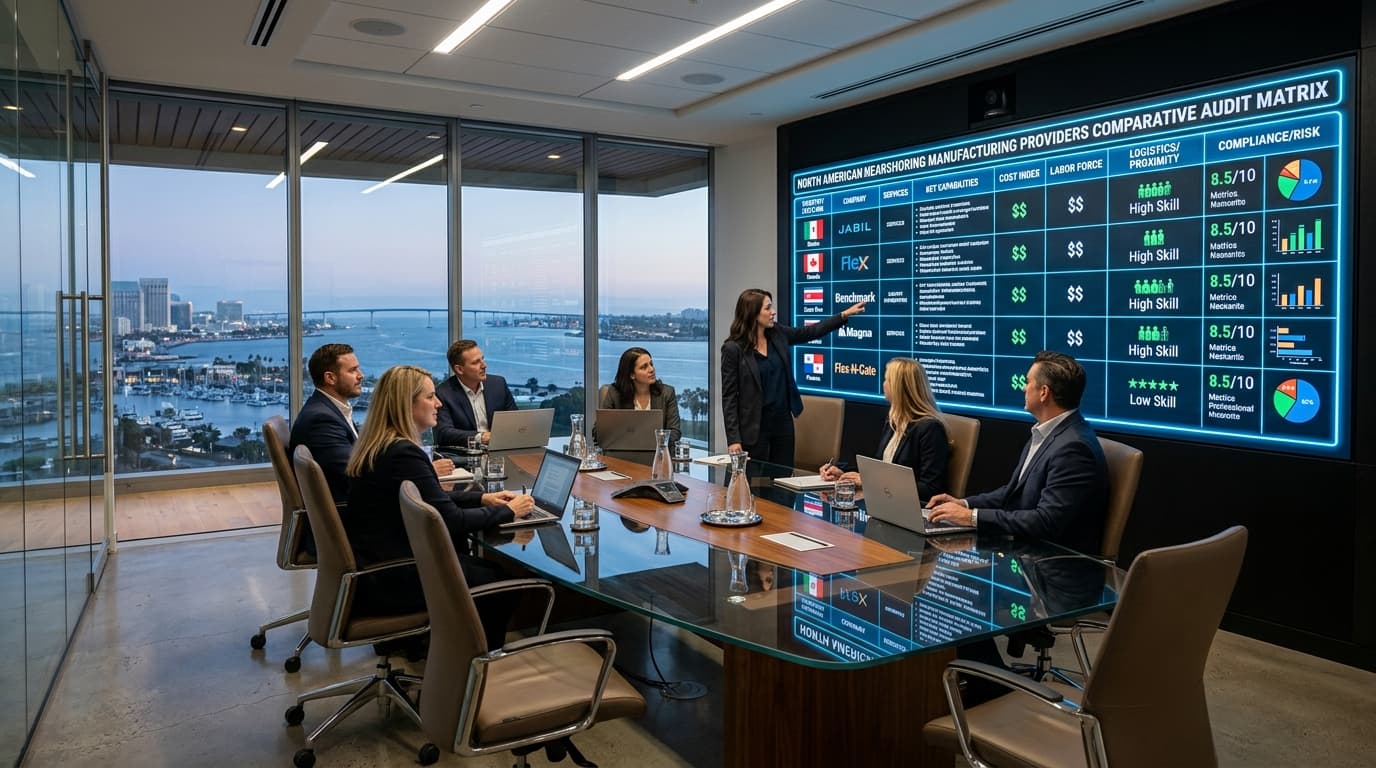
Top 10 Shelter Service Providers in Mexico: 2026 Comparative Due Diligence & Pricing Matrix
Compare Mexico's top 10 shelter providers: Tetakawi, Tecma, IVEMSA, TACNA, NAPS, American Industries, CPI, Prodensa, Entrada, Intermex. Audit markups, fees & leases.
Top 10 Shelter Service Providers in Mexico: 2026 Comparative Due Diligence & Pricing Matrix
An Independent Executive Due Diligence Audit of Mexico's Leading Manufacturing Shelter Operators, Pricing Structures, Real Estate Traps, and Fiduciary Selection Frameworks By Denisse Martinez, Founder & Principal Nearshore Advisor, Nearshore Navigator- The Nearshoring Inflection Point: Amid tightening United States-Mexico-Canada Agreement (USMCA) regional value content rules and heightened regulatory enforcement under Mexico's Tax Administration Service (SAT), shelter service providers manage more than $45 billion in annual manufactured exports across automotive, aerospace, medical device, and electronics sectors.
- Bundled vs. Unbundled Structural Divide: Mexican shelter operators divide into two distinct operating architectures: bundled campus landlords (who monetize proprietary industrial real estate alongside administration) and unbundled administrative fiduciaries (who operate on pure pass-through accounting and direct institutional leases). Decoupling real estate from administration prevents an average 15% to 22% stealth premium on plant operations.
- Hidden Labor Burden Arbitrage: Opaque shelter contracts routinely pad statutory payroll costs by quoting flat 48% to 56% burdens against true legal burdens of 33% to 38%, generating an undisclosed $250,000 to $600,000 annual margin per 100 direct labor operators. CFOs must enforce open-book pass-through backed by monthly digital payroll XMLs (CFDI 4.0 timbrados) and official IMSS SUA payment receipts.
- Statutory Joint Liability Exposure: Under Mexican Federal Labor Law (LFT) Articles 13–15 and Federal Fiscal Code (CFF) Article 26 (Responsabilidad Solidaria), contracting with non-compliant shelter entities lacking active STPS REPSE registration triggers the total disallowance of Mexican tax deductions, 16% VAT forfeiture, and catastrophic financial fines.
- Fiduciary Advisory vs. Vendor Sales Representation: Operating under a shelter structure remains the fastest operational vehicle to launch manufacturing in Mexico (30–60 days versus 9–12 months for a standalone S.A. de C.V.). However, foreign manufacturers must utilize independent tenant representation and pre-negotiate employer substitution (patrono sustituto under LFT Article 41) to secure unencumbered exit rights. Explore our specialized Mexico Shelter Services Framework or benchmark your direct costs using our Nearshore Landed Cost Calculator.
1. Executive Summary: The 2026 Mexican Shelter Provider Landscape
Direct Answer: Mexico’s shelter service landscape in 2026 is concentrated among ten major operators managing over 100,000 manufacturing jobs. As cross-border trade accelerates under USMCA scrutiny, corporate selection hinges on two structural models: bundled real estate operators who package proprietary industrial parks, and unbundled administrative fiduciaries offering transparent pass-through accounting and direct institutional leases.
The nearshoring movement has permanently transformed Mexico from an alternative low-cost assembly hub into North America’s indispensable advanced manufacturing corridor. According to data compiled by Mexico’s National Institute of Statistics and Geography (INEGI) and the Secretariat of Economy (SE), foreign direct investment (FDI) into Mexican manufacturing surpassed $36 billion in 2025, driven by global aerospace, medical device, electronics, and automotive OEMs actively de-risking their supply chains away from Asian dependence.
Yet, as enterprise and mid-market industrial corporations deploy capital across Northern border hubs like Tijuana, Mexicali, Ciudad Juárez, and Monterrey, as well as the Bajío aerospace corridor, the operational method of market entry dictates financial return on investment (ROI). Establishing a wholly owned Mexican subsidiary (Sociedad Anónima de Capital Variable or S.A. de C.V.) requires navigating complex bureaucratic channels: securing an independent IMMEX license, obtaining SAT AAA VAT/IEPS certification, procuring local environmental and municipal operational permits, and executing union collective bargaining agreements under Mexico's reformed Federal Labor Law. This standalone route routinely consumes 9 to 14 months and millions of dollars in front-loaded compliance, legal, and fiscal overhead.
To circumvent this initial administrative drag, foreign manufacturers overwhelmingly rely on Mexican Shelter Service Providers. Under a shelter program, an established Mexican administrative umbrella entity serves as the legal and statutory employer of record, holds the IMMEX program and AAA VAT certification, and manages accounting, human resources, trade compliance, and government relations. The foreign manufacturing principal retains 100% ownership and operational control over its proprietary equipment, tooling, production processes, engineering, intellectual property, and supply chain. Production launches within 30 to 60 days following facility occupancy.
However, the rapid commercial expansion of shelter services has exposed sharp structural disparities across provider business models. Corporate buyers are frequently blinded by polished sales presentations, failing to distinguish between:
In an era of intensified trade compliance—marked by the upcoming USMCA Joint Review, the abolition of general labor outsourcing under the 2021 Labor Reform (LFT Articles 13–15), and aggressive SAT digital audits utilizing automated Annex 24 and Annex 30 reconciliations—selecting a shelter partner is no longer a simple transactional procurement task. It is a critical corporate governance decision involving multimillion-dollar balance sheet exposure. This 2026 comparative matrix provides CFOs, General Counsel, and Vice Presidents of Supply Chain with an objective, forensic evaluation of Mexico's top 10 shelter providers.
2. What Is a Shelter Company in Mexico & Why US Manufacturers Use Them
Direct Answer: A Mexican shelter company is a legal entity holding an approved IMMEX program and AAA VAT certification, allowing foreign manufacturers to import raw materials and equipment duty-free without establishing a permanent establishment under Mexican Income Tax Law Articles 181–182. The shelter assumes legal, labor, and customs compliance, enabling operational launch within 30 to 60 days.
The concept of the "shelter" manufacturing model originated in the 1960s alongside Mexico’s Maquiladora framework (now formalized as the IMMEX program). Unlike contract manufacturing (CM) or original equipment manufacturing (OEM) partnerships—where a third-party factory owns the manufacturing assets and manufactures finished goods to client specifications—the shelter model is an administrative and legal vehicle designed specifically to insulate a foreign manufacturing company from foreign legal and fiscal liability while allowing it to retain complete technical control.
``` +-------------------------------------------------------------------------------+ | THE MEXICAN SHELTER OPERATING MODEL | +-------------------------------------------------------------------------------+ | | | FOREIGN PARENT COMPANY (US / EU / ASIA) | | - 100% Ownership of Capital Equipment, Tooling & IP | | - Complete Operational, Quality & Production Management | | - Selection & Supply Chain Sourcing of Raw Materials | | - Direct Supervision of Technical Plant Processes | | | +---------------------------------------+---------------------------------------+ | (Commercial Manufacturing Agreement) v +-------------------------------------------------------------------------------+ | MEXICAN SHELTER COMPANY (LEGAL ENTITY OF RECORD) | | - Legal Holder of IMMEX License & AAA VAT/IEPS Certification (SAT) | | - Employer of Record (Labor Contracts, Payroll, IMSS, INFONAVIT, REPSE) | | - Customs Brokerage & Import/Export Compliance (Annex 24 / Annex 30) | | - Local Regulatory, Environmental (SEMARNAT) & Municipal Permitting | | - Corporate Permanent Establishment (PE) Statutory Shield (LISR Art. 181) | +-------------------------------------------------------------------------------+ ```
The Three Statutory Pillars of Mexico's Shelter Framework
To understand why enterprise manufacturers leverage shelter services rather than incorporating immediate subsidiaries, executive teams must examine the three primary statutory pillars established under Mexican trade and tax legislation:
1. The IMMEX Program & AAA VAT/IEPS Certification Shield
Under Article 3 and Article 33 of the Decree for the Promotion of the Manufacturing, Maquiladora and Export Services Industry (Decree IMMEX), certified shelter companies are authorized to temporarily import foreign raw materials, components, tooling, machinery, and production equipment into Mexico without paying the General Import Tax (IGI) or compensatory duties, provided the finished goods are exported within statutory timeframes (typically 18 months under Ley Aduanera Article 108).Crucially, under Article 28-A of Mexico's Value Added Tax Law (Ley del Impuesto al Valor Agregado or LIVA), imports into Mexico incur a mandatory 16% Value Added Tax (IVA). For a high-volume manufacturing operation consuming $50 million in imported raw materials and capital equipment annually, paying this 16% IVA upfront at the port of entry would impose an intolerable $8 million cash-flow drag. Shelter operators hold SAT-approved AAA VAT/IEPS Certifications, which provide an immediate 100% tax credit on the temporary import pedimento. The 16% IVA is credited instantly in SAT's Automated Fiscal Credit Control System (Sistema de Control de Cuentas de Créditos y Garantías or SCCC-VE), eliminating cash outlays entirely.
2. The Permanent Establishment (PE) Tax Shield (LISR Articles 181–182)
In international corporate tax law, establishing physical operations, placing personnel, or maintaining capital inventory inside a foreign jurisdiction creates a "Permanent Establishment" (Establecimiento Permanente), subjecting the foreign parent company's global earnings or Mexican-attributed operating profits to Mexico’s 30% corporate income tax (Impuesto Sobre la Renta - ISR).Articles 181 and 182 of the Mexican Income Tax Law (Ley del Impuesto sobre la Renta - LISR), reinforced by the United States-Mexico Bilateral Income Tax Treaty, provide an explicit statutory safe harbor for foreign principals operating through an authorized Mexican shelter company. Under these provisions, the foreign company is legally shielded from creating a taxable Permanent Establishment in Mexico. The shelter entity satisfies Mexican corporate income tax obligations on behalf of the operation by utilizing a statutory safe-harbor transfer pricing methodology—calculating taxable income as the greater of:
By operating through a certified shelter, foreign corporations legally insulate their headquarters balance sheet from Mexican tax authority audits and transfer pricing challenges.
3. Complete Workforce Administration & REPSE Compliance
Under Mexico's comprehensive 2021 Labor Subcontracting Reform, general labor outsourcing and personnel dispatching were banned across Mexico. Third-party labor provision is strictly restricted to "specialized services" under Mexican Federal Labor Law (Ley Federal del Trabajo - LFT) Articles 13, 14, and 15.A legitimate shelter operator is registered as a specialized service provider on the Secretariat of Labor and Social Welfare's (Secretaría del Trabajo y Previsión Social - STPS) national registry (REPSE). The shelter acts as the direct, legal employer of all direct labor operators, line supervisors, material handlers, and administrative staff. It assumes statutory liability for:
Operational Comparison: Standalone Entity vs. Contract Manufacturing vs. Shelter
To illustrate why corporations utilize shelter services during their initial nearshoring deployment, the following structured comparison contrasts the three core market entry pathways:
| Evaluation Criteria | Standalone Subsidiary (S.A. de C.V.) | Contract Manufacturing (OEM/CM) | Shelter Service Model (Fiduciary) |
|---|---|---|---|
| Operational Launch Speed | 9 to 14 Months (Lengthy setup) | 30 to 60 Days (Immediate) | 30 to 60 Days (Rapid deployment) |
| Asset & Equipment Ownership | 100% Owned by Client Subsidiary | 100% Owned by Third-Party CM | 100% Owned by Foreign Principal |
| Intellectual Property Protection | Absolute (Direct internal control) | Low-Moderate (Vendor IP exposure) | Absolute (Proprietary ring-fencing) |
| Quality & Engineering Control | 100% Client Managed | Vendor Dictated / SLA Dependent | 100% Client Managed & Supervised |
| Customs & Regulatory Liability | Client Directly Exposed to SAT | Vendor Absorbs Operations | Shared / Administered by Shelter |
| Permanent Establishment Shield | No (Direct 30% ISR tax nexus) | Not Applicable | Yes (Statutory LISR Art. 181-182) |
| IMMEX & AAA VAT Certification | 6–9 Month Application Process | Leverages Vendor Licensure | Immediate (Under Shelter Umbrella) |
| Exit Flexibility & Real Estate | High Exit Drag (Entity liquidation) | Contractual Notice (30–90 days) | High (Direct lease unbundling) |
| Long-Term Cost Efficiency | Highest at >300 Operators | Built-in Vendor Profit Margin (20%+) | Optimized at 30 to 300 Operators |
3. The 2026 Top 10 Shelter Provider Comparative Matrix
Direct Answer: The 2026 top ten Mexican shelter matrix evaluates providers across regional footprint, real estate independence, pricing architecture, and audit transparency. Leading operators fall into two tiers: unbundled fiduciaries like IVEMSA, TACNA, and NAPS providing open-book pass-through accounting, versus campus or real estate developers like Tetakawi, American Industries, and Entrada utilizing bundled space-and-service contracts.
The following comparative due diligence matrix benchmarks the ten largest and most established manufacturing shelter service providers in Mexico. Data reflects audited 2025–2026 operational filings, regional footprint concentrations, real estate lease structures, administrative pricing architectures, and independent transparency assessments conducted by Nearshore Navigator.
2026 Comparative Matrix: Top 10 Mexican Shelter Providers
| # | Provider Name | Founded / Scale | Core Regional Footprint | Real Estate Operating Model | Administrative Pricing Model | Primary Industry Verticals | Standalone Transition Path | Transparency Rating |
|---|---|---|---|---|---|---|---|---|
| 1 | Tetakawi | 1986 24,000+ Emps 75+ Plants | Guaymas/Empalme, Hermosillo, Saltillo, Querétaro, Mazatlán | Bundled (Proprietary industrial parks) | Composite rate or bundled sqft + per-headcount charge ($220–$350+/emp/mo) | Aerospace, Automotive Tier-1, Medical, Precision Machining | High Friction (Campus lease lock-in) | Tier 2 (Moderate / Bundled) |
| 2 | The Tecma Group | 1986 10,000+ Emps 75+ Plants | Ciudad Juárez, Tijuana, Torreón, Monterrey, Silao | Hybrid (Master lease & standalone third-party) | Per-headcount hourly fee or fixed monthly ($175–$275/emp/mo) | Medical Devices, Electronics, Automotive, Packaging | Moderate (Dependent on facility lease terms) | Tier 2 (Moderate-High) |
| 3 | IVEMSA | 1982 8,000+ Emps 45+ Plants | Tijuana, Mexicali, Querétaro, San Luis Potosí, Hermosillo | Unbundled / Decoupled (Pure tenant representation) | Pure Pass-Through + Fixed Fee per operator ($160–$250/emp/mo) | Medical (ISO 13485), Aerospace (AS9100), Precision Electronics | Seamless (Guaranteed contractual pathway) | Tier 1 (High / Open-Book) |
| 4 | TACNA Services | 1983 8,000+ Emps 60+ Plants | Tijuana, Mexicali, Tecate, Rosarito, Ensenada | Unbundled / Decoupled (Direct third-party leases) | Cost-Plus with transparent administrative surcharge or fixed fee | Precision Metal, Injection Molding, Electronics, Consumer Goods | Seamless (Standardized employer substitution) | Tier 1 (High / Open-Book) |
| 5 | NAPS (North American Production Sharing) | 1991 10,000+ Emps 80+ Plants | Tijuana, Mexicali, Juárez, Monterrey, Querétaro, Bajío | 100% Unbundled (Pure administration; zero RE ownership) | Fixed monthly fee per operator tier ($180–$280/emp/mo) | Automotive Tier-1/2, Medical Devices, Aerospace, Industrial | Seamless (Structured graduation covenants) | Tier 1 (High / Open-Book) |
| 6 | American Industries Group | 1976 15,000+ Emps 100+ Plants | Chihuahua, Juárez, Monterrey, Querétaro, Guanajuato, SLP | Bundled Developer (Owns 15M+ sqft industrial space) | Blended real estate lease + shelter administrative fee | Automotive OEM, Aerospace, Heavy Machinery, Metal-Mechanic | Moderate-Low (Complex lease disentanglement) | Tier 2 (Moderate / Developer) |
| 7 | Co-Production International (CPI) | 1979 4,500+ Emps 35+ Plants | Tijuana, Mexicali, Hermosillo, Guadalajara, Monterrey | Unbundled / Decoupled (Independent REIT leases) | Fixed administrative fee per operator ($170–$260/emp/mo) | Medical Devices, Clean Tech, Electronics, Aerospace Aftermarket | High (Explicit focus on standalone graduation) | Tier 1 (High / Open-Book) |
| 8 | Prodensa | 1985 12,000+ Emps 1,000+ Projects | Monterrey (HQ), Saltillo, Bajío, Ciudad Juárez, Tijuana | Advisory / Decoupled (Site selection & tenant rep) | Enterprise retainer + per-headcount consulting/shelter fee | Automotive Tier-1, Heavy Industrial, Clean Tech, Appliances | High (Advisory-led corporate transition) | Tier 1 (High / Institutional) |
| 9 | Entrada Group | 2001 5,000+ Emps 30+ Plants | Zacatecas (Fresnillo Park), Celaya / Guanajuato (Bajío) | Bundled Campus (Proprietary shared services parks) | All-inclusive campus rate (Facility sqft + shared overhead + admin) | Automotive Components, Precision Machining, Industrial Valves | Low (Tied to proprietary industrial campuses) | Tier 2 (Moderate / Campus) |
| 10 | Intermex | 1971 6,000+ Emps 50+ Plants | Chihuahua, Ciudad Juárez, Monterrey, Guadalajara | Bundled Developer (General contractor & park owner) | Bundled industrial lease rate + shelter administrative fee | Aerospace, Heavy Metal Stamping, Automotive Assemblies | Low (Real estate asset lock-in) | Tier 2 (Moderate / Developer) |
Key Takeaways from the 2026 Matrix
An analytical review of the 2026 matrix reveals three critical structural trends:
4. Detailed Provider Profiles: Strengths, Limitations & Ideal Use Cases
Direct Answer: Selecting among Mexico’s top ten shelter providers requires aligning enterprise scale, geographic supply chains, and real estate flexibility. While enterprise operators like Tetakawi and American Industries excel in large aerospace build-to-suits, regional specialists like IVEMSA, TACNA, and NAPS deliver superior contract transparency, unbundled tenant representation, and seamless transition pathways to standalone IMMEX operations.
To empower corporate executive committees with actionable due diligence intelligence, the following detailed profiles evaluate the operational strengths, inherent limitations, and ideal corporate profiles for each of the top 10 Mexican shelter providers.
4.1 Tetakawi (Formerly The Offshore Group)
Operational Overview & Core Architecture
Tetakawi is the largest manufacturing shelter company in Mexico by total square footage and direct employee headcount. Operating for nearly four decades, Tetakawi’s defining characteristic is its proprietary industrial campus model. The company owns and operates fully master-planned industrial parks equipped with proprietary electrical substations, water treatment facilities, dedicated fire stations, on-site medical clinics, and centralized security infrastructure. Tetakawi specializes in large-scale aerospace (AS9100), automotive Tier-1, and precision machining manufacturing clusters.Key Operational Strengths
Strategic Limitations & Drawbacks
Ideal Executive Fit
Enterprise-level aerospace, automotive, or medical OEMs scaling operations to 300–1,500+ employees who require guaranteed high-megawatt electrical infrastructure and a fully self-contained campus in Sonora or Coahuila, and who plan to remain permanently under a shelter umbrella.4.2 The Tecma Group
Operational Overview & Core Architecture
The Tecma Group is a cornerstone of the El Paso–Ciudad Juárez cross-border industrial corridor. Founded on the "Tecma Shelter Program," the firm provides a full suite of administrative services while operating extensive cross-border warehousing, 3PL trucking, and US customs brokerage operations in El Paso. Tecma has expanded aggressively beyond its Chihuahua roots, establishing satellite shelter hubs in Tijuana, Torreón, and Central Mexico.Key Operational Strengths
Strategic Limitations & Drawbacks
Ideal Executive Fit
Mid-sized to enterprise US manufacturers whose supply chains demand immediate, daily integration with Texas interstate freight corridors (I-10), requiring integrated US warehousing, CBP brokerage, and robust labor management in Ciudad Juárez.4.3 IVEMSA
Operational Overview & Core Architecture
IVEMSA is widely recognized among trade compliance attorneys and CFOs as the pioneer of the unbundled, open-book fiduciary shelter model in Mexico. Celebrating over 40 years of continuous operations, IVEMSA deliberately owns zero industrial real estate. Instead, the firm acts as an uncompromised fiduciary tenant advocate, assisting clients in negotiating direct, institutional triple-net (NNN) leases with third-party industrial REITs (such as Prologis, Finsa, and Terrafina). IVEMSA’s hallmark is complete financial transparency, passing all direct labor, statutory taxes, and utility costs through at exact invoice cost, supported by a fixed monthly administrative fee per employee.Key Operational Strengths
Strategic Limitations & Drawbacks
Ideal Executive Fit
CFOs, General Counsel, and mid-to-large manufacturers ($20M to $500M revenue) in medical devices, aerospace, and precision technology who demand 100% open-book accounting, unbundled real estate independence, and a guaranteed long-term pathway to a standalone Mexican subsidiary.4.4 TACNA Services
Operational Overview & Core Architecture
TACNA Services is the dominant regional shelter provider across the Baja California manufacturing corridor. Headquartered directly on the US-Mexico border in San Diego, TACNA has perfected cross-border administrative integration for West Coast manufacturers. The firm operates on an unbundled, cost-plus accounting model, providing turnkey administrative, human resources, trade compliance, and accounting services, while coordinating daily freight drayage through the Otay Mesa, Tecate, and Calexico commercial ports of entry.Key Operational Strengths
Strategic Limitations & Drawbacks
Ideal Executive Fit
California and Western US manufacturers seeking rapid, low-friction manufacturing deployment in Tijuana, Tecate, or Mexicali, who prioritize direct access to San Diego executive management, cost-plus accounting, and same-day cross-border logistics.4.5 North American Production Sharing (NAPS)
Operational Overview & Core Architecture
North American Production Sharing (NAPS) is an elite, national-scale administrative shelter provider. NAPS operates exclusively on a pure administrative model, deliberately avoiding real estate ownership or master-leasing arrangements. NAPS is distinguished by its proprietary, cloud-based enterprise compliance portal, which provides multinational clients with real-time digital visibility into Mexican payroll processing, human resources KPIs, customs inventory balances (Annex 24), and financial accounting reports.Key Operational Strengths
Strategic Limitations & Drawbacks
Ideal Executive Fit
Mid-market to Fortune 500 manufacturing corporations demanding enterprise-grade software visibility, multi-site Mexican expansion options, strict corporate governance, and zero real estate entanglements.4.6 American Industries Group
Operational Overview & Core Architecture
American Industries Group is a pioneer of Mexico’s industrial development landscape. Founded by industrialist Don Alberto Lara, the company is both a major industrial real estate developer (owning and managing more than 15 million square feet of Class A industrial inventory across dozens of industrial parks) and a full-service shelter provider. American Industries specializes in facilitating massive, complex industrial expansions for global automotive OEMs, Tier-1 aerospace suppliers, and heavy industrial machinery manufacturers.Key Operational Strengths
Strategic Limitations & Drawbacks
Ideal Executive Fit
Multinational automotive, aerospace, or heavy industrial conglomerates requiring massive build-to-suit manufacturing facilities requiring landlord-provided capital expenditure financing, with a long-term commitment to remaining in Northern or Central Mexico.4.7 Co-Production International (CPI)
Operational Overview & Core Architecture
Co-Production International (CPI) is a high-touch, boutique manufacturing shelter provider with over four decades of operational history along the US-Mexico border. CPI specializes in providing turnkey operational setups, site selection, and administrative management for mid-sized North American and European manufacturers. CPI deliberately distinguishes itself through its deliberate graduation philosophy, openly encouraging and structuring shelter agreements designed to transition clients into fully independent, standalone Mexican subsidiaries within 3 to 5 years.Key Operational Strengths
Strategic Limitations & Drawbacks
Ideal Executive Fit
Mid-market manufacturing enterprises ($15M to $100M revenue) in medical devices, clean technology, and precision electronics seeking rapid 60-day market entry with executive-level guidance and a pre-planned 3-year migration strategy to a standalone Mexican entity.4.8 Prodensa
Operational Overview & Core Architecture
Prodensa is Mexico's premier industrial advisory and shelter hybrid firm. Rooted in Monterrey—the industrial manufacturing capital of Mexico—Prodensa has advised more than 1,000 corporate expansion projects representing over $15 billion in capital investment. Prodensa operates on an unbundled, advisory-driven model, offering specialized site-selection analytics, supply chain localization, project management, and ongoing administrative shelter shared services.Key Operational Strengths
Strategic Limitations & Drawbacks
Ideal Executive Fit
Tier-1 automotive suppliers, capital equipment manufacturers, and global enterprises evaluating multi-state Mexican site selections, complex USMCA supply chain restructuring, and large-scale manufacturing operations in Monterrey, Saltillo, or the Bajío.4.9 Entrada Group
Operational Overview & Core Architecture
The Entrada Group operates on a specialized shared-services manufacturing campus model in Central Mexico. Rather than scattering client facilities across urban border markets, Entrada establishes consolidated, proprietary industrial manufacturing parks in secondary industrial regions—most notably in Fresnillo, Zacatecas, and Celaya, Guanajuato. Within these campuses, Entrada provides all physical infrastructure, administrative shared services, central security, dining facilities, and human resources administration, allowing mid-sized European and North American manufacturers to operate in low-cost, low-turnover regional environments.Key Operational Strengths
Strategic Limitations & Drawbacks
Ideal Executive Fit
Small-to-mid-sized European and North American manufacturers ($10M to $75M revenue) producing medium-to-high mix, labor-intensive components where minimizing labor turnover and hourly wages outweighs the logistics convenience of the US border.4.10 Intermex
Operational Overview & Core Architecture
Intermex is one of the oldest and most established industrial developers in Northern Mexico, tracing its origins back to the foundational days of the Maquiladora program in 1971. The company operates as a vertically integrated industrial park owner, general construction contractor, and shelter service provider. Intermex has developed more than 300 manufacturing facilities totaling over 12 million square feet, with extensive land reserves and master-planned parks across Chihuahua, Juárez, and Monterrey.Key Operational Strengths
Strategic Limitations & Drawbacks
Ideal Executive Fit
Heavy manufacturing, aerospace stamping, or industrial equipment companies requiring extensive building customizations, high electrical power capacity, and specialized structural engineering in Chihuahua or Ciudad Juárez.5. Hidden Labor Markups vs Pass-Through Pricing: How to Audit Shelter Proposals
Direct Answer: Shelter proposals often conceal 12% to 18% profit margins inside inflated payroll burdens, billing clients flat 48% to 56% burden rates against actual statutory costs of 33% to 38%. To prevent fraud and REPSE joint liability under Federal Labor Law Articles 13–15, CFOs must mandate open-book pass-through pricing audited against monthly digital CFDI payroll vouchers.
When evaluating Mexican shelter proposals, corporate CFOs and procurement directors are frequently misled by low stated administrative fees. A shelter operator may advertise an attractive management fee of $175 per employee per month, appearing significantly cheaper than a competitor quoting $250 per employee per month.
However, forensic contract audits consistently reveal that low-fee operators frequently recoup their margins by inflating direct labor burden markups—creating a hidden profit center that extracts hundreds of thousands of dollars in undisclosed revenue.
The Anatomy of Mexican Direct Labor Burden
To detect hidden markups, corporate executives must understand the precise statutory components that constitute legal payroll burden in Mexico. Direct labor costs consist of the base daily wage (Salario Diario) and statutory benefits integrated into the Integrated Daily Wage (Salario Diario Integrado - SDI), plus employer payroll taxes:
``` +-------------------------------------------------------------------------------+ | TRUE STATUTORY LABOR BURDEN IN MEXICO | +-------------------------------------------------------------------------------+ | STATUTORY MANDATE | TYPICAL EFFECTIVE COST (% BASE)| | --------------------------------------------+--------------------------------| | 1. IMSS Employer Social Security Quotas | 18.5% - 22.5% (Capped at 25 UMA| | 2. INFONAVIT Housing Contribution | 5.00% (Mandatory federal levy) | | 3. SAR Retirement Savings Fund | 2.00% (Mandatory federal levy) | | 4. Mandatory Christmas Bonus (Aguinaldo) | 4.11% (15 days minimum base) | | 5. Statutory Vacation Premium (25%+) | 0.82% - 1.64% (Years 1 to 5) | | 6. State Payroll Tax (ISN) | 2.50% - 4.00% (State specific) | | 7. Statutory Paid Holidays & Sundays | 2.50% - 3.50% (LFT statutory) | | --------------------------------------------+--------------------------------| | TRUE EFFECTIVE STATUTORY LABOR BURDEN: | 34.5% - 39.5% | +-------------------------------------------------------------------------------+ ```
Depending on the operational worker turnover rate, occupational risk classification at IMSS (Prima de Riesgo de Trabajo under IMSS Regulation Article 72), and the specific state payroll tax (e.g., 4.0% in Baja California, 3.0% in Nuevo León, 3.0% in Chihuahua), the true statutory burden for a Mexican manufacturing operator ranges strictly between 33.0% and 39.5%.
The "Black Box" Labor Burden Padding Scheme
In an opaque, bundled shelter agreement, the operator quotes a "flat, all-inclusive payroll burden rate" of 48% to 56% on top of gross operator wages, claiming this covers all statutory taxes, benefits, and administrative handling.
The mathematical reality of this flat rate represents a massive, undisclosed financial extraction:
Financial Impact Modeling: 150-Operator Manufacturing Facility
To illustrate the balance sheet destruction caused by burden padding, examine the financial comparison below for a mid-sized facility employing 150 direct operators earning a competitive border wage:
| Direct Labor Cost Component | Open-Book Pass-Through Model (IVEMSA / NAPS / TACNA) | Opaque "Black Box" Flat Burden Model (Bundled Operators) | Variance (Hidden Arbitrage Leakage) |
|---|---|---|---|
| Direct Operator Headcount | 150 Operators | 150 Operators | — |
| Average Base Wage per Hour | $4.80 USD / Hour | $4.80 USD / Hour | Identical |
| Annual Direct Base Wages (48 hrs/wk) | $1,797,120 USD | $1,797,120 USD | Identical |
| Billed Labor Burden Percentage | 35.5% (Actual statutory pass-through) | 52.0% (Flat black-box contractual rate) | +16.5% Hidden Burden Inflation |
| Annual Billed Labor Burden | $637,978 USD | $934,502 USD | +$296,524 USD Overpayment |
| Stated Annual Administrative Fee | $405,000 USD ($225/emp/mo) | $270,000 USD ($150/emp/mo advertised) | -$135,000 USD "Perceived Savings" |
| Total Annual Cost (Labor + Admin) | $2,840,098 USD | $3,001,622 USD | +$161,524 USD Net Loss |
| 5-Year Compounded Cost Disadvantage | $14,200,490 USD | $15,008,110 USD | +$807,620 USD Undisclosed Profit |
REPSE Subcontracting Compliance & Joint Liability (Responsabilidad Solidaria)
Under Mexico's 2021 Labor Subcontracting Reform, executing an agreement with an uncertified or non-compliant labor provider carries severe statutory penalties under Mexican law:
The 5-Point CFO Labor Audit Protocol
Before signing or renewing any shelter agreement, corporate financial leadership must incorporate the following mandatory audit covenants:
6. Bundled Real Estate vs Independent Tenant Representation: The Real Estate Trap
Direct Answer: Bundled real estate agreements allow shelter operators to act as master landlords, marking up industrial triple-net lease rates by $0.15 to $0.35 per square foot monthly and amortizing tenant improvements at inflated rates. This structure creates substantial exit friction, effectively preventing manufacturers from transitioning to standalone IMMEX entities without paying catastrophic plant relocation or lease breakage costs.
The most pervasive and financially damaging risk facing foreign manufacturers entering Mexico is the Shelter Real Estate Trap. This occurs when a shelter operator bundles industrial building leasing, facility maintenance, and administrative services into a single monolithic contract.
While bundled contracts are marketed as "turnkey convenience," they structurally align the shelter operator’s financial incentives against the manufacturing client.
``` +-------------------------------------------------------------------------------+ | THE SHELTER REAL ESTATE TRAP | +-------------------------------------------------------------------------------+ | | | BUNDLED OPERATOR / PARK DEVELOPER | | - Owns or Master-Leases Industrial Facility | | - Marks up NNN Rent by $0.15 - $0.35/sqft/month | | - Amortizes Tenant Improvements (TI) at 14% - 18% Imputed Interest | | - Retains Absolute Control of Facility Lease Assignment | | | +---------------------------------------+---------------------------------------+ | (Holds Building Occupancy Hostage) v +-------------------------------------------------------------------------------+ | MANUFACTURING CLIENT AT CONTRACT TERMINATION | | - Desires to Graduate to Standalone IMMEX (S.A. de C.V.) | | - BUNDLED DILEMMA: | | * Option A: Pay exorbitant lease buyout / penalty fees to stay. | | * Option B: Relocate entire physical factory to a new building | | (Losing workforce, re-certifying cleanrooms, incurring $1M+ capex). | +-------------------------------------------------------------------------------+ ```
The Three Financial Pitfalls of Bundled Leases
1. Triple-Net (NNN) Rental Rate Markups
In an unbundled scenario, an institutional tenant represented by an independent broker negotiates a direct lease with institutional REITs (e.g., Prologis, Finsa, Vesta, CPA, Terrafina). In 2026, prime Class A industrial space in Tijuana commands approximately $0.72 to $0.85 per square foot monthly NNN (depending on submarket and power capacity).In a bundled shelter contract, the operator acts as a master lessee or proprietary landlord, quoting an "all-inclusive facility and administration charge" or marking up the lease to $0.95 to $1.15 per square foot monthly. On a standard 75,000-square-foot manufacturing plant, a $0.25/sqft monthly markup extracts $18,750 per month ($225,000 annually) in excess rent over market rates.
2. Tenant Improvement (TI) Financing Arbitrage
Manufacturing facilities require specialized capital improvements: heavy electrical substations, compressed air loops, ESD flooring, HVAC, and cleanrooms (ISO Class 7 or 8).Bundled shelter operators frequently finance these tenant improvements directly, embedding the amortization into the monthly building charge. However, forensic audits reveal that shelters routinely apply 14% to 18% imputed annual interest rates on TI capital, while charging an additional 15% "project management oversight fee" on construction contractors. When the client completes its initial 3-to-5 year contract term, the shelter retains ownership of the underlying building infrastructure.
3. The "Exit Hostage" & Standalone Graduation Blockade
The most severe danger of bundled real estate emerges when a manufacturing client scales beyond 200–300 operators and determines that incorporating a wholly owned Mexican subsidiary (S.A. de C.V.) is financially optimal.When the client attempts to uncouple administrative shelter services from the facility, the bundled shelter operator exercises its contractual leverage:
The Solution: Independent Tenant Representation & Tripartite Leases
To eliminate real estate lock-in, corporate executives must adhere to a strict rule of engagement: Never permit a shelter provider to act as your landlord or master lessee.
Corporate leadership must structure facility acquisitions utilizing an Unbundled Tripartite Framework:
7. 5-Step Due Diligence Protocol for Selecting a Mexican Shelter Partner
Direct Answer: A comprehensive five-step due diligence protocol requires auditing labor pass-through rates, unbundling industrial leases via direct tripartite agreements, verifying active REPSE registrations and SAT 32-D tax standing, validating Annex 24 and Annex 30 customs reconciliations, and formalizing employer substitution transition terms under Federal Labor Law Article 41 before executing binding Mexican manufacturing contracts.
Selecting a Mexican shelter partner requires a forensic, multi-disciplinary corporate due diligence protocol. CFOs, General Counsel, and Vice Presidents of Supply Chain must execute the following five-step protocol before entering into commercial negotiations:
``` +-------------------------------------------------------------------------------+ | 5-STEP CORPORATE DUE DILIGENCE PROTOCOL FOR SHELTER SELECTION | +-------------------------------------------------------------------------------+ | | | [STEP 1] Audit Labor Pass-Through & Mandate CFDI 4.0 Timbrados | | | - Eliminate flat burden rates (48%-56%) | | | - Enforce 100% open-book pass-through (33%-38% true burden) | | v | | [STEP 2] Decouple Industrial Real Estate via Tripartite Leases | | | - Direct lease with institutional REIT (Prologis, Finsa, Vesta) | | | - Pre-negotiated, zero-fee lease assignment covenants | | v | | [STEP 3] Verify REPSE, STPS & SAT Article 32-D Tax Standing | | | - Confirm active STPS specialized services registration | | | - Secure positive SAT, IMSS & INFONAVIT compliance certificates | | v | | [STEP 4] Audit Automated Customs Software (Annex 24 & Annex 30) | | | - Inspect SCCC-VE credit reconciliations to prevent VAT clawbacks | | | - Verify segregated sub-account inventory ring-fencing | | v | | [STEP 5] Contractually Codify Standalone IMMEX Transition Pathways | | - Pre-negotiate Employer Substitution (Patrono Sustituto LFT 41) | | - Virtual pedimento asset transfer mechanics (Clave V1) | | | +-------------------------------------------------------------------------------+ ```
Step 1: Mandate 100% Open-Book Labor Pass-Through and Digital Payroll Audits
Reject any proposal offering a "blended hourly billing rate" or a "flat labor burden percentage." Require the shelter candidate to contractually incorporate an open-book pass-through clause into the Master Services Agreement (MSA).The contract must obligate the shelter to deliver monthly audit packages comprising:
Step 2: Decouple Industrial Real Estate Leases via Direct Tripartite Contracts
Refuse bundled landlord-shelter proposals unless unique campus technical requirements (such as massive aerospace co-generation power) leave no alternative. Retain independent tenant representation to evaluate competing Class A parks across your target submarket.Structure the industrial real estate lease as a Tripartite Lease Agreement:
Step 3: Execute Statutory Labor (REPSE) and Tax Standing Verification (SAT 32-D)
Under LFT Article 14, corporate principals face joint liability if specialized contractors fail statutory audits. Perform exhaustive legal due diligence on the specific Mexican operating entity proposed by the shelter:Step 4: Audit Customs Management Systems (Annex 24) and Fiscal Credit Balances (Annex 30)
Under Mexico's Ley Aduanera, failure to reconcile temporarily imported raw materials against exported finished goods results in catastrophic fiscal consequences: the cancellation of AAA VAT certification, seizure of plant inventory under an Administrative Procedure in Customs Matters (Procedimiento Administrativo en Materia Aduanera - PAMA), and retroactive assessment of 16% VAT plus severe inflationary fines.Engage trade compliance counsel to audit the shelter’s customs infrastructure:
Step 5: Codify Standalone IMMEX Transition Mechanics and Workforce Substitution Terms
The ultimate measure of a shelter partner's corporate integrity is how it behaves when a client prepares to leave. Before signing the initial agreement, pre-negotiate the complete legal and operational pathway to transition to an independent Mexican subsidiary (S.A. de C.V.):8. Strategic Conclusion & Independent Advisory Recommendation
Direct Answer: Manufacturing executives must evaluate Mexican shelter partners through an independent fiduciary lens rather than accepting vendor sales collateral. While shelter partnerships drastically accelerate time-to-market and mitigate cross-border regulatory exposure, securing unbundled real estate, 100% pass-through labor accounting, and pre-negotiated standalone IMMEX exit rights is paramount to preserving long-term enterprise value and operational autonomy.
Operating under a shelter manufacturing program in Mexico remains one of the most powerful strategic levers available to North American executive leadership. By collapsing operational launch timelines from 12 months down to 30 to 60 days, providing an immediate statutory shield against Permanent Establishment tax liabilities (LISR Art. 181–182), and offering immediate 16% VAT credits under SAT AAA certifications, shelter partnerships eliminate the primary barriers to cross-border manufacturing deployment.
However, as demonstrated throughout this 2026 comparative audit, the Mexican shelter provider landscape is not homogeneous. The commercial divide between bundled real estate developers and unbundled administrative fiduciaries represents the difference between a flexible, cost-effective manufacturing operation and an expensive, legally entangled lease trap.
Executive Decision Framework: Matching Needs to Provider Profiles
To assist corporate leadership in narrowing the selection field, Nearshore Navigator recommends aligning organizational profiles with the following provider categories:
The Fiduciary Advantage: Navigating Mexico with Independent Advisory
Entering the Mexican manufacturing market should never be conducted across a negotiating table where the only counterparty is a shelter vendor selling its own industrial real estate and administrative services.
Nearshore Navigator operates as an independent corporate fiduciary. We do not own industrial parks, we do not operate shelter entities, and we do not accept undisclosed vendor placement fees. Our advisory practice provides C-Suite executives, VPs of Supply Chain, and General Counsel with:
To model your specific facility economics, utilize our interactive Nearshore Landed Cost Calculator. To schedule an executive briefing or initiate a confidential shelter due diligence audit, contact our Senior Advisory Team.
Frequently Asked Questions (FAQs)
Direct Answer: The following executive FAQ addresses the six most critical questions regarding Mexican shelter services, including operational costs, bundled versus unbundled real estate structures, statutory joint tax liability, setup timelines, standalone IMMEX transition mechanics, and regional manufacturing specialization across Mexico.
How much do shelter services typically cost in Mexico?
Shelter service costs in Mexico generally range from $160 to $280 per direct labor employee per month under an unbundled fixed-fee administrative model, or a 10% to 15% administrative fee on direct payroll in cost-plus structures. In contrast, bundled campus providers charge composite rates that blend industrial lease costs, campus maintenance, and administration, often ranging from $8.50 to $14.00 per square foot annually plus payroll markups. Companies must demand transparent pass-through billing to prevent undisclosed 12% to 18% labor burden padding.What is the difference between bundled and unbundled shelter providers in Mexico?
Bundled shelter providers own or master-lease industrial real estate and require foreign manufacturers to locate within their proprietary industrial parks, combining building rent, utilities, and administrative fees into a single invoice. Unbundled shelter providers operate solely as administrative fiduciaries, allowing manufacturers to negotiate direct, institutional triple-net leases with third-party industrial REITs (such as Prologis, Finsa, or Vesta), eliminating real estate markups and landlord conflicts of interest.Can foreign companies be held liable for a Mexican shelter company's tax or labor violations?
Yes. Under Mexican Federal Labor Law (LFT) Articles 13–15 and Federal Fiscal Code (CFF) Article 26, foreign companies face joint and several liability (Responsabilidad Solidaria) if their shelter provider lacks a valid REPSE registration or defaults on IMSS social security, INFONAVIT, or SAT tax payments. Furthermore, customs non-compliance under Ley Aduanera can trigger retroactive 16% VAT clawbacks on Annex 30 inventory.How long does it take to launch manufacturing in Mexico under a shelter program?
Operating under a Mexican shelter company allows foreign manufacturers to initiate production within 30 to 60 days of facility handover. Because the shelter provides an existing corporate entity, approved IMMEX license, AAA VAT certification, environmental permits, and active import/export programs, clients bypass the 6 to 12 months typically required to incorporate a standalone Mexican subsidiary.How do you transition from a shelter company to a standalone Mexican IMMEX entity?
Transitioning from a shelter to a standalone Mexican subsidiary (S.A. de C.V.) takes approximately 6 to 9 months and requires executing an employer substitution (Patrono Sustituto under LFT Article 41) to transfer the workforce without losing seniority or paying severances. Additionally, machinery and inventory must be virtually transferred via customs pedimentos (clave V1), and the facility lease reassigned directly.Which Mexican region is best for nearshoring manufacturing in 2026?
The optimal Mexican manufacturing region depends on industry vertical and supply chain logistics. Baja California (Tijuana and Mexicali) leads medical devices, electronics, and aerospace due to Pacific rim access and California border synergy. Ciudad Juárez and Monterrey dominate high-volume automotive, metal fabrication, and appliance manufacturing connected to Texas distribution hubs, while the Bajío excels in precision aerospace and automotive OEM supply chains.Strategic Nearshoring & Industrial Intelligence
For North American executives, CFOs, and supply chain directors evaluating cross-border manufacturing, explore our master portal on nearshoring Mexico, review Class A availability and park vacancy in our comprehensive dossier on industrial real estate Tijuana, evaluate operational risk mitigation under maquiladora advisory and shelter services, or model your exact multi-state savings using the interactive nearshore landed cost calculator.