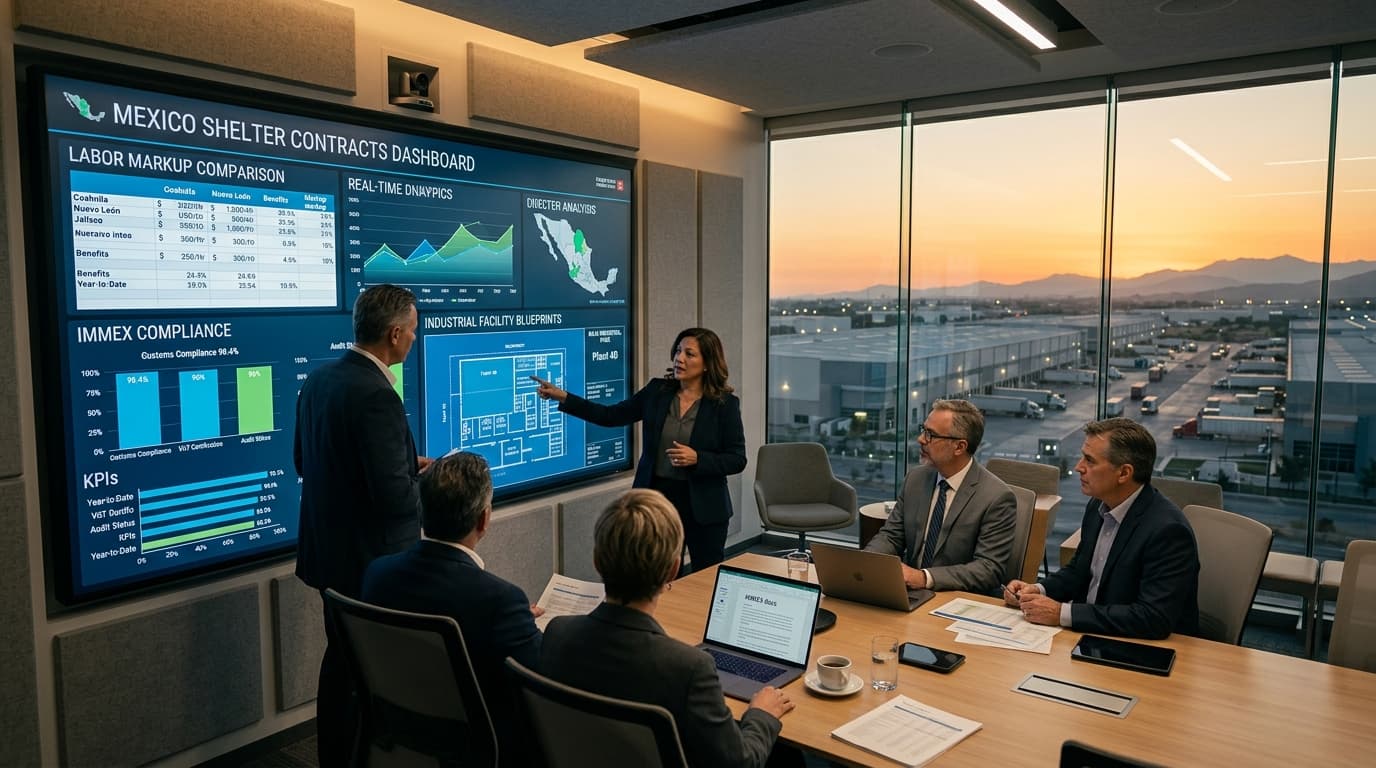
The CFO's 2026 Mexico Shelter Company Due Diligence Audit: 12 Traps, Hidden Markups & IMMEX Liability Transfer
Master Mexico shelter company due diligence. Audit hidden labor burden markups (12-18%), REPSE LFT Art. 13-15 liability, SAT Annex 24/30 clawbacks, and direct leases.
The CFO's 2026 Mexico Shelter Company Due Diligence Audit: 12 Traps, Hidden Markups & IMMEX Liability Transfer
A Forensic Guide for CFOs, General Counsel, and Supply Chain Leaders on Contract Transparency, REPSE Subcontracting Exposure, SCCC-VE Tax Clawbacks, and Unbundled Industrial Leases
By Denisse Martinez, Senior Technical SEO & Trade Compliance Specialist, Nearshore Navigator
- The Fiduciary Disconnect: Mexican shelter manufacturing models remain the fastest, most effective vehicle for nearshoring production to Mexico, collapsing time-to-market from 12 months down to 30–60 days. However, opaque "black-box" contracts frequently disguise 12% to 18% hidden labor burden markups, $0.15–$0.35/sqft monthly real estate markups, and severe joint tax liabilities.
- Labor Law Liability (LFT Articles 13–15): The 2021 Subcontracting Reform eliminated generic staffing outsourcing in Mexico. Contracting with an uncertified or non-compliant shelter triggers fines up to 50,000 UMA ($5.4M+ MXN), complete disallowance of Mexican income tax deductions (LISR Art. 27-V), loss of VAT credits, and potential felony tax fraud prosecution (defraudación fiscal calificada under CFF Art. 108).
- Customs & SCCC-VE Clawbacks: Under Ley Aduanera Article 108, temporarily imported raw materials have an 18-month stay limit. Failures in Annex 24 software or Annex 30 SCCC-VE fiscal credit reconciliations trigger automatic retroactive 16% VAT clawbacks, severe fines, and joint personal executive liability under CFF Article 26 (Responsabilidad Solidaria).
- Real Estate Bundling: Shelters acting as lease intermediaries routinely mark up triple-net (NNN) rates and amortize tenant improvements (TI) at double-digit imputed interest rates, while holding facility occupancy hostage during contract disputes.
- Fiduciary Advisory vs. Vendor Pitches: Foreign corporate leadership must decouple administrative services, insist on 100% open-book pass-through accounting, execute direct institutional developer leases, and conduct independent third-party audits before signing any shelter agreement. Explore our comprehensive Mexico Shelter Services Framework or model operational scenarios with our interactive Nearshore Landed Cost Calculator.
Executive Summary: The True Economics of Mexico Shelter Partnerships
Direct Answer: Mexico shelter companies allow foreign manufacturers to operate under an umbrella IMMEX and AAA VAT certification without establishing a Mexican corporate entity. However, opaque shelter agreements often disguise inflated labor burdens, landlord lease markups, and shared tax liabilities. CFOs must conduct rigorous due diligence to secure transparent, open-book pricing and eliminate statutory tax and labor clawbacks.
For enterprise and mid-market Chief Financial Officers (CFOs), the commercial logic of nearshoring manufacturing to Mexico is undeniable. With North American freight transit times measured in days rather than weeks, zero tariffs under the United States-Mexico-Canada Agreement (USMCA) for qualifying goods, and highly skilled direct manufacturing labor available at competitive regional rates, expanding operations across northern industrial corridors like Tijuana, Mexicali, Ciudad Juárez, and Monterrey represents an unparalleled strategic lever.
Yet, when cross-border manufacturing initiatives reach the finance and legal committees, CFOs and General Counsel routinely hesitate.
This hesitation is neither irrational nor unfounded. Experienced corporate finance leaders recognize that the traditional Mexican "shelter company" sales pitch—promising a completely frictionless, risk-free turnkey deployment where the foreign company focuses purely on production while the shelter handles "everything else"—often glosses over critical balance-sheet risks. In practice, ambiguous contract terms, bundled billing, and regulatory opacity have exposed unwary foreign parent corporations to substantial hidden profit margins, sudden tax assessments, and debilitating labor disputes.
┌────────────────────────────────────────────────────────────────────────────────────────────────────────┐
│                              THE CFO'S SHELTER DECISION MATRIX (2026)                                  │
└────────────────────────────────────────────────────────────────────────────────────────────────────────┘
                                                    │
              ┌─────────────────────────────────────┴─────────────────────────────────────┐
              ▼                                                                           ▼
┌───────────────────────────────────────────┐                           ┌───────────────────────────────────────────┐
│     OPACITY: THE "BLACK BOX" SHELTER      │                           │    TRANSPARENCY: OPEN-BOOK FIDUCIARY      │
├───────────────────────────────────────────┤                           ├───────────────────────────────────────────┤
│ • Headline Fee: $1.15/clock hour          │                           │ • Headline Fee: $1.25/clock hour (True)   │
│ • Flat Labor Burden: 52% (Actual: 36%)    │                           │ • Labor Burden: Net Cost Pass-Through     │
│ • Hidden Burden Arbitrage: +16% padding   │                           │ • Verified CFDI 4.0 & IMSS SUA receipts   │
│ • Bundled Lease: $0.98/sqft NNN (Markup)  │                           │ • Direct Landlord Lease: $0.78/sqft NNN   │
│ • Multi-tenant SCCC-VE: Shared Tax Risk   │                           │ • Dedicated SPV / Ring-Fenced Inventory   │
│ • Exit Penalty: Hostaged TI & Workforce   │                           │ • Contractual Standalone Transition Path  │
├───────────────────────────────────────────┤                           ├───────────────────────────────────────────┤
│ RESULT: 18–25% Unbudgeted Cost Creep      │                           │ RESULT: Zero Hidden Margin, Audit-Proof   │
└───────────────────────────────────────────┘                           └───────────────────────────────────────────┘
The fundamental economic value of a Mexican shelter manufacturing model is genuine. By operating under an established shelter operator's corporate umbrella, a foreign original equipment manufacturer (OEM) secures:
- $0
True due diligence requires a forensic audit of every line item in the shelter agreement: unbundling labor burden multipliers from base wages, decoupling industrial real estate leases, auditing REPSE compliance status, verifying SAT Annex 24/30 inventory telemetry, and negotiating enforceable, penalty-free contract transition mechanics.
Hidden Markups Exposed: Administrative Fees vs. Burden Padding
Direct Answer: Predatory shelter operators market low headline administrative fees ($1.10 to $1.50 per clock hour) while secretly inflating statutory labor burdens by 12% to 18%. By billing clients a flat 50% to 55% payroll burden against true costs of 34% to 38%, shelters capture significant undisclosed margins on direct production labor, benefits, and payroll taxes.
The single most lucrative and deceptive revenue driver in the traditional shelter services sector is labor burden padding. When presenting their commercial proposals to North American corporate procurement teams, shelter operators typically anchor the negotiation around their "administrative fee" (tarifa de administración).
Shelter operators commonly pitch this fee in one of three commercial formats:
- $0
The Anatomy of Statutory Labor Burdens in Mexico
Under Mexican labor and tax law, every direct manufacturing employee receives a daily base wage (cuota diaria), which must be integrated with mandatory statutory fringe benefits into the Integrated Daily Wage (Salario Diario Integrado - SDI) under Article 84 of the Federal Labor Law (Ley Federal del Trabajo - LFT). The employer is legally obligated to remit statutory contributions across multiple federal and state entities:┌────────────────────────────────────────────────────────────────────────────────────────────────────────┐
│ MEXICAN STATUTORY PAYROLL BURDEN: COMPONENT BREAKDOWN │
└────────────────────────────────────────────────────────────────────────────────────────────────────────┘
│
┌────────────────────┬───────────────────────┼───────────────────────┬────────────────────┐
▼ ▼ ▼ ▼ ▼
[IMSS Employer Quotas] [INFONAVIT Housing] [SAR Retirement] [Statutory Benefits] [State Payroll Tax]
• Sickness & Maternity • 5.0% of SDI • 2.0% of SDI • Aguinaldo (15-30d) • ISN: 1.8% - 4.5%
• Disability & Life (Federal Housing (Retirement Savings • Vacation Premium (e.g., 4.25% in BC,
• Retirement / Old Age Fund Institute) Fund - Afore) (25% of 12-32 days) 3.0% in NL/Chih)
• Work Risk (Class V) • Severance Reserves- $0
- $0
The Padding Mechanism: The 12% to 18% Hidden Arbitrage
When properly calculated for a standard assembly worker earning between $350 and $450 MXN per day in northern border industrial parks, the true statutory burden (IMSS, INFONAVIT, SAR, statutory Aguinaldo, Vacation Premium, and State ISN) totals between 33.5% and 38.5% of base payroll.In a predatory shelter agreement, the operator includes a clause stating: > "Client shall be billed direct labor costs based on base hourly wages multiplied by a standard statutory and contractual fringe burden factor of 52.0%."
The shelter presents this flat 52.0% multiplier as a convenience, claiming it absorbs all employer payroll taxes, IMSS volatility, and social security accruals.
Here is the financial reality: The shelter’s actual cash disbursement to IMSS, INFONAVIT, and the state tax authority is only 36.2%. The remaining 15.8% difference is pure, undisclosed profit captured by the shelter operator on every single payroll cycle.
Comparative Financial Impact: 250-Operator Manufacturing Operation
To illustrate the massive balance sheet impact of burden padding, examine the annual cost variance for a mid-market electronics or medical device assembly plant employing 250 direct production operators in Tijuana:| Payroll & Fee Component | Opaque Shelter Model (Flat Burden) | Fiduciary Open-Book Model (True Cost) | Hidden Annual Arbitrage (Variance) |
|---|---|---|---|
| Direct Headcount | 250 Direct Operators | 250 Direct Operators | Identical Operational Scale |
| Annual Working Hours | 520,000 Hours (48-hr workweek) | 520,000 Hours (48-hr workweek) | Zero Operational Discrepancy |
| Average Base Wage | $5.25 USD / Hour ($2.73M USD Base) | $5.25 USD / Hour ($2.73M USD Base) | Identical Worker Compensation |
| Billed Administrative Fee | $1.15 / Clock Hour ($598,000 USD) | $1.40 / Clock Hour ($728,000 USD) | +$130,000 USD (Apparent Shelter Premium) |
| Direct Labor Burden Rate | Flat 52.0% Multiplier | Actual Net Cost: 36.5% | +15.5% Hidden Burden Pad |
| Total Billed Labor Burden | $1,419,600 USD | $996,450 USD | +$423,150 USD Billed to Client |
| Annual Cash Paid to Authorities | $996,450 USD (IMSS/Tax/ISN) | $996,450 USD (IMSS/Tax/ISN) | True Statutory Cost |
| True Administrative Take | $598,000 + $423,150 = $1,021,150 USD | $728,000 USD (All-inclusive) | +$293,150 USD Undisclosed Fee (+40.2%) |
| Net Effective Hourly Admin Cost | $1.96 / Clock Hour | $1.40 / Clock Hour | +40.0% Premium Over Quoted Rate |
Additional Payroll Burden Traps to Audit
- $0
Labor Law Articles 13–15 & REPSE: Avoiding Criminal Subcontracting Penalties
Direct Answer: Under Mexico’s Federal Labor Law Articles 13, 14, and 15, general personnel subcontracting is strictly prohibited, requiring specialized service providers to maintain active REPSE certification. Operating with an uncertified or non-compliant shelter triggers civil fines exceeding $300,000 USD, loss of corporate income tax deductions, and potential criminal tax fraud liability under Federal Fiscal Code Article 108.
The regulatory landscape governing Mexican workforce contracting changed permanently with the enactment of the 2021 Labor Subcontracting Reform (Reforma de Subcontratación Laboral). Designed to eradicate aggressive corporate tax evasion schemes and shell labor entities (factureras), the reform enacted strict amendments to the Federal Labor Law (Ley Federal del Trabajo - LFT), the Federal Fiscal Code (Código Fiscal de la Federación - CFF), the Income Tax Law (LISR), and the Value-Added Tax Law (LIVA).
For foreign C-suite executives operating under shelter manufacturing frameworks, understanding the precise statutory mechanics of LFT Articles 12, 13, 14, and 15 is non-negotiable.
┌────────────────────────────────────────────────────────────────────────────────────────────────────────┐
│                        MEXICO 2021 SUBCONTRACTING REFORM: LEGAL ENFORCEMENT ENGINE                    │
└────────────────────────────────────────────────────────────────────────────────────────────────────────┘
                                                    │
       ┌────────────────────────────────────────────┴────────────────────────────────────────────┐
       ▼                                                                                         ▼
[LFT Article 12: GENERAL PROHIBITION]                                     [LFT Article 13: SPECIALIZED EXCEPTION]
Personnel subcontracting strictly prohibited.                             Specialized services permitted ONLY IF:
No entity may supply workers to perform the core                          1. Not part of beneficiary's corporate purpose.
corporate activity of the contracting party.                              2. Provider holds active STPS REPSE registration.
       │                                                                                         │
       └────────────────────────────────────────────┬────────────────────────────────────────────┘
                                                    │
                                                    ▼
                             ┌─────────────────────────────────────────────┐
                             │       LFT ARTICLE 14 & 15 COMPLIANCE        │
                             ├─────────────────────────────────────────────┤
                             │ • Mandatory formalized written contract     │
                             │ • Valid 3-year renewable REPSE certificate  │
                             │ • Quarterly ICSOE (IMSS) & SISUB filings    │
                             │ • Zero subcontracting of core functions     │
                             └──────────────────────┬──────────────────────┘
                                                    │
              ┌─────────────────────────────────────┴─────────────────────────────────────┐
              ▼                                                                           ▼
   [COMPLIANT SHELTER STRUCTURE]                                             [NON-COMPLIANT SHELTER TRAP]
• Direct employer holding IMMEX license.                                  • Shelter uses uncertified temp agencies.
• Specialized manufacturing execution.                                    • Secondary subcontracting of labor.
• Full corporate tax deductibility (LISR).                                • Disallowance of 100% tax deductions.
• Valid 16% VAT crediting (LIVA).                                         • Fines: 2,000–50,000 UMA ($5.4M+ MXN).
• Zero criminal exposure for foreign officers.                            • CFF Art. 108 Felony Tax Fraud Charges.
The Core Statutory Framework: LFT Articles 12 Through 15
- $0
How Shelter Companies Legally Operate Post-Reform
A compliant Mexican shelter manufacturing company does not operate as a staff leasing agency or temporary employment firm. Legally, a shelter operator is an industrial operating company holding an authorized IMMEX Program issued by the Ministry of Economy.Under the shelter framework, the shelter company directly hires the Mexican manufacturing workforce on its own payroll, maintains primary employer liability under LFT Article 10, pays all IMSS/INFONAVIT quotas directly, and acts as the legal manufacturer and exporter of record.
The Catastrophic Due Diligence Trap: Many legacy shelter operators and local third-party providers attempt to cut costs by using secondary temporary staffing firms or labor brokers to source floor workers during peak production runs. If a shelter deploys secondary personnel who are not directly employed on the shelter's primary payroll, or if those secondary staffing providers lack an active, verified REPSE registration, the entire legal structure collapses.
The Financial & Criminal Penalties of Non-Compliance
Operating with a shelter provider that violates REPSE and labor subcontracting mandates exposes the foreign manufacturing parent to immediate federal enforcement:- $0
The CFO's REPSE Verification Checklist
Prior to signing any shelter contract, and on a strict quarterly basis thereafter, corporate treasury and legal counsel must require the shelter operator to provide:- $0
SAT Annex 24/30 & VAT Certification: Protecting Against Joint Tax Liability
Direct Answer: SAT requires IMMEX manufacturers to balance customs entries in Annex 24 and fiscal VAT credits in Annex 30. Un-discharged temporary imports exceeding the statutory 18-month stay trigger immediate 16% VAT clawbacks, severe fines, and joint liability under CFF Article 26. Multi-tenant shelter structures risk shared compliance contagion if co-located manufacturers trigger SAT enforcement actions.
Under the Mexican legal architecture, an IMMEX program (Industria Manufacturera, Maquiladora y de Servicio de Exportación) does not automatically exempt an importer from paying Mexico's 16% Value-Added Tax (VAT/IVA) at the border.
Under Article 28-A of the Value-Added Tax Law (Ley del IVA), all goods temporarily imported for manufacturing, processing, or repair are fully subject to the payment of 16% VAT upon customs entry.
To eliminate this working capital barrier, foreign manufacturers rely on a VAT/IEPS Certification (Certificación en Materia de IVA e IEPS) granted by the SAT under General Foreign Trade Rules (Reglas Generales de Comercio Exterior - RGCE). Holding an active AAA VAT Certification grants an immediate 100% tax credit offsetting the 16% VAT on temporary import declarations (pedimentos clave IN).
The mechanism that enables this tax credit is SAT's automated inventory ledger: Annex 24 and Annex 30.
┌────────────────────────────────────────────────────────────────────────────────────────────────────────┐
│                          SAT ANNEX 24 VS. ANNEX 30 SCCC-VE RECONCILIATION ENGINE                       │
└────────────────────────────────────────────────────────────────────────────────────────────────────────┘
                                                    │
       ┌────────────────────────────────────────────┴────────────────────────────────────────────┐
       ▼                                                                                         ▼
[INTERNAL INVENTORY: ANNEX 24]                                            [SAT FISCAL LEDGER: ANNEX 30]
Corporate customs software tracking:                                      Centralized SCCC-VE database tracking:
• Temporary Inbound Pedimentos (IN/AF)                                    • Granted 16% VAT Tax Credits
• Multi-Level Bill of Materials (BOM)                                     • Monthly Discharge Pedimentos (RT/V1)
• Production scrap (mermas y desperdicios)                                • Statutory 18-Month Stay Expiration Clocks
• Outbound Export Pedimentos (RT/V1)                                      • Automated Algorithmic Variance Triggers
       │                                                                                         │
       └────────────────────────────────────────────┬────────────────────────────────────────────┘
                                                    │
                                                    ▼
                             ┌─────────────────────────────────────────────┐
                             │       THE SCCC-VE RECONCILIATION GATE       │
                             ├─────────────────────────────────────────────┤
                             │ Real-time electronic variance cross-check.  │
                             │ If un-discharged goods reach 18 months:     │
                             │ • SAT cancels 16% VAT tax credit            │
                             │ • Buzón Tributario CFF Art. 53-B audit      │
                             │ • Precautionary seizure (PAMA Art. 151)     │
                             └──────────────────────┬──────────────────────┘
                                                    │
              ┌─────────────────────────────────────┴─────────────────────────────────────┐
              ▼                                                                           ▼
   [DEDICATED SPV SHELTER]                                                   [MULTI-TENANT SHELTER CONTAGION]
• Isolated IMMEX & Annex 24 software.                                     • 10+ unrelated OEMs share one IMMEX license.
• Company inventory segregated from third parties.                        • Tenant B commits customs classification fraud.
• Zero contagion risk from external tenants.                              • SAT suspends AAA VAT across ALL tenants!
• Complete balance-sheet ring-fencing.                                    • Company A's imports frozen at border.
The Technical Interplay: Annex 24 vs. Annex 30
- $0
SAT treats un-discharged balances as unauthorized domestic diversions. The agency initiates automated audit proceedings under CFF Article 53-B, assessing:
- $0
The CFF Article 26 Trap: Joint and Several Liability (Responsabilidad Solidaria)
Foreign corporate executives frequently assume that operating through a Mexican shelter company completely insulates their balance sheet from Mexican tax and customs liabilities.This is a dangerous legal misconception.
Under Article 26, Sections III, VIII, and X of the Federal Fiscal Code (Código Fiscal de la Federación), the concept of Responsabilidad Solidaria (Joint and Several Liability) establishes that when a Mexican legal entity fails to satisfy its tax obligations, fails to register changes of fiscal address, or commits foreign trade infractions, statutory liability transfers directly to:
- $0
The "Contagion Risk" of Multi-Tenant Shelters
In a traditional multi-tenant shelter structure, a single Mexican operating entity holds one master IMMEX permit and one master AAA VAT Certification, housing 5, 10, or 20 distinct foreign manufacturing divisions under one legal umbrella.If Tenant Division B (an unrelated tier-2 plastics molder sharing the shelter's corporate RFC) fails to reconcile its Annex 24 inventory, smuggles unauthorized tooling across the border, or defaults on an AGACE foreign trade audit:
- $0
How CFOs Protect Against Customs Contagion
To insulate your balance sheet against catastrophic customs contagion, corporate treasury must mandate one of two structural protections:- $0
Real Estate Bundling vs. Direct Leases: Navigating Industrial Landlord Markups
Direct Answer: Shelter companies frequently bundle factory leases into service contracts, adding hidden premiums of $0.15 to $0.35 per square foot monthly above institutional market rates. Additionally, shelters often inflate tenant improvement amortizations and retain security deposits. CFOs should negotiate direct tripartite leases with institutional landlords to secure market pricing and preserve unencumbered facility tenure.
The second largest hidden cost center in a legacy shelter partnership is industrial real estate lease bundling.
In northern Mexico’s premier manufacturing corridors—including Tijuana, Mexicali, Ciudad Juárez, Saltillo, and Monterrey—the industrial real estate market is dominated by world-class institutional Real Estate Investment Trusts (REITs / FIBRAs) and institutional private developers, such as Prologis, Finsa, Vesta, Terrafina, Fibra Uno, Fibra Macquarie, and Advance Real Estate.
These institutional developers publish clear, market-rate triple-net (NNN) lease rates, standard Common Area Maintenance (CAM) charges, and structured Tenant Improvement (TI) allowances.
However, when a foreign manufacturing company negotiates a bundled shelter agreement, the shelter operator frequently insists on acting as the prime lessee, signing the master lease with the industrial developer and subleasing or licensing the space to the foreign client.
┌────────────────────────────────────────────────────────────────────────────────────────────────────────┐
│                          REAL ESTATE BUNDLING: HIDDEN SPREAD VS. DIRECT LEASE                          │
└────────────────────────────────────────────────────────────────────────────────────────────────────────┘
                                                    │
       ┌────────────────────────────────────────────┴────────────────────────────────────────────┐
       ▼                                                                                         ▼
[THE BUNDLED SHELTER LEASE TRAP]                                          [THE DIRECT TRIPARTITE LEASE MODEL]
• Landlord direct rate: $0.78/sqft/mo NNN                                 • Client executes direct lease with REIT/Developer
• Shelter charges client: $0.98/sqft/mo NNN                               • True market rate: $0.78/sqft/mo NNN
• Hidden spread: $0.20/sqft/mo ($240,000/yr on 100k sqft)                 • Zero intermediary rent markup
• TI amortized at 20% imputed interest rate                               • TI financed transparently or self-funded
• Security deposit: 4 months retained by shelter                          • Security deposit held in escrow
• Exit hostaging: Terminating shelter terminates lease                    • Autonomous tenure: Retain building upon transition
The Mechanics of the Real Estate Spread
When a shelter bundles the real estate lease into its overarching administrative services invoice:- $0
The Fiduciary Solution: Tripartite Direct Lease Structuring
CFOs and General Counsel should establish an unbundled commercial real estate framework prior to issuing any Letter of Intent (LOI):- $0
The 12-Point CFO Shelter Due Diligence Scorecard
Direct Answer: The 12-Point CFO Shelter Due Diligence Scorecard evaluates prospective Mexican manufacturing partners across fiscal solvency, REPSE labor compliance, SAT AAA VAT certification, SCCC-VE ledger balances, and contract termination flexibility. By systematically scoring providers against verified institutional standards, executive teams eliminate hidden markup risks, prevent regulatory contagion, and safeguard long-term enterprise value.
To equip corporate finance, procurement, and legal teams with an objective evaluation framework, Nearshore Navigator has formalized the 12-Point CFO Shelter Due Diligence Scorecard.
Every prospective shelter partner should be audited against these 12 forensic vectors prior to commercial term sheet execution:
| Vector # | Due Diligence Vector | Regulatory / Commercial Benchmark | Red Flag / Predatory Trap | Audit Pass Standard (Fiduciary Benchmark) | Impact on 5-Year P&L & Risk |
|---|---|---|---|---|---|
| 1 | Corporate Solvency & Capitalization | Audited balance sheets, paid-in capital, banking debt ratios. | Under-capitalized shell entity ($50k MXN capital); refusal to share audited financials. | Tangible net worth > $5M USD; audited IFRS financials for 3 consecutive years; Tier-1 banking references. | High: Shields against provider insolvency or sudden creditor asset freezes. |
| 2 | REPSE Labor Registration Validity | LFT Articles 13, 14, 15; STPS public registry verification. | Expired, pending, or revoked REPSE; operating through third-party temp staffing agencies. | Active STPS REPSE registration; quarterly ICSOE and SISUB filing receipts delivered automatically. | Critical: Prevents criminal tax fraud exposure (CFF Art. 108) and $270k+ fines. |
| 3 | SAT VAT/IEPS Certification Tier | RGCE Rule 7.1.3; 100% 16% VAT credit on temporary imports. | Single 'A' or 'AA' rating; lapses in renewal; pending SAT revocation proceedings. | Active AAA VAT Certification with minimum 18 months remaining before renewal; zero negative compliance opinions. | Critical: Eliminates 16% cash VAT at customs ($2M–$10M working capital protection). |
| 4 | SAT AEO / CTPAT Security Status | Operador Económico Autorizado (AEO); C-TPAT Tier 2/3. | No supply chain security certification; standard customs lane clearance only. | Certified Mexican AEO and U.S. C-TPAT certification; dedicated FAST border clearance access. | Medium: Reduces border transit delays by 36–48 hours; cuts customs inspection rates. |
| 5 | Annex 24 / Annex 30 Tech Stack | Ley Aduanera Art. 59-I; SAT SCCC-VE ledger balance. | Manual Excel-based customs logs; historical un-discharged balances exceeding 18 months. | Enterprise automated software (e.g., ZOE, Integra, VALLEN); weekly automated SCCC-VE discrepancy reconciliation. | High: Prevents retroactive 16% VAT clawbacks and PAMA customs equipment seizures. |
| 6 | Labor Burden Pass-Through | LFT Article 84; IMSS/INFONAVIT statutory quotas. | Flat "burden multiplier" (48%–56%); hidden padding of SDI, Aguinaldo, and ISN. | 100% Open-Book Pass-Through: Billed at verified net statutory cost with monthly CFDI 4.0 and IMSS SUA receipts. | High: Saves $200,000–$500,000 USD annually in unearned hidden intermediary markup. |
| 7 | Permanent Establishment (PE) Shield | Mexican Income Tax Law (LISR) Art. 182; APA Safe Harbor. | Ambiguous transfer pricing language; direct commercial risk assumption in Mexico. | Full statutory PE Safe Harbor compliance under LISR Art. 182; documented APA or 6.5% cost-plus compliance. | High: Protects foreign parent company from worldwide income taxation by SAT. |
| 8 | IMSS Work Risk Premium Management | Ley del Seguro Social Art. 73; Prima de Riesgo (Class I–V). | Charging client Class V (7.58%) while reporting Class II or III to IMSS; retaining accident rebates. | Plant-specific risk classification; transparent annual accident rating filings (Declaración de Riesgos). | Medium: Prevents 2%–5% payroll overcharges on direct production labor. |
| 9 | Real Estate Lease Structuring | Institutional NNN lease terms; unbundled facility fees. | Bundled master lease; shelter marks up rent by $0.15–$0.35/sqft; 20% imputed TI interest. | Direct Tripartite Lease: Client signs direct lease with institutional REIT; zero rental spread; autonomous tenure. | High: Saves $500,000–$1,500,000 USD over 5 years; prevents eviction during disputes. |
| 10 | Union Relations & CBA Legitimación | 2019 Labor Reform; USMCA Annex 23-A; Centro Laboral. | Secret "protection union" contracts; un-legitimized collective bargaining agreements. | Legitimized CBA under USMCA guidelines; transparent worker voting; zero Rapid Response Labor Mechanism risk. | Critical: Prevents USMCA trade sanctions, border export blocks, and wildcat strikes. |
| 11 | Turnover & Absenteeism Benchmarks | Regional manufacturing labor metrics (Tijuana/Juárez/MTY). | Monthly turnover > 8.0%; absenteeism > 6.0%; no formal retention architecture. | Monthly turnover < 3.5%; absenteeism < 2.5%; verified HR retention programs and subsidized transport/cafeteria. | High: Stabilizes production yields; reduces onboarding and re-training costs by 60%. |
| 12 | Contract Termination & Exit Protocol | Standalone IMMEX transition clauses; asset transfer. | Exorbitant exit penalties; refusal to execute employer substitution; hostaging facility lease. | Guaranteed Standalone Transition: LFT Art. 41 patrono sustituto clause; zero-fee asset transfer via pedimento V1; capped exit fee. | High: Preserves continuity; enables seamless conversion to wholly owned Mexican subsidiary. |
5-Step Fiduciary Negotiation Protocol for Shelter Contracts
Direct Answer: The 5-Step Fiduciary Negotiation Protocol protects foreign manufacturing executives by demanding open-book payroll accounting, separating industrial real estate leases, ring-fencing Annex 30 tax liabilities, auditing quarterly REPSE compliance, and establishing guaranteed standalone transition rights. This disciplined commercial approach guarantees institutional rate parity and eliminates predatory shelter contract lock-in.
To ensure your organization secures an institutional-grade, fiduciary shelter agreement that eliminates hidden markups and legal liability, execute this five-step negotiation protocol during contract drafting:
Step 1: Enforce Open-Book Labor Pass-Through with True Cost Disclosures
Eliminate all flat "burden and fringe percentage multipliers." The definitive commercial agreement must stipulate that direct production labor, indirect labor, and plant management are billed strictly on an open-book pass-through basis at net actual cost.- $0
Step 2: Decouple Industrial Real Estate Leases and Capital Improvements
Never permit the shelter operator to serve as an opaque landlord intermediary.- $0
Step 3: Implement SCCC-VE Inventory Ring-Fencing and Tax Indemnification Escrow
Insulate your balance sheet against customs penalties and third-party multi-tenant contagion.- $0
Step 4: Mandate Independent Quarterly REPSE, IMSS, and SAT Audit Deliverables
Build automatic contract compliance triggers that protect against administrative neglect.- $0
Step 5: Embed a Contractual Standalone IMMEX Transition Pathway with Capped Exit Fees
Every nearshore manufacturing deployment should be structured with the long-term flexibility to convert into a wholly owned Mexican corporate subsidiary (standalone IMMEX) once production reaches scale.- $0
Strategic Conclusion: Why Fiduciary Advisory Beats Single-Provider Pitches
Direct Answer: Single-provider shelter pitches present inherent structural conflicts of interest, as operators promote internal industrial real estate, proprietary margins, and restrictive service agreements. In contrast, independent fiduciary advisory provides unconflicted competitive bidding across premier industrial regions, benchmarks genuine labor burden costs, unbundles leases, and negotiates protective exit terms that safeguard the client's corporate capital.
When a multinational corporation evaluates expanding into Mexico, the most common operational misstep is engaging directly with a single shelter company's sales team and relying on them for market intelligence, site selection, labor rate projections, and contract structuring.
A shelter company is a vendor. Like any commercial vendor, its corporate objective is to maximize its own profit margins, fill its own proprietary real estate vacancies, utilize its existing internal administrative capacity, and lock clients into long-term, high-margin service agreements.
A shelter provider cannot provide neutral, fiduciary advice on whether its own labor burden multiplier is inflated, whether its real estate lease rate is above market, or whether its contract termination clauses are excessively punitive.
┌────────────────────────────────────────────────────────────────────────────────────────────────────────┐
│                        FINANCIAL LIABILITY & DUE DILIGENCE RISK ARCHITECTURE                           │
└────────────────────────────────────────────────────────────────────────────────────────────────────────┘
                                                    │
                                  [FOREIGN PARENT CORPORATION (CFO)]
                                                    │
                        ┌───────────────────────────┴───────────────────────────┐
                        │ Independent Fiduciary Advisory & Forensic Contract    │
                        │ Auditing (Nearshore Navigator Fiduciary Shield)       │
                        └───────────────────────────┬───────────────────────────┘
                                                    │
        ┌───────────────────────────────────────────┼───────────────────────────────────────────┐
        ▼                                           ▼                                           ▼
[UNBUNDLED REAL ESTATE]                 [OPEN-BOOK SHELTER SERVICES]                [STATUTORY COMPLIANCE]
• Direct Tripartite Lease               • Pass-Through Direct Labor                 • STPS Active REPSE (LFT 13-15)
• Institutional REIT (Prologis/Vesta)   • Net IMSS/INFONAVIT/ISN Cost               • SAT AAA VAT Certification
• Zero Intermediary Markup Spread       • Fixed Transparent Admin Fee               • Isolated SCCC-VE Annex 24/30
• Autonomous Facility Tenure            • Dedicated SPV Corporate Shield            • Zero CFF Art. 26 Liability
        │                                           │                                           │
        └───────────────────────────────────────────┼───────────────────────────────────────────┘
                                                    ▼
                               ┌─────────────────────────────────────────┐
                               │   OPTIMIZED NEARSHORE VALUE CREATION    │
                               │  • 30-Day Accelerated Time-to-Market    │
                               │  • Zero Permanent Establishment (PE)    │
                               │  • $300k–$800k Annual Hidden Cost Saved │
                               │  • 100% Unencumbered Standalone Exit    │
                               └─────────────────────────────────────────┘
The Fiduciary Representation Advantage
Engaging independent, fiduciary trade and nearshore advisory transforms the procurement dynamic:- $0
If your organization is actively evaluating Mexico shelter proposals, negotiating an upcoming contract renewal, or suspecting hidden markups in your existing cross-border manufacturing operations, do not sign an ambiguous term sheet.
Contact Nearshore Navigator's senior trade compliance specialists and cross-border finance directors for a Confidential 30-Minute CFO Fiduciary Contract Audit. We will review your proposed or existing shelter agreement line-by-line, calculate your true statutory labor burden, benchmark your facility lease rates against institutional REIT indices, and identify critical regulatory liability gaps under Mexican labor and tax law.
Schedule Your Confidential Contract Audit Now or explore our comprehensive Mexico Shelter Services Framework.
Frequently Asked Questions: Mexico Shelter Due Diligence & Contract Markups
Direct Answer: Navigating Mexico shelter partnerships requires CFOs and trade counsel to master complex regulatory frameworks, labor burden calculations, and cross-border liability structures. Addressing these core commercial, tax, and legal questions enables executive leadership to uncover hidden markups, ensure statutory compliance under Mexican law, and execute resilient nearshore manufacturing expansions.
What is the typical hidden markup on direct labor in a Mexican shelter company agreement?
In opaque shelter contracts, operators frequently bill clients a flat payroll burden rate of 48% to 56% on direct labor wages, while their actual statutory labor costs (IMSS social security, INFONAVIT, Aguinaldo, vacation premium, and state payroll tax) average between 33% and 38%. This hidden burden padding generates an undisclosed 12% to 18% arbitrage for the shelter on every direct labor hour, in addition to their stated administrative fee.Can our company be held liable if our Mexican shelter provider loses its REPSE registration?
Yes. Under Mexican Federal Labor Law (LFT) Articles 13, 14, and 15 and CFF Article 26, contracting specialized services with a non-compliant or uncertified provider triggers joint and several liability (Responsabilidad Solidaria). The foreign principal faces disallowance of Mexican income tax deductions, loss of VAT crediting, civil fines ranging up to 50,000 UMA ($5.4M+ MXN), and potential criminal tax fraud exposure under CFF Article 108.How does SAT Annex 30 inventory reconciliation affect our corporate financial statements?
Under Mexico's IMMEX regime, temporarily imported raw materials receive an automatic 16% VAT credit managed through SAT's SCCC-VE system (Annex 30). If raw materials exceed the 18-month stay limit under Ley Aduanera Article 108 or fail physical inventory reconciliation against Annex 24, SAT revokes the credit and assesses retroactive 16% VAT plus inflationary surcharges, creating immediate balance sheet contingent liabilities.Should our company sign a bundled real estate lease through a shelter operator or lease directly?
CFOs should always insist on a direct or tripartite lease with the institutional industrial developer (such as Prologis, Finsa, or Vesta). Shelters that bundle real estate into their administrative agreements routinely markup rental rates by $0.15 to $0.35 per square foot monthly, inflate tenant improvement financing, and hold facility occupancy hostage during contract disputes or standalone IMMEX transitions.What is the difference between a multi-tenant shelter and a dedicated SPV shelter in Mexico?
In a multi-tenant shelter, multiple foreign manufacturers share a single corporate Mexican entity, IMMEX license, and SAT VAT/IEPS certification. A compliance violation, customs seizure (PAMA), or tax lien against one tenant can freeze operations for all tenants. A dedicated Special Purpose Vehicle (SPV) shelter isolates your operations into a distinct Mexican corporate entity managed by the shelter, completely ring-fencing regulatory and fiscal liability.How difficult is it to transition from a shelter manufacturing agreement to our own standalone IMMEX entity?
Transitioning to a standalone Mexican subsidiary typically takes 6 to 9 months and is straightforward if anticipated in the initial shelter contract. Crucial contract protections include: guaranteed transfer of the workforce with preserved seniority under LFT Article 41 (Patrono Sustituto), unencumbered lease assignment, virtual customs pedimento transfer (V1) of machinery and inventory without duties, and zero punitive termination exit fees.Executive Action Checklist: Pre-Signature Shelter Due Diligence Deliverables
Before executing any binding Letter of Intent (LOI), Memorandum of Understanding (MOU), or Master Services Agreement (MSA) with a Mexican shelter provider, the CFO and General Counsel should formally collect and independently verify the following seven due diligence deliverables:
- $0
Strategic Nearshoring & Industrial Intelligence
For North American executives, CFOs, and supply chain directors evaluating cross-border manufacturing, explore our master portal on nearshoring Mexico, review Class A availability and park vacancy in our comprehensive dossier on industrial real estate Tijuana, evaluate operational risk mitigation under maquiladora advisory and shelter services, or model your exact multi-state savings using the interactive nearshore landed cost calculator.