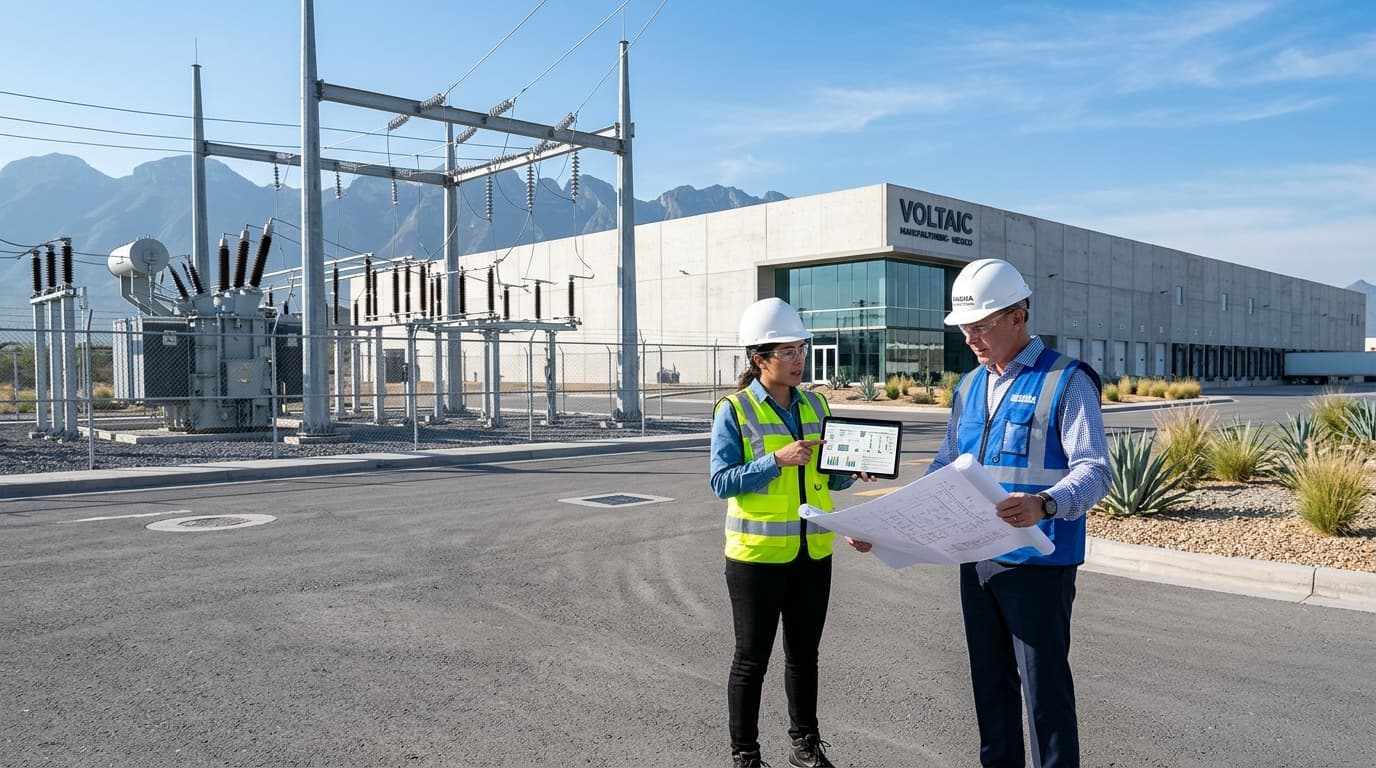
Mexico Industrial Real Estate (Q3/Q4 2026 Decoded): The 10-Market Site Selection Playbook on Phantom Power, Substation Delays, and the Normalizing Rent Fallacy
An executive infrastructure and real estate roadmap for COOs, VPs of Manufacturing, and PE Operating Partners on CENACE transmission saturation, $150–$350/kVA substation CapEx, 80-week transformer lead times, and fiduciary lease covenants in Tijuana, Juarez, and Monterrey.
Direct Answer: While headline reports claim Mexico's industrial real estate market is normalizing as national vacancy rises to 6.28%, over 84% of newly delivered construction consists of speculative concrete shells lacking energized electrical substations. Manufacturing executives shortlisting sites across Monterrey, Tijuana, and Ciudad Juárez face 18 to 36-month CFE interconnection backlogs, $150 to $350/kVA substation CapEx outlays, and acute CONAGUA water restrictions unless non-negotiable fiduciary lease covenants are enforced.
Across executive boardrooms in Detroit, Chicago, Stuttgart, and Tokyo, corporate site selection committees evaluating nearshoring expansions into Mexico are being fed a dangerous narrative by commercial real estate brokers and marketing-driven shelter operators: “The market is normalizing, supply is opening up, and asking rents have finally plateaued.”
On paper, the macroeconomic indicators appear reassuring. According to national Q3 2026 market data, Mexico's industrial real estate inventory expanded to 109 million square meters (m²), with gross quarterly absorption reaching 1.3 million m² (3.4 million m² year-to-date). Average vacancy rates inched upward by 115 basis points to 6.28% nationally, with northwest border markets such as Tijuana climbing above 9.27%.
Brokers are quick to pitch these statistics as a tenant's market: “More speculative space means faster speed-to-market. Negotiate hard on base rent and move in next quarter.”
This narrative is an operational trap.
What commercial broker brochures casually omit is that 84% of all construction starts nationwide in 2026 are speculative developments. Developers can pour a concrete slab and tilt up insulated concrete wall panels in 7 to 9 months. However, securing a high-voltage grid drop from the state electrical utility (Comisión Federal de Electricidad - CFE), obtaining technical approvals from the grid operator (Centro Nacional de Control de Energía - CENACE), and procuring medium/high-power step-down transformers currently requires 18 to 36 months.
The result is a nationwide epidemic of “Phantom Power”: brand-new, architecturally pristine Class A industrial shells standing empty along the border, while tenant machinery sits in shipping crates and multi-million-dollar OEM delivery contracts are breached.
When expanding enterprises evaluate industrial real estate in Mexico, site selection is no longer a real estate negotiation—it is an infrastructure engineering due diligence audit. Before signing a 7-to-10-year lease, manufacturing leadership must decode the actual utility, regulatory, and legal constraints governing Mexico's 10 primary industrial markets.
The “Normalizing Market” Fallacy: Why Rising Vacancy is a Speculative Shell Trap
Direct Answer: Rising vacancy in late 2026 does not indicate abundant manufacturing capacity; it reflects an accumulation of speculative logistics warehouses that cannot support heavy industrial power loads. Because 52% of absorbed space is low-power logistics, developers built speculative shells without dedicated substations, leaving advanced manufacturing tenants with un-energized buildings and multi-million-dollar carrying costs.
To understand why headline vacancy figures mislead C-suite decision-makers, one must analyze the composition of demand. In Q3 2026, logistics and e-commerce distribution accounted for 52% of total national absorption, while heavy electrical equipment manufacturing represented 13% and automotive/transportation represented 11%.
Logistics facilities have minimal utility requirements: basic interior high-bay LED lighting, dock door levelers, and modest office air conditioning, requiring merely 1.5 to 2.5 kVA per 1,000 square feet (150 to 250 kVA for a 100,000 sq ft warehouse). Consequently, institutional real estate developers capitalized on low-risk capital by constructing speculative distribution warehouses across Monterrey, Saltillo, and Tijuana.
Advanced manufacturing operations, however, operate in a completely different physical reality:
When an industrial park brochure advertises “Speculative Building Ready for Immediate Occupancy”, it almost universally delivers between 250 and 500 kVA of total capacity hooked to a shared medium-voltage commercial circuit. If your manufacturing process demands 4,000 kVA (4.0 MVA), that building is not “ready in 30 days”—it is 24 months away from operational energization.
The Mathematical Cost of Dead Carrying Rent
When a manufacturing tenant executes an unvetted industrial lease, base rent obligations typically commence upon “Substantial Completion of the Landlord's Shell” rather than “Final CFE Utility Energization.”
Consider a standard 200,000 sq ft manufacturing footprint in Apodaca (Monterrey) or Otay Mesa (Tijuana):
Facility Footprint:                                 200,000 sq ft
Contracted Triple-Net (NNN) Base Rent:               $0.75 USD / sq ft / month
Operating Expenses (CAM, Taxes, Insurance, Security): $0.12 USD / sq ft / month
Total Monthly Facility Outflow:                      $174,000 USD / month

Projected CFE Substation Delivery Delay:             16 Months
Cumulative Dead Rent Paid for an Idled Facility:      $2,784,000 USD
Idled Capitalized Machinery Depreciation (at 12%):   $1,440,000 USD
OEM Production Delay Penalties & Expedited Freight:  $2,500,000 USD
--------------------------------------------------------------------------------
TOTAL PRE-OPERATIONAL CASH BURN:                    $6,724,000 USD
A minor $0.03/sq ft rent discount negotiated during landlord meetings is utterly wiped out by an un-energized substation delay in month three.
The 10-Market Infrastructure Benchmark: 2026/2027 Scorecard
Direct Answer: Across Mexico's 10 key manufacturing markets, utility saturation varies drastically. Tijuana leads northern border vacancy at 9.27% but faces 18 to 24-month CFE transmission queues. Monterrey commands 30% of national absorption but suffers critical substation backlogs in Apodaca and Santa Catarina, while Querétaro's data center corridor has created severe medium-voltage power rationing.
To provide cross-border leadership with unconflicted technical data, Nearshore Navigator maintains continuous empirical benchmarking across Mexico's top 10 manufacturing corridors.
Table 1: Mexico 10-Market Industrial Infrastructure Due Diligence Matrix (Q3/Q4 2026)
| Manufacturing Hub & Submarkets | Q3 2026 Vacancy Rate (%) | Class A Asking Rent ($USD/sq ft/mo NNN) | Avg. CFE Substation Queue (>3 MVA) | Avg. Substation CapEx ($USD/kVA installed) | CONAGUA Industrial Water Stress Level | Primary Infrastructure Bottleneck |
|---|---|---|---|---|---|---|
| Monterrey, NL (Apodaca, Santa Catarina, Pesquería, Ciénega) |
4.85% | $0.58 – $0.72 | 14 – 20 Months | $190 – $260 | CRITICAL | 115 kV donor substation saturation; CFE obras de refuerzo mandated across transmission nodes. |
| Saltillo / Ramos Arizpe, COAH (Derramadero, Ramos Arizpe) |
3.60% | $0.52 – $0.62 | 12 – 16 Months | $175 – $230 | Moderate | Rapid automotive expansion (EV cluster) absorbing high-voltage breaker capacity at Ramos nodes. |
| Tijuana, BC (Otay Mesa, El Florido, Valle Redondo, Alamar) |
9.27% | $0.78 – $0.88 | 18 – 26 Months | $240 – $340 | High | Isolated Baja California Grid (BCA): Zero connection to Mexico's National Grid; reliant on CAISO imports. |
| Mexicali, BC (Palaco, Gonzalez Ortega, Parque Sur) |
5.40% | $0.65 – $0.74 | 12 – 18 Months | $210 – $290 | Moderate | Extreme summer ambient temperatures (>48°C) de-rate transformer capacity by 18–25%. |
| Ciudad Juárez, CHIH (Southeast, Panamericana, Intermex) |
6.10% | $0.68 – $0.78 | 16 – 22 Months | $200 – $275 | CRITICAL | High-voltage transmission lines saturated along border; CFE requiring dedicated switching bays. |
| Reynosa / Matamoros, TAM (Pharr Bridge, Poniente, Del Norte) |
4.20% | $0.54 – $0.64 | 10 – 15 Months | $165 – $210 | Low to Moderate | Regional gas pipeline capacity constraints for on-site cogeneration/microgrids. |
| Querétaro, QRO (El Marqués, Bernardo Quintana, Aeropuerto) |
5.15% | $0.60 – $0.70 | 20 – 30 Months | $250 – $360 | High | Hyperscale Data Center Saturation: Tech giants absorbing 300+ MW, crowding out manufacturing tenants. |
| San Luis Potosí, SLP (Parque Industrial Millennium, WTC 1 & 2) |
4.40% | $0.50 – $0.60 | 12 – 16 Months | $170 – $225 | High | Deep well concessions restricted under CONAGUA decrees; WTC private substation capacity premium. |
| Guadalajara, JAL (El Salto, Zapopan Norte, Tlajomulco) |
3.10% | $0.66 – $0.76 | 16 – 24 Months | $220 – $310 | Moderate | Extreme land scarcity in El Salto; semiconductor cleanroom power demands competing for CFE feeds. |
| Guanajuato / Bajío (Silao, Celaya, Puerto Interior, Irapuato) |
6.80% | $0.48 – $0.58 | 10 – 14 Months | $155 – $205 | High | Highly favorable rail logistics (Ferromex/CPKC), but localized 34.5 kV line drops require private bays. |
The “Phantom Power” Crisis: Substation Engineering, CENACE Código de Red, and the 80-Week Transformer Crunch
Direct Answer: Phantom power occurs when developers advertise nominal park capacity that cannot be physically drawn from the CFE transmission grid. Substation construction requires $150 to $350 per kVA installed, while large power transformers face 70 to 110-week global manufacturing lead times. Additionally, CENACE Código de Red 2.0 imposes fines up to 10% of gross revenue for uncorrected power factor and harmonic variances.
When a multinational corporation imports specialized automated machinery into Mexico, the electrical interconnection is governed by strict federal statutory codes under the Ley de la Industria Eléctrica (LIE) and regulatory standards enforced by CENACE and the energy regulatory authorities.
1. The Engineering Math: Substation CapEx Breakdown
A manufacturer requiring more than 1,000 kVA (1.0 MVA) cannot connect directly to low-voltage municipal distribution. The facility must construct a private on-site electrical substation that steps down high voltage (115 kV) or medium voltage (13.8 kV, 23 kV, or 34.5 kV) to industrial operating voltage (480V / 220V, 3-phase, 60 Hz).
Where:
Representative Substation CapEx for a 10 MVA Plant (Monterrey / Tijuana):
├── 115 kV / 13.8 kV Substation Bay & Civil Infrastructure:  $1,850,000 USD
├── 10/12.5 MVA ONAN/ONAF Step-Down Transformer:            $1,650,000 USD
├── Primary Switchgear (13.8 kV Metal-Clad Vacuum Breakers):   $480,000 USD
├── Harmonic Filtering Bank & Fast-Response Power Factor:     $290,000 USD
├── CFE LAPEM Testing, UVIE Certification & Commissioning:    $140,000 USD
└── CFE Off-Site Transmission Feeder Upgrades (Obras de Refuerzo): $450,000 USD
--------------------------------------------------------------------------------
TOTAL ON-SITE SUBSTATION CAPITAL INVESTMENT:                 $4,860,000 USD
Unit Capital Cost:                                           $486 USD / kVA
2. The Global Transformer Crunch (70 to 110-Week Lead Times)
The single greatest physical barrier to nearshoring plant commissioning in 2026 is the global power transformer supply chain crisis.
Driven by the simultaneous expansion of AI data centers in the United States, utility grid decarbonization, and industrial nearshoring in northern Mexico, global manufacturing backlogs for large step-down power transformers (5 MVA to 30 MVA) produced by major OEMs (Prolec GE, WEG, Siemens Energy, ABB, Schneider Electric) have reached historic extremes:
If a developer breaks ground on a speculative manufacturing plant today without having already purchased and received their primary substation transformer, that plant cannot be energized under any commercial circumstance for at least 18 months.
The Water Bottleneck: CONAGUA Concessions, Municipal Moratoriums, and Industrial Treatment
Direct Answer: Industrial water in Mexico is governed exclusively by CONAGUA under the Ley de Aguas Nacionales. In water-stressed corridors including Monterrey, Bajío, and Ciudad Juárez, deep-well extraction bans prohibit new well drilling. Manufacturers requiring process water must verify that the park holds an active, unencumbered REPDA concession title or municipal treated water infrastructure.
While electrical power constraints cause visible factory delays, water availability is an uninsurable operational veto. A factory without power can theoretically run emergency diesel generators; a wet manufacturing plant without water cannot operate.
Under Article 27 of the Mexican Constitution and the Ley de Aguas Nacionales (LAN), all underground and surface waters are property of the Mexican Nation, administered exclusively by the federal water commission (Comisión Nacional del Agua - CONAGUA).
1. The REPDA Concession Title Verification Protocol
Industrial parks cannot simply drill a well because they own land. To extract groundwater legally, the developer must possess an active Título de Concesión registered in the Registro Público de Derechos de Agua (REPDA) specifying:
The Agricultural Title Conversion Trap: In secondary markets across Querétaro, San Luis Potosí, and Guanajuato, developers frequently purchase former agricultural farmland and assure foreign tenants that “the property has existing wells.” However, converting an agricultural water concession to industrial manufacturing use requires formal CONAGUA technical authorization, public environmental impact reviews, and payment of statutory extraction duty deltas. In critical deficit aquifers, CONAGUA enforces a permanent Veda de Aguas Subterráneas (Groundwater Extraction Moratorium), making agricultural-to-industrial title transfers impossible.
The 4-Tier CFE Verification Framework: Exposing Fake “Factibilidad” Letters
Direct Answer: The 4-tier CFE verification framework separates non-binding marketing claims from legally enforceable utility commitments. Tiers 1 and 2 (park brochures and Cartas de Factibilidad) carry zero legal obligation to deliver power. Only Tier 3 (CENACE Dictamen de Interconexión) and Tier 4 (executed Contrato de Conexión with escrowed CapEx) guarantee plant energization.
       [TIER 1: MARKETING BROCHURE]
       ├── Status: Commercially Unverified
       ├── Document: Developer Spec Sheet ("10 MVA Available")
       └── Legal Enforceability: ZERO (Gross park design; often leased to prior tenants)
               │
               v
       [TIER 2: CFE CARTA DE FACTIBILIDAD]
       ├── Status: Preliminary Informational
       ├── Document: CFE Distribución Factibility Letter
       └── Legal Enforceability: ZERO (Non-binding; strictly expires after 180 days)
               │
               v
       [TIER 3: CENACE DICTAMEN DE INTERCONEXIÓN]
       ├── Status: Technical Engineering Approval
       ├── Document: Formal SISCON / SIASIC Impact & Installation Study
       └── Legal Enforceability: BINDING TECHNICAL BLUEPRINT (Identifies Obras de Refuerzo)
               │
               v
       [TIER 4: CONVENIO DE APORTACIÓN & CONTRATO DE CONEXIÓN]
       ├── Status: Enforceable Commercial Commitment
       ├── Document: Bilateral CFE-Tenant Contract + Escrowed Financial Guarantees
       └── Legal Enforceability: 100% LEGALLY ENFORCEABLE (Guaranteed Energization Date)
Tier 1: The Park Spec Sheet (“10 MVA Available in Park”)
The “10 MVA” refers to the gross theoretical capacity granted to the entire industrial park master plan when the land was subdivided ten years ago. It fails to account for the fact that three existing tenants have already contracted 8.5 MVA of that capacity, leaving only 1.5 MVA for the entire remaining 100-acre development.
Tier 2: The CFE “Carta de Factibilidad”
The fine print at the bottom of every CFE Carta de Factibilidad explicitly states: “El presente documento es de carácter meramente informativo y no constituye compromiso formal de suministro eléctrico ni reserva de capacidad en las redes generales de distribución.” Under CFE administrative criteria, a Carta de Factibilidad automatically expires 180 calendar days after issuance. It creates zero legal rights for an incoming tenant.
Tier 3: The CENACE Dictamen de Interconexión (SISCON / SIASIC)
For loads exceeding 1,000 kVA (1.0 MW), Mexican federal law mandates that interconnection studies must be conducted by CENACE through the SIASIC portal. This technical study models steady-state power flows, short-circuit levels, and contingency scenarios (N-1), specifying exact Obras de Refuerzo.
Tier 4: The Convenio de Aportación & Contrato de Conexión y Medición
The definitive commercial agreement signed between CFE, CENACE, and the industrial entity. The developer or tenant deposits an irrevocable Carta de Crédito or cash guarantee securing the cost of all dedicated interconnection works, and CFE issues a legally binding construction and energization schedule with an assigned account number (Número de Servicio RPU).
5 Non-Negotiable Fiduciary Lease Covenants for Mexico Industrial Real Estate
Direct Answer: Fiduciary lease covenants protect manufacturing tenants from bearing the financial cost of developer utility defaults. Essential clauses include a Utility Delivery Condition Precedent abating all rent until CFE energization, landlord-escrowed substation CapEx with daily delay penalties, contractual kVA nodal allocation riders, and unconditional lease rescission rights after 120 days.
When negotiating an industrial lease in Mexico, standard commercial broker lease templates heavily favor the landlord. They define “Delivery of the Leased Premises” as the physical completion of the roof, walls, and floor slab, decoupling rent commencement from utility functionality.
To protect corporate capital, General Counsel and VPs of Manufacturing must mandate the insertion of five non-negotiable fiduciary covenants into the final lease agreement (Contrato de Arrendamiento Industrial):
Clause 1: Utility Energization Condition Precedent (Condición Suspensiva de Servicios)
“Notwithstanding any provision herein to the contrary, the Lease Commencement Date, the obligation to take possession of the Leased Premises, and the obligation to pay Base Rent, Operating Expenses, or any other financial charges shall be strictly conditioned upon the complete, certified energization and delivery of [X,XXX] kVA of continuous electrical capacity by the Comisión Federal de Electricidad (CFE) to Tenant’s dedicated meter, as substantiated by an official CFE UVIE Inspection Certificate and active commercial service activation.”
Clause 2: Substation CapEx Escrow & Liquidated Delay Damages
“Landlord shall cause the construction and commissioning of the on-site electrical substation to be completed no later than [Date] ('Target Energization Date'). Landlord shall deposit the full estimated construction cost ($[X,XXX,XXX] USD) into an irrevocable third-party escrow account upon lease execution. In the event CFE energization is delayed beyond the Target Energization Date for any reason other than Tenant-caused Force Majeure, Landlord shall pay to Tenant liquidated damages in the amount of $1,500.00 USD per calendar day of delay for the first 60 days, and $3,000.00 USD per day thereafter, representing reimbursement for idled equipment depreciation and overhead.”
Clause 3: Contractually Guaranteed kVA Nodal Allocation Rider
“Landlord legally warrants and covenants that of the total capacity allocated to the Industrial Park under CENACE Dictamen [Study Number], strictly [X,XXX] kVA has been contractually dedicated and reserved exclusively for the Leased Premises (Lot [X]). Landlord expressly covenants not to reallocate, transfer, encumber, or assign any portion of said capacity to any other tenant, building, or future phase within the Industrial Park without Tenant’s prior written consent.”
Clause 4: Temporary Power Generation Cost-Sharing Subsidy
“In the event that the Leased Premises are physically complete and Tenant desires to begin machinery commissioning prior to formal CFE grid energization, Landlord shall, at its sole cost and expense, provide on-site mobile diesel or natural gas generators capable of delivering [X,XXX] kW of continuous power, and Landlord shall subsidize 100% of the cost differential between on-site generator fuel/rental expenses and standard CFE industrial tariff rates (GDMTH) until final grid energization is achieved.”
Clause 5: Mutual Unconditional Right of Rescission (Derecho de Rescisión Unilateral)
“If final CFE energization and certified delivery of contracted utility capacity has not occurred within one hundred twenty (120) calendar days following the Target Energization Date, Tenant shall have the absolute and unconditional right to terminate this Lease Agreement immediately upon written notice to Landlord. Upon such termination, Landlord shall immediately refund to Tenant 100% of all security deposits, prepaid rent, and escrowed improvement funds, without deduction, setoff, or penalty.”
Interactive Infrastructure Assessment: Model Your Project Risk
To eliminate speculative guesswork before shortlisting industrial sites in Mexico, Nearshore Navigator engineered the CFE Industrial Power Feasibility & KVA Cost Estimator.
This interactive financial and engineering model calculates:
Launch CFE Power Feasibility & KVA Cost Estimator →
Frequently Asked Questions: Industrial Site Selection & Utilities
Direct Answer: Common industrial real estate inquiries in Mexico focus on the distinction between CFE distribution and transmission queues, substation procurement lead times, water concession legitimacy under CONAGUA, and negotiating utility conditions precedent. Independent technical due diligence protects capital before lease execution.
What is the difference between a CFE Carta de Factibilidad and a CENACE Dictamen?
A CFE Carta de Factibilidad is an initial, non-binding opinion issued by regional distribution offices indicating whether local lines exist. It automatically expires after 180 calendar days and confers zero legal right to capacity. A CENACE Dictamen de Interconexión is a formal, statutory technical approval issued by the national grid operator under the Ley de la Industria Eléctrica after evaluating grid stability, transient power flows, and short-circuit capacity. It legally establishes the precise electromechanical works required to connect the facility.
Why are transformer lead times extending to 80+ weeks in North America?
The severe transformer shortage is driven by the simultaneous convergence of three global demand shocks: the massive expansion of artificial intelligence hyperscale data centers, utility grid electrification and renewable interconnections in the US, and the unprecedented boom in Mexican nearshoring manufacturing construction. Large step-down transformers require specialized grain-oriented electrical steel (GOES) and high-voltage bushings, which suffer from severe global manufacturing bottlenecks.
Can an industrial tenant install on-site solar panels to bypass CFE grid queues?
Under current Mexican energy regulations governing Generación Distribuida (Distributed Generation), solar installations are exempt from complex generation permits only up to 0.7 MW (700 kW), with streamlined fast-tracking up to 1.0 MW under the Sheinbaum administration’s 2024–2030 National Energy Plan. While 700 kW can offset basic lighting and office HVAC, it represents only a small fraction of the 3,000 to 10,000 kVA required by heavy industrial manufacturing. Solar alone cannot replace a high-voltage CFE grid interconnection.
What is an “Obra de Refuerzo” and why does the landlord make the tenant pay for it?
An Obra de Refuerzo is an infrastructure upgrade to CFE's public transmission or distribution grid located outside the physical boundary of the industrial park—such as re-conductoring high-voltage transmission lines, adding switching bays at a distant CFE donor substation, or replacing circuit breakers. Because CENACE mandates these upgrades before granting energization, landlords frequently bury these multi-million-dollar utility donation requirements inside the tenant’s Tenant Improvement (TI) budget or lease annexes.
How does CONAGUA audit industrial water usage in Mexican maquiladoras?
CONAGUA audits water compliance through the Registro Público de Derechos de Agua (REPDA). Inspectors verify that total metered extraction does not exceed the volumetric quota registered in the park's concession title, that water meters are certified and digitally sealed, and that industrial wastewater discharges comply with official Mexican standards (NOM-001-SEMARNAT-2021 and NOM-002-SEMARNAT-1996) regarding heavy metals, chemical oxygen demand (COD), and biological oxygen demand (BOD).
How does Nearshore Navigator verify electrical and water due diligence before lease signing?
Nearshore Navigator acts as an unconflicted fiduciary advisor. We do not represent industrial landlords or earn commercial brokerage leasing commissions. Our engineering and legal team conducts independent utility audits: we review raw CENACE nodal capacity studies, verify on-site substation switchgear single-line diagrams, cross-reference REPDA concession titles with CONAGUA, and draft enforceable fiduciary covenants into your industrial lease contract to guarantee that your company pays zero rent until your factory is fully powered and certified.
Secure Your Mexican Manufacturing Site Selection Architecture
Industrial real estate decisions in Mexico in late 2026 cannot be evaluated through generic real estate brochures or high-level marketing newsletters. A mistake in power capacity or water concession legitimacy will idled multi-million-dollar automated machinery, breach OEM delivery schedules, and burn corporate liquidity.
Whether your executive team is shortlisting industrial parks across Monterrey, Saltillo, Tijuana, or the Bajío, Nearshore Navigator provides the independent technical due diligence and fiduciary contract governance required to protect your nearshoring investment.
Strategic Nearshoring & Industrial Intelligence
For North American executives, CFOs, and supply chain directors evaluating cross-border manufacturing, explore our master portal on nearshoring Mexico, review Class A availability and park vacancy in our comprehensive dossier on industrial real estate Tijuana, evaluate operational risk mitigation under maquiladora advisory and shelter services, or model your exact multi-state savings using the interactive nearshore landed cost calculator.