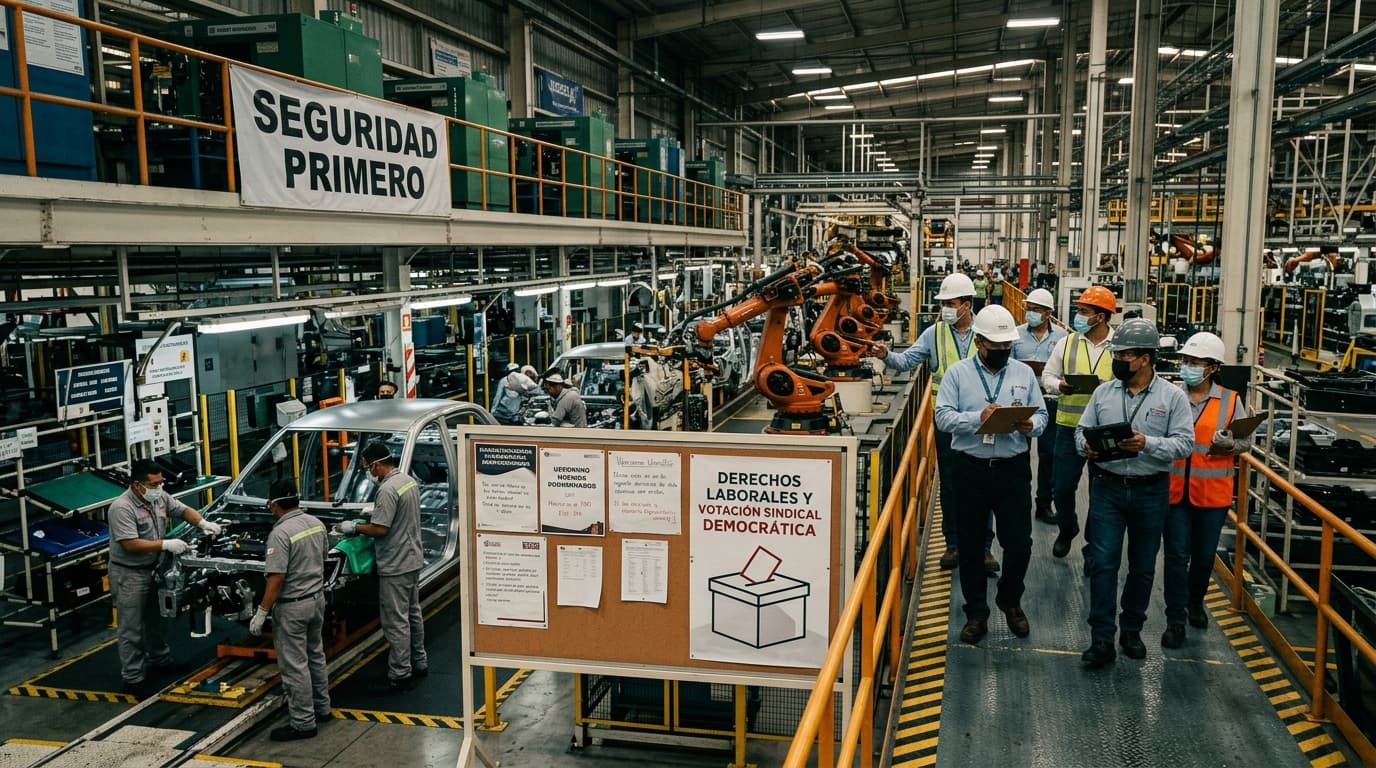
USMCA Rapid Response Labor Mechanism (RRLM) & Mexico Labor Reform: The 2026 Compliance Guide to Independent Unions, CFCRL Audits & Avoiding CBP Border Embargoes
Master the USMCA Rapid Response Labor Mechanism (RRLM). Prevent CBP liquidation freezes, navigate CFCRL independent union votes, and resolve SINTTIA vs CTM disputes.
USMCA Rapid Response Labor Mechanism (RRLM) & Mexico Labor Reform: The 2026 Compliance Guide to Independent Unions, CFCRL Audits & Avoiding CBP Border Embargoes
The United States-Mexico-Canada Agreement (USMCA / T-MEC) fundamentally transformed the relationship between cross-border trade and domestic labor standards. While corporate leadership teams historically treated Mexican labor compliance as a localized human resources matter, the enforcement landscape in 2026 has elevated workforce relations into a high-stakes international trade risk.
At the center of this paradigm shift is the Facility-Specific Rapid Response Labor Mechanism (RRLM) established under Annex 31-A of the USMCA. Unlike traditional international trade disputes—which require years of diplomatic consultations between sovereign governments—the RRLM operates directly against individual manufacturing facilities. A single petition filed by a U.S. or Mexican labor union alleging interference in union organizing or collective bargaining can trigger an expedited 45-day investigation, resulting in U.S. Customs and Border Protection (CBP) immediately halting the liquidation of customs accounts and threatening an outright import ban at the U.S. border.
With over 46 RRLM petitions initiated through mid-2026—over 67% concentrated in automotive assembly, heavy equipment, and aerospace supply chains—foreign manufacturers in Mexico can no longer rely on outdated playbooks. The historical era of employer-friendly "protection contracts" (contratos de protección patronal) has been dismantled by Mexico's Federal Labor Reform. Today, expanding manufacturers must navigate genuine democratic union elections, aggressive organizing campaigns by independent unions (such as SINTTIA and SNITIS), and strict regulatory scrutiny from the Federal Center for Conciliation and Labor Registration (CFCRL).
This executive compliance manual delivers a comprehensive operational and legal roadmap for General Counsel, Chief People Officers, Vice Presidents of Global Operations, and Plant Directors operating in Mexico.
The 2026 USMCA Labor Landscape: The Enforcement Record & Automotive Target Concentration
Between the entry into force of the USMCA in July 2020 and September 2026, the RRLM evolved from a novel treaty experiment into the United States government's most potent weapon for enforcing cross-border labor parity.
+---------------------------------------------------------------------------------------------------+
|                        THE USMCA RRLM ENFORCEMENT TRAJECTORY (2020–2026)                          |
+---------------------------------------------------------------------------------------------------+
|                                                                                                   |
|  CUMULATIVE PETITIONS INITIATED BY USTR / US DOL: 46 CASES                                        |
|                                                                                                   |
|  INDUSTRY TARGET DISTRIBUTION:                                                                    |
|  * Automotive Assembly & Tier-1/Tier-2 Components: [|||||||||||||||||||||||||||||||] 31 Cases (67%)|
|  * Aerospace & Heavy Mechanical Manufacturing:     [||||||] 6 Cases (13%)                         |
|  * Call Centers, BPO & Telecommunications:         [||||] 4 Cases (9%)                            |
|  * Steel, Metalworking & Foundries:                [|||] 3 Cases (7%)                             |
|  * Consumer Goods & Food Processing:               [||] 2 Cases (4%)                              |
|                                                                                                   |
|  CORE PETITION ALLEGATIONS:                                                                       |
|  1. Employer interference in union leadership votes or collective agreement approvals (84%)       |
|  2. Retaliatory termination of independent union organizers (71%)                                 |
|  3. Refusal to bargain in good faith with newly certified independent unions (59%)                 |
|  4. Collusion with entrenched legacy unions (CTM / CROC) to block worker access (52%)            |
|                                                                                                   |
+---------------------------------------------------------------------------------------------------+
Key Precedent-Setting Case Law
The enforcement trajectory reveals an aggressive, bipartisan U.S. posture spearheaded by the Interagency Labor Committee for Monitoring and Enforcement (co-chaired by the U.S. Trade Representative - USTR and the Department of Labor - USDOL):
- General Motors (Silao, Guanajuato): The benchmark case establishing that tampering with secret-ballot legitimation votes triggers immediate CBP border suspension and necessitates re-running elections under international ILO and CFCRL monitoring.
- Tridonex (Matamoros, Tamaulipas): Established precedent for substantial severance payouts and personal safety guarantees for independent union organizers backed by the SNITIS union.
- Panasonic Automotive Systems (Reynosa, Tamaulipas): Demonstrated that signing a collective bargaining agreement with a legacy union while an independent union is actively petitioning for representation constitutes an immediate Denial of Rights, requiring contract cancellation and restitution of withheld union dues.
- Unique Fabricating, Goodyear, and Yazaki: Established strict operational remediation plans requiring foreign corporate boards to publish formal company-wide neutrality declarations and implement anti-coercion supervisor retraining.
The Anatomy of Annex 31-A: How an RRLM Petition is Filed, Investigated, and Enforced
Understanding the rigid, fast-moving timeline of an Annex 31-A petition is critical for corporate risk mitigation. Unlike domestic litigation where response windows span months, the RRLM operates on an aggressive calendar measured in days.
+---------------------------------------------------------------------------------------------------+
|                        THE USMCA ANNEX 31-A DISPUTE TIMELINE                                      |
+---------------------------------------------------------------------------------------------------+
|                                                                                                   |
|  DAY 0: PETITION FILED                                                                            |
|  * U.S. labor union (e.g., UAW, USW) or Mexican workers submit complaint to U.S. Interagency     |
|    Labor Committee (USTR & US DOL).                                                               |
|                                                                                                   |
|  DAY 1–30: U.S. GOVERNMENT REVIEW                                                                 |
|  * USTR audits whether sufficient, credible evidence exists of a "Denial of Rights."             |
|                                                                                                   |
|  DAY 30: THE NUCLEAR TRIGGER --> CBP LIQUIDATION FREEZE INITIATED                                 |
|  * USTR requests Mexican Government to conduct a review under Article 31-A.4.                     |
|  * USTR SIMULTANEOUSLY DIRECTS CBP TO SUSPEND LIQUIDATION OF ALL GOODS FROM THE PLANT.            |
|                                                                                                   |
|  DAY 30–75: MEXICAN GOVERNMENT INVESTIGATION                                                      |
|  * Ministry of Labor (STPS) and CFCRL inspect plant, interview workers, and audit union records. |
|  * Mexico accepts or denies whether a Denial of Rights occurred.                                 |
|                                                                                                   |
|  DAY 75–105: REMEDIATION NEGOTIATION OR ARBITRATION PANEL                                         |
|  * If agreed: Mexico and U.S. execute a bilateral Remediation Plan (e.g., re-vote, rehiring).      |
|  * If disputed: Tri-national Rapid Response Independent Panel of Labor Experts convened.          |
|                                                                                                   |
|  FINAL RESOLUTION OR PENALTIES ENFORCED:                                                          |
|  * Compliance Achieved: CBP lifts suspension of liquidation; entries liquidated duty-free.        |
|  * Remediation Rejected: Permanent revocation of USMCA 0% tariffs; border import ban applied.     |
|                                                                                                   |
+---------------------------------------------------------------------------------------------------+
The Standard of "Denial of Rights"
Under USMCA Article 31-A.2, an RRLM proceeding can be invoked against any "Covered Facility" (defined broadly as any enterprise producing goods traded between the Parties or providing services in priority sectors including automotive, aerospace, electronics, chemicals, and industrial mining) whenever:
> "A Party has a good faith basis to believe that workers in a Covered Facility are being denied the right of free association and collective bargaining under laws necessary to fulfill the Party's labor obligations."
Crucially, the petitioner does not need to prove a systemic pattern of abuse. A single incident—such as a plant manager allowing a favored union to hold captive-audience speeches inside the plant while security guards eject independent union organizers from the public gates—is sufficient to substantiate an international trade complaint.
The Border Nuclear Option: CBP Suspension of Liquidation, Retroactive Tariffs, and Physical Cargo Embargoes
Many corporate executives fundamentally misunderstand what happens when USTR files an RRLM request with the Mexican government. They assume legal proceedings operate in the abstract while supply chains continue unaffected.
This assumption is catastrophic.
The Mechanics of Customs Suspension
When USTR delivers a formal RRLM request to Mexico, it concurrently issues an official directive to the U.S. Department of Homeland Security and U.S. Customs and Border Protection under Section 411 of the USMCA Implementation Act (19 U.S.C. § 4581):
- Immediate Freezing of Entry Summaries: CBP issues an electronic hold via the Automated Commercial Environment (ACE) system, ordering port directors across all commercial land crossings (Laredo, Otay Mesa, El Paso, Pharr, Nogales) to suspend liquidation of all customs entry summaries associated with goods produced by the targeted facility.
- Surety Bond Escalation: Importers of record (typically the U.S. parent company or customer Tier-1 OEM) are required to post high-value continuous customs surety bonds covering the potential full Most-Favored-Nation (MFN) tariff exposure on all imported goods.
- Retroactive Tariff Clawbacks: Under normal customs law, entry liquidation finalizes duty obligations after 314 days. Under suspension of liquidation, all accounts remain legally open indefinitely. If the RRLM arbitration panel ultimately determines that a Denial of Rights occurred and was not fully remediated, CBP retroactively re-liquidates every single shipment entered during the dispute at full non-preferential MFN duty rates (averaging 2.5% to 25% depending on the HTSUS classification).
- Physical Cargo Exclusion (Import Ban): In severe cases involving repeated non-compliance or failure to execute an agreed bilateral remediation plan, USMCA Article 31-A.10 authorizes the United States to deny entry completely to manufactured goods produced by the offending facility, transforming a localized labor grievance into a total commercial blockade.
+---------------------------------------------------------------------------------------------------+
|                        THE FINANCIAL REALITY OF CBP SUSPENSION OF LIQUIDATION                     |
+---------------------------------------------------------------------------------------------------+
|  HYPOTHETICAL AUTO PARTS FACILITY EXPORTING $10,000,000 USD / MONTH TO U.S. CUSTOMERS:            |
|                                                                                                   |
|  * NORMAL USMCA OPERATION:                                                                        |
|    - Applicable Tariff: 0.0% (USMCA Preferential Duty-Free Entry)                                 |
|    - Customs Duty Paid: $0 USD                                                                    |
|    - Customer Supply Chain: Continuous, frictionless JIT delivery                                 |
|                                                                                                   |
|  * UNDER RRLM CBP SUSPENSION OF LIQUIDATION (90-Day Dispute Window):                              |
|    - Total Value of Shipped Goods Held in Suspense: $30,000,000 USD                                |
|    - MFN Tariff Exposure (e.g., 25% HTSUS 8708 auto components): $7,500,000 USD                   |
|    - Required Surety Bond Collateral Reserve: $7,500,000 USD frozen on parent company balance sheet|
|    - Customer Reaction: Tier-1 OEM customers serve emergency commercial default notices due to   |
|      customs liability and threat of border shipment halts.                                       |
|                                                                                                   |
|  * FINANCIAL IMPACT: Immediate executive liquidity crisis, customer contract cancellations, and  |
|    forced emergency remediation under severe distress.                                            |
+---------------------------------------------------------------------------------------------------+
Mexico's Labor Reform Reality: The Fall of Protection Contracts and the Elimination of 105,000 Legacy CCTs
To understand why RRLM petitions are surging in 2026, foreign executives must comprehend the legal destruction of the historical Mexican industrial labor architecture.
For over six decades, foreign corporations entering Mexico relied on "Protection Contracts" (contratos de protección patronal). Under this historical practice, an expanding company hired a local labor attorney who pre-signed a collective bargaining agreement with a "friendly" union federation (predominantly the CTM - Confederación de Trabajadores de México, or CROC) before a single worker was hired or a single factory brick was laid.
The contract was filed with corrupt local conciliation boards (Juntas Locales de Conciliación y Arbitraje), legally inoculating the plant against strikes. The direct workforce was never shown the contract, never voted on its terms, and often did not even know a union existed until mandatory dues were deducted from their paychecks.
The Legislative Overhaul (2019 Labor Reform)
Enacted to comply with USMCA Annex 23-A obligations, Mexico’s Federal Labor Reform enacted radical statutory mandates codified in the Ley Federal del Trabajo (LFT):
- Creation of the CFCRL: Local conciliation boards were permanently abolished. All union registrations, collective contracts, and labor oversight were centralized under the Centro Federal de Conciliación y Registro Laboral (CFCRL), an autonomous federal agency equipped with advanced digital auditing tools.
- *Mandatory Secret-Ballot Legitimation (Legitimación de CCT):* Every existing collective bargaining agreement in Mexico was required to undergo a secret-ballot, direct, democratic worker vote supervised by the CFCRL before the statutory deadline of May 1, 2023 (LFT Transitorio Decimoprimero).
- The 105,000 Contract Wipeout: The empirical results were staggering. Out of approximately 139,000 collective agreements registered in Mexico, only ~30,500 agreements were successfully legitimized. Over 105,000 contracts were formally terminated by law because corrupt unions either failed to organize a vote or workers voted overwhelmingly to reject the legacy contracts.
The 2026 Union Vacuum
As a direct consequence of this statutory mass cancellation, thousands of foreign-owned manufacturing plants in Mexico are currently operating as non-unionized facilities. While some naive executives celebrated this as a return to a "union-free" environment, seasoned industrial labor experts recognize it as a high-voltage operational vacuum. Under modern Mexican labor law, non-union facilities are open targets for competing union organizing drives.
The Rise of Independent Democratic Unions: SINTTIA, SNITIS, and Los Mineros vs. CTM, CROC, and CATEM
The Mexican labor landscape in 2026 is characterized by fierce ideological and operational competition between two diametrically opposed union models:
+---------------------------------------------------------------------------------------------------+
|                            THE MEXICAN UNION POWER DYNAMIC (2026)                                 |
+---------------------------------------------------------------------------------------------------+
|  LEGACY INDUSTRIAL FEDERATIONS                          INDEPENDENT DEMOCRATIC UNIONS             |
|  (CTM, CROC, CROM, CATEM)                               (SINTTIA, SNITIS, Los Mineros, FENASIB)   |
|                                                                                                   |
|  * Operational Philosophy:                              * Operational Philosophy:                 |
|    Top-down corporate alignment; preservation of          Grassroots worker democracy; aggressive |
|    status quo; historical protection contracts.           wage demands; international alignment.  |
|                                                                                                   |
|  * Key Vulnerabilities:                                 * Key Weapons:                            |
|    Low worker trust; tainted historical reputation;       Direct backing from U.S. labor (AFL-CIO,|
|    vulnerable to RRLM secret-ballot challenges.           UAW, USW); mastery of RRLM mechanisms.  |
|                                                                                                   |
|  * Geographic Strongholds:                              * Geographic Strongholds:                 |
|    Coahuila (Saltillo), State of Mexico, Puebla,          Guanajuato (Silao/Bajío), Tamaulipas    |
|    traditional industrial parks in Monterrey.             (Matamoros), San Luis Potosí, Querétaro.|
+---------------------------------------------------------------------------------------------------+
The SINTTIA Revolution
The most prominent independent union is SINTTIA (Sindicato Nacional Independiente de Trabajadores y Trabajadoras de la Industria Automotriz), which rose to global prominence by toppling the entrenched CTM union at General Motors' flagship assembly complex in Silao, Guanajuato. Following its historic victory, SINTTIA demonstrated that independent unions could negotiate double-digit wage increases (8% to 10% above inflation), reform shift scheduling, and eliminate supervisor favoritism without crippling factory productivity.
In 2026, SINTTIA and allied independent confederations (such as SNITIS in the northern maquiladora belt of Tamaulipas, and the Mineros union led by Napoleón Gómez Urrutia) are systematically targeting Tier-1 and Tier-2 automotive component suppliers, plastic injection molders, wire harness plants, and aerospace machining facilities across Guanajuato, San Luis Potosí, Querétaro, and Coahuila.
The CFCRL 30% Threshold: How a Constancia de Representatividad Triggers Strike Notices
For foreign corporate managers unfamiliar with Mexican statutory procedures, the legal mechanics of how a union gains collective bargaining rights represent the most frequent flashpoint for RRLM violations.
+---------------------------------------------------------------------------------------------------+
|                  THE STATUTORY UNION CERTIFICATION PATHWAY (LFT ART. 390 BIS)                     |
+---------------------------------------------------------------------------------------------------+
|                                                                                                   |
|  PHASE 1: WORKER ORGANIZING & 30% SIGNATURE COLLECTION                                            |
|  * An independent union quietly collects signed support cards (*cédulas de adhesión*) from at     |
|    least 30% of the plant's operational workforce.                                               |
|                                                                                                   |
|  PHASE 2: FILING FOR CONSTANCIA WITH THE CFCRL                                                    |
|  * The union submits signatures to the CFCRL. The CFCRL validates worker authenticity against SAT |
|    tax payroll records and IMSS social security registries.                                       |
|                                                                                                   |
|  PHASE 3: MANDATORY EMPLOYER NOTIFICATION & 10-DAY WINDOW                                        |
|  * The CFCRL officially notifies the plant management. Management must post the notification on    |
|    factory bulletin boards within 10 days to inform all workers.                                 |
|  * CRITICAL LEGAL POINT: If competing unions gather 30% support, the CFCRL calls a democratic    |
|    secret-ballot election (*consulta de representatividad*) to decide the winner.                 |
|                                                                                                   |
|  PHASE 4: ISSUANCE OF CONSTANCIA DE REPRESENTATIVIDAD                                             |
|  * The winning union receives the official Constancia, granting it a 6-month exclusive legal      |
|    monopoly to negotiate an initial Collective Bargaining Agreement (CCT) with the employer.      |
|                                                                                                   |
|  PHASE 5: THE NUCLEAR LEVERAGE --> EMPLAZAMIENTO A HUELGA (STRIKE NOTICE)                         |
|  * Under LFT Article 920, the certified union serves formal notice of strike intent to compel the |
|    employer to sign the negotiated contract within 60 days.                                       |
|                                                                                                   |
+---------------------------------------------------------------------------------------------------+
The Fatal Executive Mistake: Retaliatory Terminations
The exact moment where 90% of RRLM petitions originate occurs during Phase 1 or Phase 2.
When plant supervisors or local human resources managers discover that internal workers are collecting signatures for an independent union like SINTTIA, their instinctive reaction—rooted in decades of obsolete Mexican labor culture—is to identify the ringleaders and terminate them immediately under fabricated pretenses of "insubordination," "absenteeism," or "restructuring."
Under modern USMCA jurisprudence, this is fatal.
When fired workers contact independent labor attorneys, a petition is immediately drafted to the U.S. Interagency Labor Committee in Washington D.C. The petition documents:
- Exact dates of signature collection.
- Evidence of supervisor surveillance or interrogation.
- Termination letters issued within days of organizing activity.
Within 30 days, USTR accepts the petition, CBP suspends customs liquidation, and the foreign parent company is dragged into an international diplomatic crisis. The standard remediation plan forced upon the employer universally mandates:
- Full unconditional reinstatement of all terminated workers with complete back-pay (salarios caídos).
- Immediate dismissal or disciplinary transfer of the anti-union supervisors.
- Formal written apologies published on factory bulletin boards and corporate websites.
- Comprehensive on-site supervision of subsequent union certification votes by federal CFCRL and international ILO observers.
Corporate Strike Mitigation & Neutrality Protocol: A 6-Step Operational Playbook
To bulletproof Mexican operations against RRLM petitions, CBP trade sanctions, and catastrophic wildcat strikes, corporate leadership must implement an institutional Labor Compliance and Employer Neutrality Protocol.
+---------------------------------------------------------------------------------------------------+
|                        THE 6-STEP EXECUTIVE LABOR MITIGATION PROTOCOL                             |
+---------------------------------------------------------------------------------------------------+
|                                                                                                   |
|  [ 1. FORMAL NEUTRALITY DECLARATION ]                                                             |
|  * Publish and distribute an explicit corporate statement affirming absolute worker freedom to    |
|    choose or reject union representation without employer interference or retaliation.            |
|                                                                                                   |
|  [ 2. SUPERVISORY ANTI-INTERFERENCE RETRAINING ]                                                  |
|  * Retrain all line leads, production supervisors, and plant managers. Enforce the "NO T-I-P-S"   |
|    doctrine (No Threats, No Interrogations, No Promises, No Spying).                             |
|                                                                                                   |
|  [ 3. EQUAL-ACCESS FACILITY PROTOCOLS ]                                                           |
|  * Establish transparent ground rules allowing certified union organizers equal access to outside |
|    gates, designated non-work bulletin boards, and communal break areas during non-shift hours.   |
|                                                                                                   |
|  [ 4. INDEPENDENT WHISTLE-BLOWER HOTLINE ]                                                        |
|  * Deploy an encrypted, third-party anonymous reporting channel for workers to report supervisor |
|    intimidation, bypassed shift allocations, or union coercion without fear of termination.      |
|                                                                                                   |
|  [ 5. CFCRL PRE-ELECTION COMPLIANCE AUDITING ]                                                    |
|  * Maintain pre-printed, validated voter registries (*padrón de trabajadores*) reflecting only   |
|    legitimate non-confidential direct operators, eliminating disputed ballots during votes.       |
|                                                                                                   |
|  [ 6. MARKET-LEADING DIRECT WAGE BENCHMARKING ]                                                   |
|  * Eliminate the economic oxygen for strikes by benchmarking base hourly wages, attendance        |
|    bonuses (*bonos de puntualidad*), and grocery vouchers (*vales de despensa*) at top quartile. |
|                                                                                                   |
+---------------------------------------------------------------------------------------------------+
1. Enforcing the Supervisory "NO T-I-P-S" Rule
Adapted from standard U.S. National Labor Relations Act (NLRA) compliance and adapted to Mexican LFT Article 133 mandates, all plant leadership must strictly obey the T-I-P-S rule:
- NO THREATS: Supervisors must never threaten facility closure, shift cancellations, bonus reductions, or termination if workers support an independent union.
- NO INTERROGATIONS: Supervisors must never question employees about union meetings, ask who signed support cards, or demand to know how individuals plan to vote.
- NO PROMISES: Management must never promise wage increases, promotions, or special facility upgrades conditioned on workers rejecting an independent union or retaining an incumbent federation.
- NO SPYING: Management must never photograph union organizing meetings outside plant gates, plant informants in worker WhatsApp groups, or monitor lawful union communications.
2. Structuring Democratic Collective Bargaining Negotiations
When an independent union successfully secures a Constancia de Representatividad from the CFCRL and serves an initial collective bargaining notice, corporate strategy must pivot from defense to professional collective bargaining:
- Assemble a Specialized Bargaining Committee: The committee must include the local Plant Manager, Corporate Global Labor Counsel, and an experienced, independent Mexican labor negotiator who is not affiliated with legacy corrupt union federations.
- Economic vs. Administrative Demands: Segregate purely economic issues (base wage rates, vacation bonuses, grocery vouchers) from operational flexibility clauses (shift rotation, overtime assignment, technology deployment rights, and disciplinary protocols).
- The 45-Day Rule for Contract Approval: Under LFT Article 390 Ter, any negotiated Collective Bargaining Agreement must be approved by a majority of the entire active workforce via secret ballot in an election supervised by the CFCRL. If workers reject the negotiated contract, the union and company must return to the bargaining table. The company cannot simply impose the agreement.
Historical Protection Contracts vs. Modern USMCA Democratic Framework
The table below contrasts the legal, operational, and trade risks governing Mexican manufacturing labor relations across the two historical eras:
| Operational Dimension | The Historical Model (Pre-2019 / NAFTA Era) | The Modern USMCA Model (2026 / Annex 31-A Era) |
|---|---|---|
| Contract Execution | Pre-signed by corporate lawyer with CTM/CROC before plant opening | Negotiated post-launch only after union proves 30%+ worker backing |
| Worker Voting & Consent | Zero worker participation; terms kept strictly confidential | Mandatory direct, secret-ballot vote supervised by CFCRL & ILO |
| Governing Labor Agency | Local Conciliation Boards (Juntas Locales) prone to political capture | Federal Center for Conciliation and Labor Registration (CFCRL) |
| Trade Sanction Mechanism | None. Labor issues had zero connection to border customs clearance | USMCA Annex 31-A Rapid Response Labor Mechanism (RRLM) |
| Customs Exposure | Normal customs liquidation; zero tariff revocation risk | CBP immediately suspends liquidation of customs entry accounts |
| Tariff Penalty Exposure | Standard 0% duty under NAFTA rules of origin | Permanent loss of 0% USMCA duty; retroactive MFN tariffs up to 25% |
| Border Disruption Risk | Minimal; strikes were suppressed by state political machines | Outright import ban at U.S. border for non-remediated facilities |
| Union Plurality | Monopolistic single-union federation control per municipality | Competitive multi-union environment (SINTTIA, SNITIS vs. CTM) |
| Supervisor Conduct Rules | Active employer coordination with favored union leaders | Strict legal neutrality; supervisory interference triggers RRLM |
| Worker Grievance Channel | Domestic labor courts taking 3 to 7 years to litigate | Fast-track 45-day international trade petition to USTR and US DOL |
Executive Conclusion: Labor Compliance as North American Market Access
In 2026, foreign corporations can no longer evaluate nearshoring to Mexico solely through the lens of engineering logistics, industrial real estate lease rates, and electrical substation drops.
Under the enforcement architecture of the USMCA, labor compliance is border customs clearance. Labor compliance is tariff elimination. Labor compliance is North American market access.
An enterprise that engineers a world-class manufacturing facility in Monterrey, Saltillo, or Guanajuato but executes its labor strategy on outdated 1995 assumptions is building its supply chain on an active regulatory fault line. A single mismanaged organizing drive or retaliatory termination can trigger an Annex 31-A petition within 30 days, freeze millions of dollars in customs accounts at the U.S. border, destroy customer JIT delivery schedules, and inflict devastating reputational damage on corporate enterprise value.
Nearshore Navigator provides strategic, objective advisory for corporate boards, general counsel, and operational leadership teams expanding into Mexico. Our labor and trade compliance advisory practice delivers:
- Comprehensive Labor Risk & Union Audits: We evaluate your current plant labor practices, collective agreements, and supervisory conduct against CFCRL and USMCA Annex 31-A benchmarks.
- Institutional Neutrality Architecture: We design and deploy lawful, bulletproof employer neutrality protocols, supervisory training programs, and anonymous worker grievance hotlines that prevent RRLM petition filings.
- Collective Bargaining Strategic Support: We assist executive management in modeling sustainable, market-leading compensation frameworks and negotiating progressive collective agreements with certified democratic unions that safeguard operational productivity and long-term industrial peace.
Before your plant becomes the next target of an international trade petition or customs liquidation freeze, contact Nearshore Navigator for a confidential executive labor compliance review.
Official Regulatory & Legal References
- USMCA / T-MEC: Chapter 23 (Labor); Annex 23-A (Worker Representation in Collective Bargaining in Mexico); Annex 31-A (Facility-Specific Rapid Response Labor Mechanism).
- United States Code: 19 U.S.C. § 4581–4589 (USMCA Implementation Act — Enforcement of Labor Obligations and Suspension of Liquidation).
- Ley Federal del Trabajo (LFT): Article 133 (Prohibited Employer Acts); Articles 386 Bis, 390 Bis, 390 Ter (Requirements for Collective Agreements and Democratic Voting); Article 41 (Sustitución Patronal); Article 920 (Procedimiento de Huelga).
- International Labour Organization (ILO): Convention 87 (Freedom of Association and Protection of the Right to Organise); Convention 98 (Right to Organise and Collective Bargaining).
- Centro Federal de Conciliación y Registro Laboral (CFCRL): Guidelines for the Issuance of the Constancia de Representatividad and Electronic Verification Protocols.
- U.S. Interagency Labor Committee for Monitoring and Enforcement: Guidelines for Public Petitions under the USMCA Rapid Response Labor Mechanism (Office of the USTR and U.S. Department of Labor).
Strategic Nearshoring & Industrial Intelligence
For North American executives, CFOs, and supply chain directors evaluating cross-border manufacturing, explore our master portal on nearshoring Mexico, review Class A availability and park vacancy in our comprehensive dossier on industrial real estate Tijuana, evaluate operational risk mitigation under maquiladora advisory and shelter services, or model your exact multi-state savings using the interactive nearshore landed cost calculator.