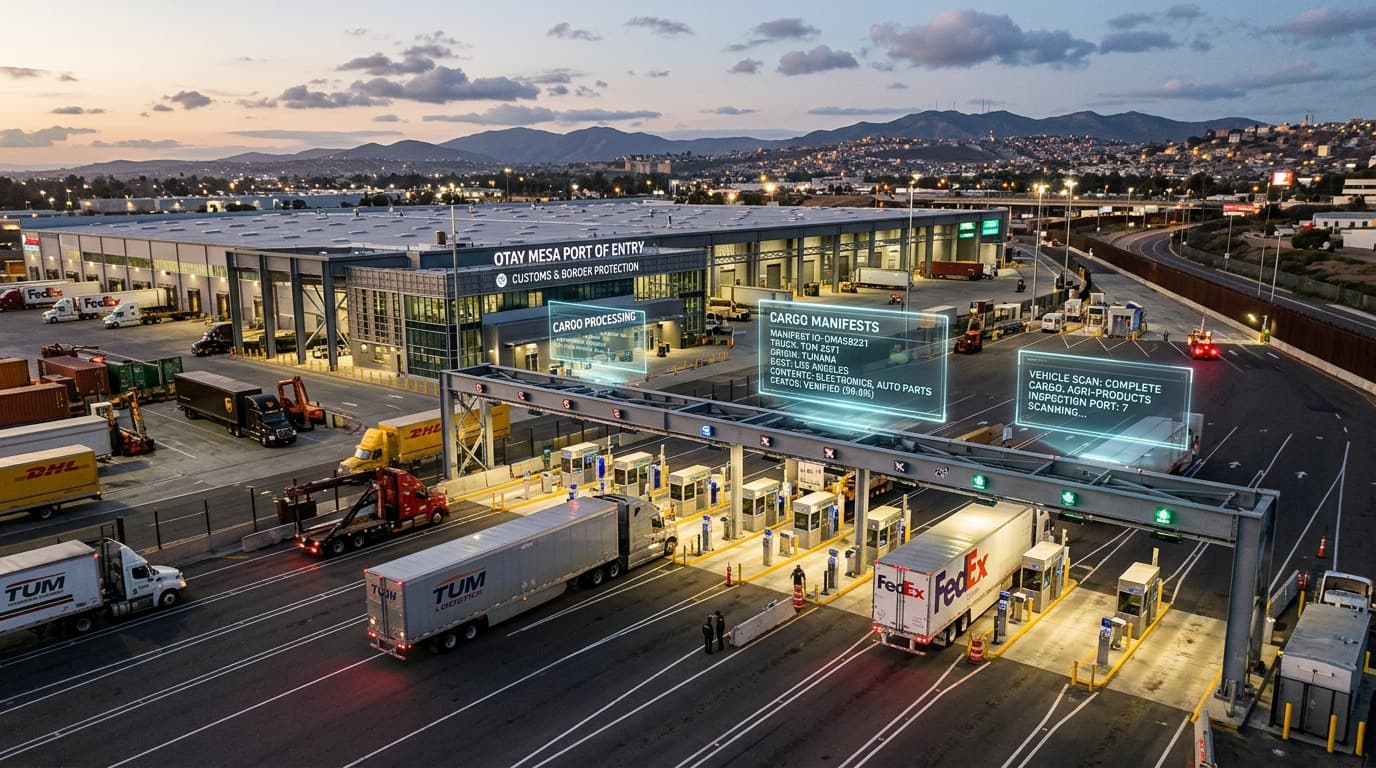
CBP Section 321 & Entry Type 86 Crackdown: The 2026 Executive Compliance Guide for Tijuana Cross-Border Logistics
Master 2026 CBP Section 321 and Entry Type 86 compliance for Tijuana cross-border logistics. Learn 10-digit HTSUS rules, Section 301 enforcement, and bonded 3PL models.
CBP Section 321 & Entry Type 86 Crackdown: The 2026 Executive Compliance Guide for Tijuana Cross-Border Logistics
An Authoritative C-Suite Blueprint on 19 U.S.C. § 1321 De Minimis Directives, 10-Digit HTSUS Cargo Systems Messaging Service Mandates, Section 301 Anti-Circumvention Scrutiny, and Compliant Otay Mesa 3PL Bonded Fulfillment Architectures
By Denisse Martinez, Senior Technical SEO & Trade Compliance Specialist, Nearshore Navigator
Executive Summary: The 2026 Section 321 Regulatory Shakeup
Executive Direct Answer: 2026 Section 321 Regulatory Shakeup
In 2026, U.S. Customs and Border Protection fundamentally restructured Section 321 de minimis import clearance. Stricter Entry Type 86 mandates now require 10-digit HTSUS classifications, full supply chain transparency, and automated Section 301 tariff enforcement. Cross-border fulfillment through Tijuana remains legally viable only when supported by bonded shelter infrastructure and auditable origins.
The global cross-border e-commerce supply chain operating along the United States-Mexico border has entered an era of unprecedented regulatory enforcement. For nearly a decade following the enactment of the Trade Facilitation and Trade Enforcement Act of 2015 (TFTEA)—which raised the statutory administrative exemption under 19 U.S.C. § 1321 from $200 to $800 USD—retail conglomerates, direct-to-consumer (DTC) e-commerce platforms, and third-party logistics providers (3PLs) leveraged Mexican border hubs as friction-free staging grounds.
By routing bulk maritime shipments from Asian ports into Mexican commercial gateways (such as the Port of Ensenada or the Port of Manzanillo) and transferring containerized freight into Northern Baja California warehouses, operators could unpack, store, pick, pack, and inject millions of individual parcel orders directly into the U.S. domestic stream under informal de minimis clearance without paying customs duties, merchandise processing fees (MPF), or retaliatory tariffs.
By 2024, de minimis volume entering the United States had exploded past 1.4 billion shipments annually, up from approximately 140 million packages in 2015. This exponential growth blinded traditional border enforcement mechanisms, creating severe national security, product safety, and commercial trade policy vulnerabilities. High-tariff consumer commodities—including apparel subject to 15% to 32%+ Most Favored Nation (MFN) duties under HTS Chapters 61 and 62, footwear under Chapter 64, and consumer electronics subject to punitive Section 301 China tariffs ranging from 25% to 100%—poured across the border with minimal manifest scrutiny.
HISTORICAL DE MINIMIS CLEARANCE vs. 2026 ENFORCEMENT ARCHITECTURE

   Legacy Informal Clearance (2016-2023):
   [Bulk Overseas Cargo] ---> [Unbonded Border Depot] ---> [Generic Truck Manifest] ---> [US Final Mile]
                              * Unverified Manifests ("Apparel", "Goods")
                              * Zero 10-Digit HTS Reporting
                              * Duty-Free Section 301 Tariff Bypass
                              * High Risk of Unregulated Parcel Flooding

2026 Restructured Clearance (Post-CSMS Directives):
   [Bonded RFE Import]   ---> [Automated Tijuana 3PL]  ---> [ACE Entry Type 86 ABI] ---> [FAST Drayage Hub]
                              * Mandatory 10-Digit HTSUS Telemetry
                              * Partner Government Agency (PGA) Pre-Clearance
                              * Section 301 Trade Remedy Filter / EAPA Scrutiny
                              * SAT Annex 24 / Annex 30 Bidirectional Discharge
Throughout 2025 and 2026, U.S. Customs and Border Protection (CBP), in coordination with the Office of the United States Trade Representative (USTR), the Department of Commerce, and the Department of Homeland Security (DHS), systematically closed this informal operational window. Through successive Cargo Systems Messaging Service (CSMS) administrative directives, CBP fundamentally restructured Entry Type 86—the electronic mechanism created to process Section 321 shipments within the Automated Commercial Environment (ACE).
Informal paper manifests and vague electronic descriptions have been permanently decommissioned. Every commercial package seeking duty-free entry under 19 U.S.C. § 1321 must now provide a precise 10-digit Harmonized Tariff Schedule of the United States (HTSUS) classification, identify the commercial seller and final consignee with verified entity numbers, provide full Partner Government Agency (PGA) compliance data, and certify that merchandise is not subject to trade remedy tariffs under Sections 301, 201, or 232.
| Metric / Regulatory Benchmark | 2022 Baseline | 2024 Transition Period | 2026 Current Mandate | Regulatory Source & Enforcement Impact |
|---|---|---|---|---|
| Annual U.S. De Minimis Volume | 685 Million Parcels | 1.05 Billion Parcels | 1.45+ Billion Parcels | CBP Office of Trade Statistics |
| ACE Entry Type 86 Utilization | 58% of Total Volume | 84% of Total Volume | 98.6% Mandatory E-Filing | CSMS Directive Series 2025-2026 |
| Manifest Commodity Detail | Generic (e.g. "Shoes", "Apparel") | 4-to-6-Digit HTS General | Mandatory 10-Digit HTSUS | 19 CFR § 143.23 / CSMS Updates |
| Physical Exam & Hold Ratio | 0.8% of Total Parcels | 3.4% of Inbound Parcels | 8.9% Targeted 1H Holds | Port of Otay Mesa Cargo Examination Stations |
| 19 U.S.C. § 1595a Seizure Rate | Baseline (< 1,200 events) | +185% YoY Increase | +420% Aggressive Forfeiture | EAPA / Textile Verification Teams |
| Broker Debarment / Sanctions | Rare Administrative Caution | 12 Suspensions | 48+ Broker Type 86 Debarments | CBP Regulations 19 CFR Part 111 / § 1484 |
To preserve the undeniable economic benefits of nearshore cross-border fulfillment, enterprises must transition to institutional, auditable logistics architectures. By anchoring operations in compliant distribution centers in Tijuana operating under Mexican Recinto Fiscalizado Estratégico (RFE) or IMMEX shelter structures, organizations can achieve flawless customs telemetry, legally eliminate U.S. duties where permitted, and maintain frictionless cross-border transit through the Otay Mesa port complex.
De Minimis Law Under Siege: 19 U.S.C. § 1321 vs. Entry Type 86 Directives
Executive Direct Answer: 19 U.S.C. § 1321 vs. Entry Type 86
Under 19 U.S.C. § 1321, individual consignees may receive up to $800 fair retail value duty-free daily. However, 2026 CBP Entry Type 86 directives eliminate informal clearance loopholes, subjecting all ACE de minimis transmissions to formal Partner Government Agency vetting, anti-structuring algorithms, and severe commercial fraud penalties under 19 U.S.C. § 1592.
To navigate the current enforcement environment, corporate executives must understand the precise statutory mechanics separating substantive statutory exemption rights from operational customs entry procedures.
The Statutory Anchor: 19 U.S.C. § 1321(a)(2)(C)
The statutory foundation of de minimis clearance resides in Section 321 of the Tariff Act of 1930, codified at 19 U.S.C. § 1321(a)(2)(C). The statute authorizes the Secretary of the Treasury to prescribe regulations permitting the duty-free and tax-free entry of:
> "articles in any manner otherwise than by mail or through the mails, where the aggregate fair retail value in the country of shipment of articles imported by one person on one day does not exceed $800."
This statutory text establishes three core legal boundaries that govern every cross-border shipment:
- $0
> "shall consolidate all shipments covered by separate bills of lading which are consigned to the same person on the same day and which have an aggregate value exceeding $800, and shall require formal entry."
19 U.S.C. § 1321 LEGAL COMPLIANCE FILTER MATRIX

                       [ Inbound B2C Parcel Batch ]
                                     |
             +-----------------------+-----------------------+
             |                                               |
    [ Value <= $800 USD ]                           [ Value > $800 USD ]
             |                                               |
             v                                               v
    [ Single Recipient / 24h? ]                     [ MANDATORY FORMAL ENTRY ]
       /                   \                         * Entry Type 01 Commercial
     (YES)                 (NO: Multi-Order)         * Standard Duties & MPF Paid
      |                             |
      v                             v
  [ Trade Remedy Flags? ]    [ STRUCTURING VIOLATION ]
    Sec 301 / 201 / 232?     Consignee Aggregate > $800
    Anti-Dumping / CVD?      19 U.S.C. § 1592 Civil Fraud
      |          |           * 19 U.S.C. § 1595a Cargo Seizure
    (YES)       (NO)
      |          |
      v          v
 (BLOCKED)  (VALID TYPE 86 ACE ENTRY)
The Operational Reality: Entry Type 86 & ACE Automation
While 19 U.S.C. § 1321 establishes the exemption, Entry Type 86 is the administrative vehicle that operationalizes it. Introduced initially as a voluntary test program in 2019 (84 FR 40079), Entry Type 86 permitted customs brokers and self-filing consignees to transmit low-value shipment data electronically via the Automated Broker Interface (ABI) into ACE without paying the Merchandise Processing Fee (MPF) or formal entry documentation fees.
However, the voluntary test structure created massive operational discrepancies. Cargo moving via traditional carrier manifests (often called "Section 321 manifest clearance") lacked electronic line-item detail, preventing automated risk targeting. In response, CBP executed an aggressive transition:
- $0
Penalties for Structuring: 19 U.S.C. § 1592 & 19 U.S.C. § 1595a
The enforcement teeth backing these operational rules are severe. Importers, e-commerce platforms, and 3PLs that manipulate order profiles to simulate Section 321 compliance face severe administrative, civil, and criminal penalties:
- $0
The 10-Digit HTSUS Mandate & The End of Vague Cargo Manifests
Executive Direct Answer: 10-Digit HTSUS Cargo Manifest Mandate
CBP Cargo Systems Messaging Service directives enforce strict 10-digit HTSUS classification descriptions for every Entry Type 86 filing. Vague terms such as apparel, electronics, or accessories trigger immediate Automated Commercial Environment manifest rejections, administrative fines, and cargo detentions, requiring logistics providers to maintain granular item-level SKU master catalogs before dispatch.
The single most disruptive operational change in 2026 cross-border trade is the absolute prohibition of vague, non-specific cargo manifest descriptions and the mandatory requirement for 10-digit HTSUS tariff classification across all Entry Type 86 filings.
The 2026 CSMS Directives: Eliminating Cargo Opacity
Under historical de minimis operations, foreign shippers frequently populated cargo descriptions with broad commercial terms such as "clothing," "auto parts," "electronics," "samples," or "kitchenware." This practice allowed high-tariff goods and restricted commodities to enter the United States without triggering automated ACE risk profiles.
Through a succession of Cargo Systems Messaging Service (CSMS) bulletins issued to the trade community, CBP mandated that all Entry Type 86 transmissions provide an exact 10-digit HTSUS statistical classification accompanied by a descriptive commercial narrative matching the physical commodity. Under current ACE business rules:
- $0
ACE AUTOMATED MANIFEST REJECTION WORKFLOW

       [ WMS Order Export: Item Description & Tariff Data ]
                                 |
                                 v
            [ Customs Broker ABI Software / ACE Engine ]
                                 |
            +--------------------+--------------------+
            |                                         |
 [ Vague Descriptor Detected ]            [ Compliant 10-Digit HTSUS ]
 (e.g. "Apparel", "Parts")                (e.g. "6109.10.00.12 - T-Shirt")
            |                                         |
            v                                         v
   [ FATAL ACE ERROR ]                        [ 301 / PGA Filter Check ]
    Manifest Rejected                         Prior Notice Validated
    Truck Dispatch Halted                     ACE Acceptance Code (01)
            |                                         |
            v                                         v
   [ 1H CUSTOMS HOLD & FINES ]                [ GREEN-LIGHT BORDER TRANSIT ]
Manifest Discrepancy & Enforcement Comparison Table
To ensure compliance across high-volume SKU catalogs, logistics directors and compliance managers must audit their product databases against CBP's prohibited nomenclature standards:
| Legacy / Prohibited Vague Descriptor | Compliant 10-Digit HTSUS Classification | Required Commercial Description Standard | CBP Regulatory & Enforcement Action Under Current Directives |
|---|---|---|---|
| "Apparel" / "Clothing" | `6109.10.00.12` | Men's 100% cotton knitted crew-neck T-shirt, short-sleeve | Fatal ACE Reject; 1H hold; Chapter 61 MFN tariff verification; Section 301 screening. |
| "Electronics" / "Gadgets" | `8517.62.00.50` | Bluetooth wireless audio receiver with rechargeable lithium battery | Fatal ACE Reject; mandatory FCC ID validation; EPA/TSCA battery declaration verification. |
| "Auto Parts" / "Accessories" | `8708.29.50.60` | Stamped steel automotive passenger side door hinge assembly | Immediate entry rejection; NHTSA safety compliance check; Section 232 steel tariff verification. |
| "Footwear" / "Shoes" | `6402.99.31.45` | Women's slip-on casual sneakers with synthetic upper & rubber outer sole | Fatal ACE Reject; Chapter 64 duty classification audit (up to 37.5% MFN rate verification). |
| "Beauty Products" / "Cosmetics" | `3304.99.50.00` | Moisturizing facial cream emulsion containing hyaluronic acid | Fatal ACE Reject; immediate FDA Prior Notice hold; cosmetic facility registration audit. |
| "Toys" / "Gifts" | `9503.00.00.73` | Plastic multi-piece mechanical construction building blocks | Fatal ACE Reject; CPSC Children's Product Certificate (CPC) verification; lead testing audit. |
| "Kitchenware" / "Household" | `7323.93.00.80` | Stainless steel cylindrical cooking pot with tempered glass lid | Fatal ACE Reject; Section 232 steel anti-circumvention check; FDA food-contact surface hold. |
Technical Architecture: The Master SKU Catalog Engine
To eliminate cargo manifest rejections, enterprise brands operating in Baja California must implement an automated Master SKU Catalog Engine that bridges warehouse management software (WMS) with customs broker filing systems. This architecture requires:
- $0
China Tariff Circumvention & Transshipment Scrutiny in Baja California
Executive Direct Answer: China Tariff Circumvention & Baja California Scrutiny
CBP aggressively targets transshipment schemes using Tijuana warehouses to bypass Section 301 China tariffs. Storing, repackaging, or sorting non-originating Chinese merchandise in Mexico does not confer origin under 19 CFR Part 102. Transshipped goods lacking substantial transformation face 19 U.S.C. § 1595a seizure and criminal prosecution under U.S. trade statutes.
The intersection of Section 301 China tariffs and Section 321 de minimis logistics represents the most volatile regulatory flashpoint along the U.S.-Mexico border. As the United States Trade Representative maintained and escalated punitive tariffs—ranging from 25% on thousands of industrial and consumer goods to 100% on electric vehicles and critical electronics—certain international merchants attempted to utilize northern Mexican warehouses as illicit transshipment stations to mask country of origin.
CBP, the Department of Commerce, and Mexico’s tax and customs authorities have launched coordinated, aggressive crackdowns targeting these practices across the Tijuana-Otay Mesa logistics corridor.
The Transshipment Myth: Warehousing Is Not Transformation
A pervasive and dangerous myth among non-compliant cross-border operators is that routing Chinese-manufactured merchandise through a Mexican warehouse converts the goods into Mexican or non-tariffed freight.
Under U.S. customs law and federal judicial precedent, the country of origin of an imported article is governed by the doctrine of Substantial Transformation, codified under 19 CFR Part 102 and reinforced by USMCA Chapter 4 (Rules of Origin):
> Substantial transformation occurs only when an article emerges from a manufacturing or processing operation with a new name, character, and use, distinct from that of the original imported components.
Minor logistics processes performed in a warehouse—such as unloading, deconsolidating, sorting, repackaging, re-boxing, applying retail barcodes, kitting, or minor aesthetic cleaning—do not constitute substantial transformation. Under 19 CFR § 102.17 (Non-qualifying operations):
> "A good shall not be considered to have undergone a substantial transformation... merely by reason of: (a) Simple packaging or repackaging, (b) Mere dilution with water or another substance, (c) Cleaning or sorting, (d) The application of marks, labels, or tags, or (e) The collection of parts to constitute a complete set."
Consequently, an apparel item woven and sewn in China, or an electronic accessory assembled in Shenzhen, that is shipped to a warehouse in Tijuana and repackaged for DTC delivery remains 100% Chinese-origin merchandise under U.S. trade law.
SUBSTANTIAL TRANSFORMATION vs. PROHIBITED TRANSSHIPMENT

   ILLICIT TRANSSHIPMENT (Severe CBP Enforcement / Seizure):
   [China Origin Goods] ---> [Tijuana Cross-Dock] ---> [Re-label / Re-box] ---> [False US Entry]
                             * No Tariff Shift / No RVC
                             * Country of Origin Remains CHINA
                             * Subject to Section 301 (25%-100%)
                             * VIOLATION: 19 U.S.C. § 1595a / 18 U.S.C. § 542

LEGITIMATE NEARSHORE TRANSFORMATION (Compliant USMCA):
   [Raw Components]     ---> [Tijuana IMMEX Plant] ---> [Advanced Manufacturing] ---> [USMCA Entry]
                             * Substantial Tariff Shift (e.g. Chapter 85)
                             * Regional Value Content (RVC >= 60-75%)
                             * Genuine Mexican Origin Conferred
                             * 0% Duty under USMCA Treaty Preference
Federal Enforcement: EAPA, Joint CBP-SAT Audits, and Criminal Fraud
To dismantle illicit transshipment networks, federal authorities have deployed specialized investigative and technological tools:
- $0
Permissible vs. Prohibited Cross-Border Processing Table
To maintain complete regulatory immunity, executive teams must clearly define the operational boundaries of their Mexican border facilities:
| Logistics / Assembly Operation | Classification Under U.S. Customs Law | Conferred Country of Origin | Section 301 Tariff Applicability | Permissible Under Section 321 / Type 86? |
|---|---|---|---|---|
| Simple Cross-Docking & DTC Parcel Labeling | Prohibited Transshipment if declared as Mexican | Country of Manufacture (e.g. China / Asia) | Fully Subject (25%–100% punitive tariffs) | NO if goods carry Section 301 tariffs; YES only if non-restricted origin & 10-digit HTS reported. |
| Component Assembly with Tariff Shift | Legitimate Substantial Transformation | Mexico (Qualifying under 19 CFR Part 102) | Exempt from Section 301; qualifies for USMCA 0% | YES (or cleared under USMCA formal entry with zero duty). |
| Garment Finishing (Yarn-Forward Fail) | Non-Qualifying Minor Assembly | Country of Fabric Origin | Subject to high MFN + Section 301 | NO (Apparel without USMCA origin blocked from informal de minimis). |
| Bonded Storage & Order Consolidation | Authorized Bonded Warehousing (RFE) | Preserves Original Manufacturing Country | Section 301 deferred until formal U.S. entry | YES under strict Entry Type 01 formal entry; NO for Section 321 if restricted. |
| Precision Electronic PCBA Manufacturing | High-Tech Substantial Transformation | Mexico (Substantial Tariff Heading Shift) | Fully Exempt from China Section 301 | YES (Eligible for 0% USMCA duty on commercial import). |
Otay Mesa Cross-Border Logistics Architecture: 3PL Bonded Fulfillment Models
Executive Direct Answer: Otay Mesa Cross-Border Logistics Architecture
Compliant Otay Mesa cross-border fulfillment combines Mexican Recinto Fiscalizado Estratégico bonded storage with certified C-TPAT drayage and automated ACE Entry Type 86 electronic filing. Goods enter Mexico duty-free under bond, undergo order picking, and clear U.S. customs within hours for direct injection into San Diego final-mile parcel carriers without triggering compliance audits.
Operating an e-commerce distribution center in Northern Baja California does not require regulatory evasion. When structured correctly, the Tijuana-Otay Mesa logistics corridor represents the most efficient, cost-effective, and fully compliant distribution architecture in North America.
Compliant brands do not hide behind informal freight forwarding. Instead, they partner with institutional third-party logistics providers (3PLs) operating under Mexico's authorized bonded customs regimes, seamlessly integrated with certified U.S. customs brokers and C-TPAT cross-border transport carriers.
The Mexican Legal Foundation: RFE and Depósito Fiscal
A compliant Tijuana distribution center relies on two distinct Mexican statutory regimes governed by the Ley Aduanera (Mexican Customs Law):
- $0
- $0
The End-to-End Cross-Border Fulfillment Architecture
The following operational blueprint illustrates how a fully compliant 3PL in Otay Mesa orchestrates inventory ingestion, electronic clearance, and final-mile U.S. injection:
====================================================================================================
               COMPLIANT TIJUANA CROSS-BORDER 3PL OPERATIONAL ARCHITECTURE
====================================================================================================

[ INBOUND MARITIME FREIGHT ]
     | Port of Ensenada / Long Beach / LA
     | In-Bond Transit (Mexican Customs Pedimento G1 / U.S. Immediate Transportation IT In-Bond)
     v
 +------------------------------------------------------------------------------------------------+
 | TIJUANA BONDED FULFILLMENT CENTER (Recinto Fiscalizado Estratégico - RFE / IMMEX Shelter)      |
 |                                                                                                |
 |  1. Inbound Ingestion: Telemetry logged into SAT Annex 24 Automated Inventory Control Software |
 |  2. Storage: 0% Mexican IVA, zero upfront import duties (SAT Certified A/AA/AAA)               |
 |  3. Order Ingestion: Real-time ERP/WMS integration via EDI 850/856 or API                      |
 |  4. Pick, Pack & Label: Automated carton sortation, weight verification, and dimensional scan |
 |  5. Master SKU Validation: 10-Digit HTSUS, Country-of-Origin & PGA flags locked to each label   |
 +------------------------------------------------------------------------------------------------+
     |
     | Real-Time Outbound Electronic Data Transmission (Pre-Arrival ABI Filings)
     v
 +------------------------------------------------------------------------------------------------+
 | U.S. CUSTOMS AUTOMATED COMMERCIAL ENVIRONMENT (ACE)                                            |
 |                                                                                                |
 |  * Entry Type 86 Transmission: Transmitted by Licensed U.S. Customs Broker 2+ Hours Pre-Border  |
 |  * Line-Item Validation: 10-Digit HTSUS verified against automated CSMS keyword filters        |
 |  * PGA Integration: Automated FDA Prior Notice / CPSC e-filing verification numbers attached    |
 |  * Anti-Structuring Screen: Automated 24h Consignee $800 daily value aggregation test passed   |
 |  * ACE Disposition Code: "Paperless Clearance / Ready for Border Injection"                     |
 +------------------------------------------------------------------------------------------------+
     |
     | Outbound Mexican Pedimento Discharge (V1 / RT) & Complemento Carta Porte 3.1 Digital Bill
     v
 +------------------------------------------------------------------------------------------------+
 | CERTIFIED CROSS-BORDER DRAYAGE (FAST / C-TPAT Level 3 Fleet)                                   |
 |                                                                                                |
 |  * Dedicated Commercial Tractor-Trailer: GPS satellite monitored, high-security tamper seals   |
 |  * Port of Entry: Otay Mesa Commercial Cargo Facility (Dedicated FAST Lanes)                  |
 |  * Border Crossing Transit Time: 45 to 90 minutes (vs. 4-6 hours standard unbonded lanes)      |
 +------------------------------------------------------------------------------------------------+
     |
     | Customs Green-Light Release at U.S. Primary Inspection Booth
     v
 +------------------------------------------------------------------------------------------------+
 | SAN DIEGO / OTAY MESA FINAL-MILE CARRIER INJECTION HUBS                                        |
 |                                                                                                |
 |  * Direct Cross-Dock Induction: USPS Sorting Facility, FedEx SmartPost, UPS Ground, OnTrac     |
 |  * Domestic SLA: 1-to-2 day delivery across California & Western U.S.; 3-day nationwide        |
 ==================================================================================================
Operational & Economic Benchmarks
Enterprise brands migrating fulfillment from Southern California (Inland Empire, Los Angeles, or South San Diego) into Tijuana achieve massive operational cost reductions while elevating compliance standards:
- $0
5-Step CBP Audit Defense Protocol for E-Commerce & Distribution Centers
Executive Direct Answer: 5-Step CBP Audit Defense Protocol
An audit-proof CBP defense protocol requires five controls: pre-arrival 10-digit HTSUS verification, automated daily $800 consignee de-duplication, dual SAT Annex 24 and ACE ledger synchronization, verified country-of-origin documentation proving non-circumvention, and automated digital binder assembly enabling immediate responses to CBP Form 28 information requests within mandatory federal response windows.
In an era of predictive customs targeting and aggressive border examinations, compliance cannot be an afterthought managed retrospectively. To guarantee that cross-border shipments clear the Otay Mesa Port of Entry without friction, supply chain executives must enforce a comprehensive, five-step audit defense protocol across their fulfillment and customs operations.
5-STEP CBP AUDIT DEFENSE PROTOCOL WORKFLOW

     [ STEP 1: HTSUS & PGA Pre-Classification ]
                     |
                     v
     [ STEP 2: Automated $800 Daily Consignee Filter ]
                     |
                     v
     [ STEP 3: Dual-Regime Annex 24 / ACE Ledger Sync ]
                     |
                     v
     [ STEP 4: Country-of-Origin Lineage Verification ]
                     |
                     v
     [ STEP 5: Rapid-Response Digital Defense Dossier ]
Step 1: Automated 10-Digit HTSUS Pre-Classification & PGA Clearance Validation
Before an individual SKU is received into the Tijuana warehouse, it must undergo systematic tariff engineering and regulatory mapping:
- $0
Step 2: Consignee De-Duplication & Aggregate Daily Value Filtering ($800 Threshold)
To prevent catastrophic structuring violations under 19 U.S.C. § 1321 and 19 CFR § 10.153, logistics software must enforce daily order aggregation algorithms:
- $0
Step 3: Dual-Regime Customs Ledger Synchronization (SAT Annex 24 vs. ACE Type 86 Telemetry)
Cross-border logistics requires compliance with two sovereign customs jurisdictions simultaneously. Discrepancies between Mexican export records and U.S. import records are the primary trigger for binational audits:
- $0
Step 4: Country-of-Origin Bill of Materials (BOM) & Non-Circumvention Substantiation
In the wake of EAPA investigations targeting transshipment through Baja California, brands must prove the legitimate origin of every product handled:
- $0
Step 5: Rapid-Response Customs Hold Dossier Assembly & Mock 19 U.S.C. § 1592 Audits
When CBP issues a cargo hold or an electronic request for information, time is the ultimate variable:
- $0
- $0
The CFO Risk Matrix: Section 321 vs. IMMEX Bonded Storage vs. Standard Entry Type 01
Executive Direct Answer: CFO Risk Matrix: Section 321 vs. IMMEX vs. Type 01
CFOs evaluating cross-border logistics must balance Section 321 speed against IMMEX manufacturing stability and standard Entry Type 01 commercial predictability. While Section 321 eliminates duties on qualifying direct-to-consumer orders under $800, IMMEX enables tax-free component assembly under USMCA origin rules, and Type 01 provides unconditional bulk commercial clearance without de minimis regulatory exposure.
For Chief Financial Officers and corporate finance committees, evaluating cross-border logistics requires analyzing the financial trade-offs between customs duty elimination, operational capital expenditure, and regulatory risk exposure.
Depending on order profiles, product valuations, and origin dynamics, enterprises operating along the Tijuana corridor typically choose among three primary import modalities:
- $0
Comprehensive Financial and Compliance Comparison Matrix
The following matrix provides corporate decision-makers with a structured comparison across core operational and regulatory parameters:
| Operational & Regulatory Parameter | U.S. Section 321 (Entry Type 86) | IMMEX Shelter / RFE Bonded Hub | Standard Commercial Entry (Type 01) |
|---|---|---|---|
| Statutory Governing Authority | 19 U.S.C. § 1321(a)(2)(C) / 19 CFR § 10.151 | Ley Aduanera Art. 108 / 135-A; USMCA Ch. 4 | 19 U.S.C. § 1484 / 19 CFR Part 141 |
| Maximum Order Value Threshold | Strict $800 USD fair retail value / person / day | Unlimited (Based on manufacturing value-add) | Unlimited (Full commercial cargo entry) |
| U.S. Customs Duty & Tariff Liability | 0% Duty & 0% MPF on qualifying goods | 0% Duty under USMCA preference | Full MFN Duty + Merchandise Processing Fee (MPF) |
| Section 301 China Tariff Exposure | High Risk / Restricted under 2026 rules | Eliminated via genuine transformation | Fully Payable (25% to 100% cash deposit) |
| Mexican Tax Treatment (IVA & IGI) | 0% IVA (Stored in bonded RFE / Transit) | 0% IVA via SAT VAT/IEPS Certification | Exempt (Transit in-bond to U.S. destination) |
| Customs Continuous Bond Requirement | Generally exempt from formal bond | Required in Mexico (SAT fiscal credit bond) | Mandatory U.S. Continuous Customs Bond |
| Pre-Arrival Data Mandates | Mandatory 10-Digit HTSUS + PGA electronic filing | Annex 24 pedimento telemetry + BOM records | Formal entry summary (CBP Form 7501) |
| Average Border Transit Time | 45 to 90 minutes via FAST / C-TPAT lanes | 45 to 90 minutes (Consolidated freight) | 2 to 4 hours (Standard commercial lanes) |
| CBP Enforcement & Audit Scrutiny | Intense (CSMS anti-structuring screens) | Moderate (Standard USMCA origin verifications) | Predictable (Routine commercial audits) |
| Operational Labor Arbitrage | High ($7.84/hr Tijuana fulfillment labor) | Maximum ($7.84/hr Tijuana assembly labor) | None (California warehouse labor at $22–$26/hr) |
| Ideal Corporate Use Case | High-volume B2C e-commerce (apparel, consumer goods) | Advanced manufacturing, electronics, medical devices | Bulk B2B retail distribution, heavy cargo, machinery |
Quantitative Landed Cost Scenario Analysis
To illustrate the tangible financial impact of these modalities, consider an enterprise distributing 10,000 units per month of high-tariff consumer goods (e.g., specialized consumer lifestyle electronics or premium footwear).
- $0
| Cost Component (10,000 Units Monthly) | Direct-to-US Import (California 3PL) | Legacy Pass-Through Section 321 | Tijuana Compliant RFE / IMMEX Hybrid |
|---|---|---|---|
| Inbound Ocean / Air Freight to Hub | $18,000 ($1.80/unit) | $19,500 ($1.95/unit to Tijuana) | $19,500 ($1.95/unit to Tijuana) |
| U.S. Customs Duties & Tariffs (37%) | $148,000 ($14.80/unit) | $0 (Bypassed under legacy rules) | $0 (Legitimate transformation / USMCA 0%) |
| Merchandise Processing Fee (MPF) & Harbor Tax | $4,500 ($0.45/unit) | $0 | $0 |
| Monthly Warehousing & Lease (15,000 sq ft) | $30,000 ($2.00/sq ft Inland Empire) | $12,750 ($0.85/sq ft Tijuana) | $12,750 ($0.85/sq ft Tijuana Class A) |
| Fulfillment & Packaging Labor ($22/hr vs $7.84/hr) | $44,000 ($4.40/unit California) | $15,680 ($1.57/unit Tijuana) | $15,680 ($1.57/unit Tijuana) |
| Cross-Border Bonded Drayage to San Diego Hub | $0 (Already in US) | $4,500 ($0.45/unit) | $4,500 ($0.45/unit FAST certified) |
| Trade Compliance Software & Broker Filings | $1,500 ($0.15/unit) | $1,200 ($0.12/unit) | $3,500 ($0.35/unit dual-ledger sync) |
| Estimated Customs Hold / Penalty Risk Reserve | $500 (Baseline) | $45,000 (High risk of seizure/fines) | $1,000 (Low auditable risk) |
| TOTAL MONTHLY OPERATING COST | $246,500 | $98,630 (High Legal Risk) | $56,930 (Audit-Proof) |
| TOTAL LANDED OPERATING COST PER UNIT | $24.65 / unit | $9.86 / unit | $5.69 / unit |
| NET ANNUALIZED COST SAVINGS vs. DIRECT US | Baseline | Illicit / Unsustainable | $2,274,840 ANNUAL SAVINGS (76.9%) |
To calculate specific cost models tailored to your company's product categories and volume, utilize our interactive nearshore cost calculator.
Strategic Conclusion & Executive Action Plan
Executive Direct Answer: Strategic Conclusion & Executive Action Plan
The 2026 Section 321 regulatory overhaul rewards enterprise operators that replace legacy informal logistics with auditable cross-border compliance architectures. By establishing bonded operations in Tijuana, enforcing 10-digit HTSUS data discipline, and partnering with vetted shelter operators, executives can secure cost advantages while completely mitigating customs seizure and debarment risks.
The regulatory transformation of U.S. Customs Section 321 and Entry Type 86 marks the permanent conclusion of informal cross-border trade. However, for forward-thinking manufacturing and logistics executives, this crackdown does not signal the demise of Mexican cross-border logistics; rather, it creates a powerful competitive moat that eliminates bad actors and rewards institutional operators.
By anchoring your North American fulfillment strategy in institutional infrastructure—combining Mexican Recinto Fiscalizado Estratégico bonded warehousing, automated 10-digit HTSUS data governance, and C-TPAT certified FAST border crossing lanes—your organization can achieve unmatched landed cost advantages while maintaining bulletproof customs compliance.
Executive 6-Point Action Plan for 2026/2027
To insulate your enterprise supply chain against border disruption, the executive leadership team should implement the following action plan immediately:
- $0
Frequently Asked Questions: Section 321 & Entry Type 86 Compliance
Executive Direct Answer: Section 321 & Type 86 FAQs
Cross-border trade under Section 321 requires strict adherence to U.S. customs entry statutes, electronic ACE Entry Type 86 filing requirements, and auditable supply chain origins. The following conversational questions address the primary regulatory, operational, and financial concerns of executive leadership teams.
Can Chinese-origin products stored in a Tijuana warehouse still enter the US under Section 321 in 2026?
No, not if the goods are subject to Section 301 trade remedy tariffs. Under 2026 CBP directives, merchandise covered by Section 301, Section 201, or Section 232 tariffs is restricted from informal Section 321 de minimis entry. Simply storing, unpacking, or re-labeling Chinese goods in a Tijuana warehouse does not confer Mexican origin under 19 CFR Part 102 rules. To enter duty-free under USMCA, goods must undergo substantial transformation meeting specific tariff shift and Regional Value Content rules in Mexico; otherwise, standard Entry Type 01 commercial clearance with full Section 301 duties is legally required.
What happens if a broker files an Entry Type 86 with a vague cargo description like 'apparel' or 'accessories'?
In 2026, the Automated Commercial Environment (ACE) triggers an automated fatal reject on any Entry Type 86 transmission containing non-specific cargo descriptions. CBP Cargo Systems Messaging Service (CSMS) mandates full 10-digit HTSUS classification codes and detailed commercial descriptions. If non-compliant freight arrives at the Otay Mesa Port of Entry without prior valid electronic filing, the shipment is subject to an immediate 1H Customs Hold, mandatory secondary physical examination at importer expense, potential 19 U.S.C. § 1595a cargo seizure, and administrative penalties against the customs broker.
How does CBP detect and penalize artificial order splitting under 19 U.S.C. § 1321?
CBP deploys advanced machine learning targeting algorithms in ACE that continuously analyze carrier manifests, recipient names, physical delivery addresses, IP addresses, and payment transaction metadata across all ports of entry. If a business artificially divides a commercial bulk order into multiple sub-$800 packages addressed to the same consignee on the same calendar day, CBP flags the shipment as intentional structuring. The agency issues formal notices of action (CBP Form 29), revokes de minimis privileges, assesses civil monetary penalties under 19 U.S.C. § 1592 for gross negligence or fraud, and seizes non-compliant freight.
What is the difference between an IMMEX shelter model and an RFE bonded warehouse for Tijuana fulfillment?
An IMMEX shelter model is a comprehensive manufacturing framework under Mexican Ley Aduanera Article 108 that allows companies to perform value-added assembly, transformation, and processing with 0% IVA (VAT) certification and zero import duties on production equipment and raw materials. A Recinto Fiscalizado Estratégico (RFE) under Articles 135-A through 135-D is a specialized bonded logistics regime permitting duty-free warehousing, sorting, packaging, and fulfillment near the border without manufacturing transformation. Compliant Tijuana 3PLs often combine both licenses to provide hybrid manufacturing and cross-border DTC parcel dispatch.
Can an e-commerce brand or importer be penalized if their customs broker loses Entry Type 86 filing privileges?
Yes. Under 19 U.S.C. § 1484, the importer of record and ultimate consignee maintain statutory legal liability for demonstrating reasonable care in customs transactions. If CBP suspends a customs broker from the Entry Type 86 Test program due to high error rates or illicit transshipment filings, all pending cargo associated with that broker is immediately placed on intensive exam hold. Importers face severe supply chain delays, demurrage and warehouse storage charges, mandatory conversion of pending entries to formal Type 01 entries with full duty payments, and increased targeted scrutiny on all future importations.
How can brands determine whether standard Entry Type 01 is more cost-effective than Section 321 fulfillment in Tijuana?
Brands must evaluate their product tariff classifications, average order values, and fulfillment volumes. Section 321 de minimis provides massive duty savings for consumer products with low manufacturing costs but high retail margins and steep MFN tariffs (such as footwear and consumer goods under $800 retail). However, if goods are subject to unavoidable Section 301 penalties, have B2B wholesale transaction profiles, or exceed $800 per shipment, importing bulk freight under standard Entry Type 01 into a U.S. distribution center avoids de minimis regulatory risk and enables traditional bonded warehouse or foreign trade zone (FTZ) tariff management.
Strategic Nearshoring & Industrial Intelligence
For North American executives, CFOs, and supply chain directors evaluating cross-border manufacturing, explore our master portal on nearshoring Mexico, review Class A availability and park vacancy in our comprehensive dossier on industrial real estate Tijuana, evaluate operational risk mitigation under maquiladora advisory and shelter services, or model your exact multi-state savings using the interactive nearshore landed cost calculator.